Machine vision editorial digest guides users to 3-D imaging applications
thumbnailimage3d

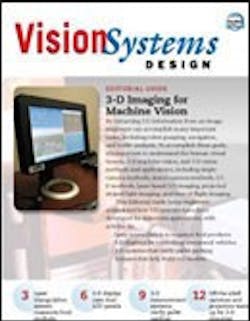
A collection of articles originally published in Vision Systems Design magazine guides engineers and system integrators with technical examples of applications inwhich 3-D imaging systems have been successfully designed and installed. The guide is titled: VSD Editorial Digest: 3-D Imaging for Machine Vision and is available for download on the Vision Systems Design website.

Understanding 3-D imaging is important because, by extracting 3-D information from an image, engineers can accomplish many tasks, including robot grasping, navigation, and traffic analysis. To accomplish these goals, it’s important to understand the human visual system, 3-D machine vision, and 3-D vision methods and applications, including single-camera methods, stereo-camera methods, 2.5-D methods, laser-based 3-D imaging, projected striped light imaging, and time of flight imaging.

This Editorial Digest helps engineers understand how 3-D systems have been developed for specific applications, with articles on:
- Laser triangulation to measure food products
- 3-D displays for controlling unmanned vehicles
- 3-D systems that verify pallet packing
- Systems that help build 3-D models

You can download the editorial guide here.


Font Sizes:


The future is here

Fri May 10 09:01:00 CDT 2013
Science and engineering aside, what is the first thing that you think of when the idea of 3D holographi... Read More >>

Respect the past, create the new

Wed May 08 11:00:00 CDT 2013
Roughly translated from Japanese to English, the phrase onkochishin means “Respect the past, crea... Read More >>

SPONSOR INFORMATION


Webcasts

Upcoming Webcasts

State-of-the-art high-speed imaging

This webcast will describe the differences between high-speed imaging and other computer vision technologies, along with their impacts. It will review innovations that are enabling product developm...

Optical Character Recognition and Verification in Vision Systems

This webcast will begin with a discussion of optical character recognition (OCR) and optical character verification (OCV) by defining the two terms and explaining their practical differences.

Vision for Networked Security and Surveillance Systems

This webcast will identify the components and technologies important in networked security and surveillance systems, including CCD and CMOS cameras, multi-sensor systems, lens types, interfaces, li...

Benefits of the New USB3 Vision Standard

In this webcast, you will learn how the new USB3 Vision standard builds on earlier USB standards but provides an optimized standard for machine vision applications that require more deterministic, ...

Archives

Click here to view archived Vision Systems Design articles