Piezo z-stage system from Prior Scientific offers 2.5 nm repeatability
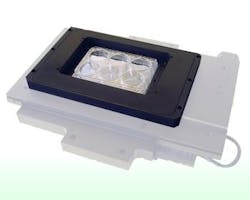
The NZ400 NanoScanpiezo stage system is suited for researchers producing rapid z-sections and live-cell 3-D images of specimens grown in well plates, large Petri dishes, or mounted to glass slides. With 50 frames/s (typical) speed, the system offers 400 μm of travel, 2.5 nm repeatability, and closed-loop control utilizing a sub-angstrom resolution piezo-resistive sensor.
Prior Scientific
Rockland, MA, USA
-- Posted byVision Systems Design
View More Vision+Automation Products
Locate a vendor or system integrator in our Online Buyer's Guide
---
NEW PRODUCT PRESS RELEASE
Prior Scientific introduces the NZ400 NanoScan Piezo Z Stage System
ROCKLAND, MA. - Prior Scientific introduces the latest in innovation in microscope automation – the NZ400 NanoScan Piezo Stage System. The NZ400 is well suited for researchers producing rapid Z sections and live cell 3D images of specimens grown in well plates, large petri dishes or mounted to glass slides. With the ability to create a stack of images using multiple objectives in the Z axis with nanometer precision at an amazingly high speed (typically 50 frames per second), the NanoScan is the perfect accessory for any three dimensional imaging application. The NZ400 NanoScan Piezo Stage System offers 400 microns of travel, 2.5 nanometer repeatability and closed loop control utilizing a sub-angstrom resolution piezo resistive sensor. Designed to mount to the Prior ProScan H117 series of high precision motorized stages the NZ400 can also be provided as a stand alone device that can be mounted onto a wide range of XY stages including manually driven stages from the world’s leading microscopy companies. Compatible with most leading imaging software packages, the NZ400 comes standard with control inputs for RS232, USB and 0-10V analog input.
For more information on the NZ400 NanoScan Piezo Stage System or other Prior Scientific products, contact Prior Scientific at 800-877-2234 or via email at [email protected]. Write to Prior Scientific, Inc., 80 Reservoir Park Drive, Rockland, MA. 02370, or visit our website at www.prior.com.
Prior Scientific is the leading manufacturer of microscope automation equipment. Prior specializes in the production of high precision motorized microscope stages, automated slide and well plate loading systems, LED and metal halide high intensity fluorescence illumination systems, physiology stage platforms, nanopositioning Piezo Z stages, motorized filter wheels, high speed shutters, autofocus systems, custom optical systems and a wide array of microscopy accessories. Prior provides standard and custom designed solutions as well as manufacturing capabilities for OEM automation systems.
SOURCE: Prior Scientific