Eye telescope helps restore vision
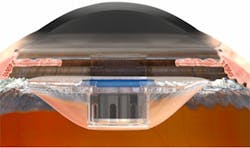
Two ophthalmologists at UC Irvine (Irvine, CA, USA) have implanted a miniature telescope in the eyes of patients with end-stage age-related macular degeneration to restore a portion of vision lost to the disease.
The implantable telescope from VisionCare Ophthalmic Technologies (Saratoga, CA, USA) incorporates wide-angle micro-optical lenses in a Galilean telescope design that enlarges images in front of the eye over twice their normal size.
The magnification allows central images to be projected onto healthy perimacular areas of the retina instead of the macula alone, where breakdown of photoreceptors and loss of vision has occurred. This helps reduce the 'blind spot' and allows the patient to distinguish and discern images that may have been unrecognizable or difficult to see.
"Macular degeneration damages the retina and causes a blind spot in the center of a person’s field of vision," says Dr. Sumit Garg, the medical director of the Gavin Herbert Eye Institute at UC Irvine (Irvine, CA, USA). "The telescope projects an image onto an undamaged portion of the retina, making it possible for patients to recognize faces, read and perform daily activities."
Clinical trials demonstrated that the implant, in addition to improved vision, increases patients' independence. It also aids social interaction by making visible the facial expressions of family and friends.
“Until now, there has been no mechanism, surgical or medical, to restore that central sight," says Dr. Marjan Farid, UC Irvine’s director of cornea, cataract and refractive surgery. "These patients are now experiencing a quality of life that they’ve not enjoyed in many years."
After surgery, implant patients work with vision specialists to retrain their brain to recognize images projected through the device.
-- Dave Wilson, Senior Editor, Vision Systems Design