Automated optical inspection system checks contact points on FPCs
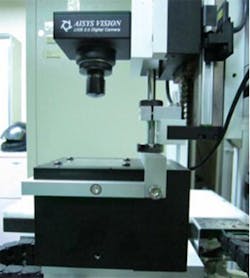
Flexible printed circuit boards (FPC) are widely used in consumer electronic products. Such FPCs commonly sport a number of gold plated pads that act as points through which an electrical contact can be made between the FPC and other electronic components.
However, during the course of machining and assembling FPCs, defects such as scratches can be introduced on the surface of the pads. Hence they must be inspected before the FPCs can be assembled into finished electronic products.
To automate the procedure, a team of engineers from the National Taiwan University of Science and Technology (Taipei, Taiwan) led by Chih-Hsien Su recently developed a prototype of an automated optical inspection system on behalf of Cheng Uei Precision Industry.
The system itself sports a high-resolution Aisys (Taipei, Taiwan) Altair U1000C CMOS camera coupled with a Moritex (San Jose, CA, USA) ML03-181N lens and a KKIMAC (Shiga, Japan) IFV-C70DW coaxial light illuminator.
Images of the FPC are captured by the camera as it transverses the FPC on a gantry under the control of a National Instruments (Austin, TX) NI PCI-7344 two-axis motion controller. The images are then transferred to a PC over a USB interface.
To enable the system to be operated through the PC, the HMI software, motion control and image processing programs were all developed in the NI LabView programming environment.
A technical article entitled "Development of an appearance defect inspection system for flexible printed circuit board" that details the design of both the system hardware and software can be found here.
The researchers presented the system at the 16th International Conference on Mechatronics Technology which was held on October 16-19, 2012 in Tianjin, China.
Recent articles on National Instruments systems that you might also find of interest.
1. Vision system sorts tomato seedlings
A vision based system has been deployed in The Netherlands that is capable of sorting tomato seedlings at a rate of 18,000/hr.
2.Linescan-based system counts seeds
Coleman Technologies (Newtown Square, PA, USA) has developed a linescan-based imaging system that can count seeds at rates of up to 1000 seeds/sec with an accuracy greater than 99%.
3. Smart cameras monitor the quality of particle board in Thailand
Engineers at Siam Riso Wood Products (Sarattani, Thailand) have developed an automated vision system that can monitor the quality of particle board using smart cameras from National Instruments Thailand (Bangkok, Thailand).
-- Dave Wilson, Senior Editor, Vision Systems Design