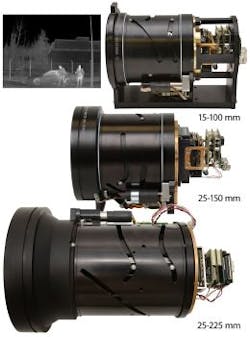
Thermal cameras from Sofradir offer three fields of view for remote surveillance
Fairfield, NJ, USA
-- Posted by Vision Systems Design
View More Vision+Automation Products
Locate a vendor or system integrator in our Online Buyer's Guide
---
NEW PRODUCT PRESS RELEASE
Sofradir EC Introduces New High Definition Uncooled IR Camera Engines Continuous zoom available in three different FOV ranges
Fairfield, NJ -- Sofradir EC, Inc. has introduced three new high definition uncooled thermal imaging camera engines with continuous zoom capability. The Atom 1024 camera engines are the ideal choice for a wide range of military and COTS thermal imaging systems including ground vehicle and airborne EOIR reconnaissance platforms. The cameras are based on the first commercially available high definition 1024x768 uncooled infrared camera (http://www.ircores.com/atom1024.html ). The new continuous optical zoom capability enables the observer to maintain a constant view of objects under surveillance as they move from far to near positions, for example. Without continuous zoom, the observer may lose track of the objects while switching fields of view.
Incorporating advanced silicon microbolometer technology, the ATOM 1024 high definition thermal imaging cameras are specially designed for delivering sharp infrared images with optimal thermal sensitivity. Based on a large 1024 x 768 microbolometer detector array, the cameras deliver a significant improvement in image resolution and detection range over VGA-based cameras with two and a half times the number of pixels. The increased performance is obtained without compromises in camera size, weight, power or sensitivity. Other performance specifications are outstanding, including thermal sensitivity (<50mk), 30/60 Hz XGA/VGA frame rate and low power consumption.
The three new cameras differ in the field of view range achieved. The ATOM 1024-40/4.4G delivers high definition infrared imaging with a horizontal field-of-view range 4.4°-40° (25-225mm). Similarly, the ATOM 1024-40/6.6G has a horizontal field-of-view range 6.6°-40° (25-150mm), and the ATOM 1024-68/10G has 9.9°-68.4° (15-100mm). Each camera is calibrated to deliver uniform images at any field of view. In addition, due to the high uniformity, operability and stability of these amorphous silicon microbolometers, the cameras deliver remarkably sharp sequences throughout the field of view and ambient temperature range (-20 to 60°C).
The ATOM 1024 is also available with a variety of fixed infrared objective lenses designed to deliver optimum performance for 17µm pitch sensors.
Company Background: Headquartered in Fairfield, New Jersey, Sofradir EC, Inc. (formerly called Electrophysics Corp.) is a member of the Sofradir Group of companies since December 2008. Sofradir EC, Inc. develops and manufactures advanced thermal imaging engines based on both cooled and uncooled infrared detectors. In addition, the company manufactures high performance infrared cameras for scientific applications as well as AstroScope Night Vision Modules for nighttime photography/videography.
SOURCE: Sofradir EC