Kinect used to create air guitar
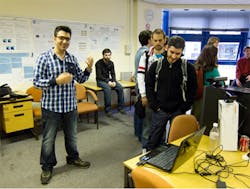
In partial fulfilment of the requirement for his degree in Enterprise Computing, a Sheffield University (Sheffield, UK) student has created a controller-less air guitar with the aid of a Microsoft Kinect sensor.
The system Sina Shamshiri developed uses the Kinect sensor to track the position of the left hand on the fretboard while detecting the strum gesture with the right hand. A sound generator synchronised with the gesture recognition system then produces the correct sound at the right time.
To evaluate the effectiveness of the system, 37 individuals consisting of 17 guitarists and 20 non-guitarists were surveyed. Surprisingly, guitarists in the group gave the system higher ratings than non-guitarists.
Shamshiri's final dissertation on the subject that details the challenges he faced in the development of the controller can be found here.
Shamshiri himself is now studying for a PhD in the verification and testing group at the university.
Related articles from Vision Systems Design that you might also find of interest.
1. Pez head
Custom heads for Pez dispensers have been created at the 'Hot Pop Factory ' using a Microsoft Kinect camera and a 3-D printer.
2. Book details design of TOF cameras
A new paperback book from Springer describes the physical principles, the hardware architecture, and the electronic design of time-of-flight (TOF) sensors.
3. Kinect helps to find objects in complex scenes
Researchers at the Helsinki Institute for Information Technology (HIIT; Helsinki, Finland) and the Max Planck Institute for Informatics (Saarbrücken, Germany) have developed a computer vision-based tracking system with vibrational feedback that can be used to steer a user's hand towards an object of interest.
4. Kinect aids rehabilitation of stroke patients
Researchers at Nottingham Trent University (Nottingham, UK) have been awarded a £347,000 grant to investigate how Microsoft's Kinect can assist with the rehabilitation of individuals with facial paralysis caused by a stroke.
5. 3-D modeling improves spinal casting process
Engineers at 4DDynamics have developed a 3-D system that can be used to develop prosthetic corsets in less than half a day.
-- Dave Wilson, Senior Editor, Vision Systems Design