From Prototype to Production: Engineering Edge AI for the Factory Floor
Key Highlights
- Industrial AI deployment requires addressing system integration complexities across numerous devices and systems, demanding standardized architectures for orchestration and lifecycle management.
- Continuous model adaptation is essential in manufacturing environments where production conditions and data distributions change, necessitating ongoing data collection, retraining, and deployment processes.
- Edge AI processing reduces bandwidth and latency issues, enhances security, and supports regulatory compliance by keeping sensitive data within the facility while enabling real-time decision-making.
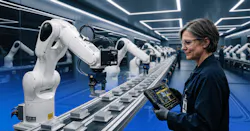
What’s the problem? A significant disconnect exists between the promise of Artificial Intelligence (AI) and its successful implementation on factory floors. While developing AI processing and computer vision applications in the laboratory is becoming increasingly straightforward (due to readily available hardware, models, frameworks, and development tools), deploying those same applications reliably across a manufacturing environment is a substantially different engineering problem.
To address this disconnect, innovative hardware and software companies are developing useful ecosystems that deliver comprehensive, production-ready solutions designed specifically for industrial, vision-based, and agentic AI applications.
What Engineers Need to Know to Address Industrial AI Challenges
A laboratory proof of concept may consist of a single camera, an Edge AI processor, a pretrained model and a controlled set of test images. In manufacturing production environments, however, the conditions affecting vision-based AI system accuracy can change continually, sometimes in subtle ways. Product SKUs, materials, or suppliers may change; cameras, lenses, or lighting can change or degrade; and changes in line speed, tooling, or environmental conditions can alter the images presented to a vision system. New defect types may also emerge as manufacturing processes evolve.
Collectively, these changes can produce data distributions (images or video output characteristics such as brightness, texture, positioning, orientation, or background conditions) that differ from those used to train and validate the original model, potentially reducing inference accuracy over time.
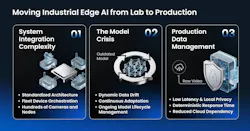
Moving industrial AI from prototype to production, therefore, requires that engineers overcome three hurdles that are often secondary considerations to initial model development: system integration, model lifecycle management, and production-data management.
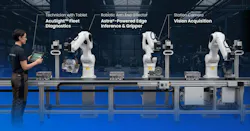
System Integration Complexity: Design for the Production Environment
In a lab environment, a vision AI model might run on a high-end development workstation connected to a single camera. Today’s industrial deployments, however, may incorporate dozens or hundreds of cameras and Edge computing nodes connected to manufacturing execution systems (MES), enterprise systems and other factory equipment. Each device must be configured, monitored, and updated while maintaining predictable operation.
Ensuring operational consistency and integrated output across these devices and systems while managing their configuration, deployment and individual lifecycles can become a massive integration exercise requiring significant resources. A production-ready Edge AI platform needs to address this complexity by providing a standardized architecture for device orchestration, software and model deployment, system integration, monitoring, and lifecycle management.
The Model Crisis: Plan for Adaptation and Evolution
One of the largest differences between laboratory and production AI is that production data does not remain static; in fact, a static AI model is a liability in a dynamic factory. Traditional AI development assumes a model is finished once it is trained, but industrial reality requires constant model adaptation.
Whenever a manufacturer introduces a SKU, or changes part colors or lighting on a production line, the AI must be updated to remain accurate. Without a process to adapt models, the system quickly becomes obsolete or requires a team of data scientists to manually intervene.
A model trained against a fixed dataset can consequently lose accuracy over time. Production architectures must include a mechanism for collecting representative field data, identifying model-performance changes, updating datasets, retraining models and deploying revised versions. This changes model training from a one-time development activity into an ongoing engineering process for industrial AI environments.
Production Data Management: Keep Production Data Close to the Process with Edge AI
Industrial vision systems can generate large quantities of image and video data. Sending all that information to cloud infrastructure introduces bandwidth requirements, latency and additional data-governance considerations. Data complexity is further compounded by the need to meet regulatory standards for data privacy and security, particularly in highly regulated industries.
Edge processing provides an alternative architecture where images can be processed locally, while inspection results, events and selected metadata are forwarded to supervisory systems. This approach can be particularly relevant in pharmaceutical, food-and-beverage, and other regulated manufacturing environments where production imagery or process information may need to remain within the facility.
Bridging the data management gap between low-level hardware and high-level enterprise software is also a significant scale-up challenge. Enterprises often rely on large, existing investments in automation that also make it more complex. Major system integration efforts drive up cost, extend timelines, and make AI deployments harder to scale quickly.
The industrial AI data management objective, therefore, must be the creation and implementation of repeatable input conditions where the resulting data does not remain isolated inside the vision system. Inspection results can feed MES, ERP and operational dashboards through APIs, allowing AI-generated information to become part of existing production and traceability workflows.
Evaluating the Benefits of an Easily Deployable Industrial Edge AI Solution
The value of an industrial Edge AI solution should be evaluated not only by inference performance, but also by how effectively it addresses the engineering requirements surrounding deployment: data collection, model iteration, compute latency, security, device management, and ongoing maintenance. Addressing these requirements as part of the production architecture can reduce the time and resources required to move an AI application from initial validation to sustained operation.
A common approach to AI development is sequential: collect and label a sufficiently representative dataset, train the model, validate its performance, optimize it for the target hardware, and then deploy it. For industrial applications, this process can become a bottleneck because representative production data may be difficult to obtain before the system is operating under actual factory conditions.
An alternative approach is to treat deployment and model development as parallel processes. An initial model that meets defined minimum performance criteria can be deployed while the system continues collecting representative production data. That data can then be reviewed, labeled, incorporated into the training dataset, and used to develop subsequent model versions. This approach creates an iterative lifecycle that is particularly useful for addressing distribution shift.
The engineering cost of an AI system extends beyond initial model development and must also be considered. Production systems require ongoing data curation, labeling, model training, validation, version control, deployment, monitoring, and retraining. Automating portions of this model lifecycle can reduce the amount of specialized data-science work required for routine maintenance. In the BrinqAI/Synaptics architecture, for example, AcuSight provides workflows for managing production data and model iterations, while edge hardware executes the resulting inference workloads.
Latency and availability constraints often make continuous dependence on remote cloud inference impractical. Image acquisition, preprocessing, inference, and production decisions can instead be executed locally on Edge processors. Local inference provides several engineering advantages, including deterministic responsiveness for high-speed inspection, robotic guidance, and automated reject mechanisms, where inference results must arrive within a defined process window.
An easily deployable industrial Edge AI solution can also simplify compliance with organizational requirements governing intellectual property, production data, customer information, or geographically constrained data storage. It also reduces the number of external systems through which high-volume production imagery must pass. Edge processing should not, however, be equated with security by default. A production architecture still requires device authentication, encrypted communications, access controls, secure software and model updates, network segmentation, and appropriate management of stored data.
Lowering the Cost of Technical Evaluation
Before deploying an Edge AI system, engineers need to determine whether the software stack, AI models, and target hardware satisfy application requirements. Reducing the setup required for this evaluation can shorten the feasibility-testing phase.
Containerized software and automated installation can make the development environment reproducible across systems. In the BrinqAI/Synaptics implementation, the software stack can be installed on supported Synaptics hardware through a command-line deployment process. A cloud-hosted AcuSight environment can also be used to evaluate the model-development workflow before moving the application onto target Edge hardware.
The evaluation should ultimately be performed against measurable production requirements, including inference latency, throughput, model accuracy, false-positive and false-negative rates, memory utilization, power consumption, thermal performance, and behavior under representative environmental conditions.
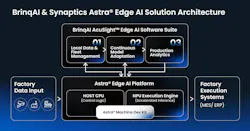
An Industrial Edge AI Solution
A combined BrinqAI and Synaptics offering is designed to address common challenges associated with deploying AI at the edge in manufacturing environments. The solution combines industrial-grade hardware, runtime software, and centralized management tools intended to support development, deployment, and scaling of AI applications.
The solution integrates the Synaptics Astra AI-native edge computing platform with BrinqAI's AcuSight platform, which provides tools for managing camera-based inspection applications, monitoring deployed systems, and updating AI models across manufacturing operations.
Engineers evaluating industrial AI applications can use the Synaptics Astra Machina development kit to prototype and test edge AI workloads on target hardware. The platform is intended to support applications such as machine vision and other AI-based automation use cases while allowing users to assess performance under real-world operating conditions.
About the Author
 Neeta Shenoy
With a strong track record of driving impactful marketing strategies across the tech industry, Neeta Shenoy joined Synaptics in April 2024 as vice president of corporate marketing. She is a seasoned global marketing executive with deep expertise in B2B technology marketing. Throughout her career, Neeta has led a broad range of marketing functions—including demand generation, brand strategy, and product-led growth. Shenoy holds a bachelor’s degree in journalism, a master’s in communication, and an Executive Management credential from the Kellogg School of Management at Northwestern University.