Low cost method maps vegetation in 3-D
Low cost method maps vegetation in 3-D

Researchers at the Department of Geography and Environmental Systems at the University of Maryland (Baltimore, MD, USA) have proposed an inexpensive way to create 3-D maps of vegetation.

Currently, the standard way to make such high spatial resolution measurements of vegetation has required the use of bulky Light Detection and Ranging (LiDAR) equipment mounted on commercial aircraft.

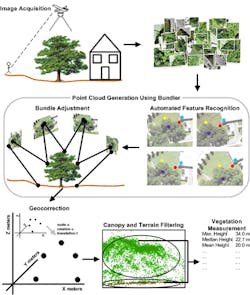
But the Maryland researchers have demonstrated that it is possible to make high spatial resolution 3-D measurements of the structure of vegetation -- together with associated spectral characteristics -- by applying open-source computer vision algorithms to ordinary digital photographs acquired using inexpensive hobbyist aerial platforms.

Recently, the University of Maryland awarded the researchers a grant to develop a software toolkit called Ecosynth based on the concept.

The open-source 3D Ecosynth toolkit will be offered as an open-source development resource on the Ecotope.org community website here to enable other researchers to also acquire images from the ground and air as well as to rapidly generate high-spatial resolution geo-referenced 3-D scans.

-- by Dave Wilson, Senior Editor, Vision Systems Design


Font Sizes:


Respect the past, create the new

05/08/2013
Roughly translated from Japanese to English, the phrase onkochishin means “Respect the past, crea... Read More >>

The eyes have it

04/24/2013
Camera-based surveillance systems have definitely played an important role in helping to keep crime dow... Read More >>

SPONSOR INFORMATION


Webcasts

Upcoming Webcasts

State-of-the-art high-speed imaging

This webcast will describe the differences between high-speed imaging and other computer vision technologies, along with their impacts. It will review innovations that are enabling product developm...

Optical Character Recognition and Verification in Vision Systems

This webcast will begin with a discussion of optical character recognition (OCR) and optical character verification (OCV) by defining the two terms and explaining their practical differences.

Vision for Networked Security and Surveillance Systems

This webcast will identify the components and technologies important in networked security and surveillance systems, including CCD and CMOS cameras, multi-sensor systems, lens types, interfaces, li...

Benefits of the New USB3 Vision Standard

In this webcast, you will learn how the new USB3 Vision standard builds on earlier USB standards but provides an optimized standard for machine vision applications that require more deterministic, ...

Archives

Click here to view archived Vision Systems Design articles