Vision-based system monitors the environment
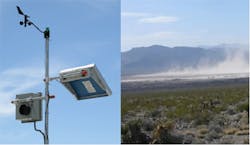
Researchers at theUS Geological Survey (Reston, VA, USA) have developed an automated digital imaging system for environmental monitoring applications.
The system, which is inexpensive and highly robust, has been designed to be placed in remote locations without wireless connectivity.
The imaging system was built from readily available, low-cost components, and powered entirely by solar energy. It requires no remote communication, minimal maintenance, and only occasional visits for data retrieval.
There are four basic subsystems that make up the imaging system: a data logger, an imager, sensors, and a power subsystem. The data logger maintains the date and time and collects, records, and analyzes data from the environmental sensors as well as triggering the stand-alone consumer-grade digital camera.
The environmental sensors include typical meteorological instruments for measuring wind, precipitation, temperature, humidity, solar radiation, leaf-wetness and soil-moisture. The power subsystem consists of a moderate-capacity sealed lead acid battery, solar panel, and customized circuitry to regulate and control power for the camera.
One of the goals of the developers of the system was that they wanted it to be easily replicated by others who may have minimal technical or electronic experience.
As such, they have produced an extensive report that details the design of the system. Written by Rian Bogle, Miguel Velasco, and John Vogel, the report, which is entitled "An automated digital imaging system for environmental monitoring applications", can be found here.
Related items from Vision Systems Design.
1.Sonar and radar monitor effect of tidal turbine
A team of UK scientists are using sonar and radar to measure the environmental effects of tidal and wave energy devices by monitoring the environment and wildlife behavior at UK test sites, the first of which is the tidal energy test area of the European Marine Energy Centre in Orkney.
2.System stitches images of underwater reefs
Researchers from the Mapua Institute of Technology (Manila, Philippines) and the National Institute of Physics (Quezon City, Philippines) have developed a system that can make fast and frequent surveys of shallow reefs.
3.Scientists awarded grant to develop lake surveillance system
A consortium of scientists from six UK universities and research institutes has been awarded a £2.5m grant to create the world's first satellite-based global lake surveillance system, to monitor how lakes and reservoirs are being affected by environmental change.
-- Dave Wilson, Senior Editor,Vision Systems Design