Valens and Imavix Launch High-Speed A-PHY and GigE Vision Connectivity Platform
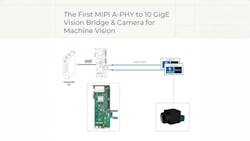
Valens Semiconductor (Hod Hasharon, Israel) and imavix engineering (Žirovnice, Czech Republic) launched a connectivity solution integrating MIPI A-PHY and GigE Vision while CIS Corporation (Tokyo, Japan) developed a camera module leveraging the new platform.
A-PHY (Automotive PHYsical layer) is an embedded vision interface standard from the MIPI Alliance (Bridgewater, NJ, USA) that was originally designed for automotive vision applications such as advanced driver assistance systems.
Related: MIPI A-PHY An Interface for Industrial Embedded Vision
The alliance has been promoting the standard for embedded vision applications, saying that key technical characteristics of A-PHY also lend themselves to increasingly complex embedded vision systems operating in harsh and space-constrained industrial environments like manufacturing plants and warehouses.
Connectivity Solution
The camera connectivity platform integrates the Valens VA7000 A-PHY chipset and imavix’s FPGA IP core. It inputs A-PHY and outputs 10 Gbps GigE Vision (v 3.0 based on RDMA), allowing connectivity to IPCs widely used in machine vision.
The solution eases adoption of A-PHY by allowing integrators and system developers to incorporate cameras based on A-PHY without having to reengineer existing systems already optimized for standard machine vision interfaces, such as GigE Vision.
Related: How GigE Vision 3.0 Fits in the Machine Vision Echosystem
The companies say the IP core is now available with a validated reference design built for Titanium FPGAs from Efinix (Cupertino, CA, USA).
Camera Module
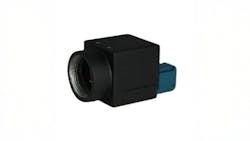
For its part, CIS Corporation developed the first camera module leveraging the platform.
With dimensions of 22 x 22 x 22 mm, the camera is half the size of typical machine vision cameras. It incorporates a 5 MPixel CMOS IMX568 image sensor from Sony (Tokyo, Japan). The camera has a frame rate of 96 fps, an optical size of 1/1.8 in, and NF-J lens mount. Its power consumption is >1.2W with transmission speeds of 8 Gbps over distances of up to 15 m.
These companies say MIPI PHY-A offers advantages for embedded vision applications. For example, the standard supports high bandwidth, long reach over twisted-pair cables, low power consumption, and EMI immunity. It also supports multiple cameras and sensors connected to a single data bus.
Related: Delivering High-Resolution Machine Vision for Enterprise Drone Applications
These characteristics are important in embedded applications involved in applications in which bandwidth-hungry image data is needed quickly to support AI-enabled actions such as robotic pick-and-place, automated inspection of complex products moving on high-speed conveyors, or detailed measurements requiring images from multiple camera angles.
About the Author
 Linda Wilson
Linda Wilson
former Editor in Chief
Linda Wilson was on the team at Vision Systems Design from 2022-2025.