AI-Powered Industrial Camera Platform Made for High-Speed Diagnostics

Combining a high-speed industrial camera with accelerometer technology and AI software, the aiOne from RDI Technologies is made especially for industrial diagnostic applications that require high-speed imaging.
The camera is designed to achieve a frame rate of up to 1,400 fps in full resolution and up to 29,000 fps at reduced resolution. It has a frequency range of up to 42,000 CPM at 1,400 fps maximum and 870,000 CPM at 29,000 fps with reduced resolution. It has minimum displacement of <0.01mils (0.25μm) at 3.3ft (1m) with a 50mm lens, and 0.005mils (0.125μm) at close focus.
Key feaures include:
- TrueSight ID. The Iris AI One platform uses AI to automatically detect and identify assets such as motors and pumps in the video feed as soon as the camera is pointed at them. This "point and shoot" capability eliminates the need for manual setup and frees up technician time.
- Stoplight-Style Vibration Severity Alerts. The AI provides real-time vibration analysis, classifying the severity of motion into three clear levels: green (acceptable), yellow (warning), and red (alarm). Combined with TrueSight ID, this allows the user to set the camera down, locate their assets, and automatically be informed if there's an issue.
- TrueSight HS and Thunderbolt Connection. The camera features onboard processing that allows for instantaneous collection and storage of high-speed data. It can capture motion at a max frame rate of 1,400 fps in HD Data transfers over a 40 Gbps Thunderbolt connection. This ensures that large, high-speed data files are transferred from the camera to the computer instantly.
- TrueSight Accel. The product can collect and store data from a simultaneously connected accelerometer. It allows technicians to detect high-frequency, low-displacement faults—such as bearing faults—that are a challenge for visual-only solutions.
- Integrated Remote Support. A "Help" button is built directly into the user interface, which automatically connects the user to RDI's expert support team.
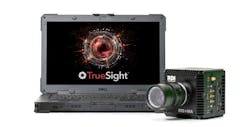
Vision Systems Design wanted to learn more, so we reached out to Jeff Hay, the founder and chief technology officer (CTO) of RDI Technologies for more information and his insights into the camera’s design and capabilities.
Editor’s note: This Q&A may have been edited for clarity and/or style.
Vision Systems Design (VSD): What are some features that make this camera system unique?
Jeff Hay (JH): It visualizes and quantifies motion. Our Motion Amplification technology provides a video of the motion, making problems easier to see and understand. This contrasts with other options that primarily provide charts, graphs, or heat maps that require expert interpretation.
It’s accessible to all users. Our TrueSight ID module and stoplight alerts are designed to allow non-experts to get immediate, accurate insights. Traditional solutions usually require a certified and experienced technician to interpret complex data.
The platform is an all-in-one solution that combines Motion Amplification's visual motion analysis with high-frequency accelerometer data to capture all major faults in one product. Others typically require a combination of multiple separate tools to achieve the same level of analysis.
It also is designed to be proactive and predictive. Our technology enables users to see and analyze the root cause of a problem before it leads to catastrophic failure. Competing tools are often reactive, alerting teams only to symptoms rather than visualizing the root cause.
VSD: What is the most important or significant feature that makes this camera the flagship camera for RDI Technologies?
JH: The most significant defining trait is that the Iris aiOne is an all-in-one solution, combining the new Iris MA camera hardware with AI-driven insights, accelerometer precision, and Motion Amplification. By combining these capabilities into a single, comprehensive solution focused on speed, performance, and simplicity, this system is designed to eliminate the compromises of traditional vibration tools and most importantly, it provides a simple, comprehensive diagnostic picture in a single system. This means users can go from data collection to visualizing the problem and the solution, all in one step.
VSD: What is the application(s) for which this camera is most frequently deployed?
JH: One application is root cause analysis— a quick diagnosis of complex issues by visualizing the root cause of vibration. For complex piping and structural assets, the platform can monitor intricate or hard-to-reach structures, particularly piping networks. Our non-contact technology visualizes movement on surfaces that are nearly impossible to monitor with traditional contact sensors, such as non-ferrous or insulated pipes, and can measure across the entire structure instantly without having to choose measurement locations.
About the Author
 Jim Tatum
Jim Tatum
Senior Editor
VSD Senior Editor Jim Tatum has more than 25 years experience in print and digital journalism, covering business/industry/economic development issues, regional and local government/regulatory issues, and more. In 2019, he transitioned from newspapers to business media full time, joining VSD in 2023.