Optotherm Launches MWIR Thermal Imaging Camera
Key Highlights
- Provides spatial resolution down to 1 μm with NETD < 20 mK sensitivity.
- Frame rates up to 1,558 Hz in windowed mode, suitable for dynamic thermal measurements.
- Enables backside semiconductor analysis through silicon using MWIR transparency, reducing the need for device destruction.
- Includes custom-designed lenses with a 240 mm HFOV, supporting detailed inspection of microscopic features.

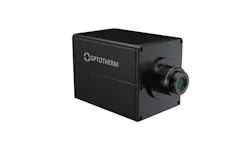
Optotherm Inc. (Warrendale, Penn, USA) has launched a Mid Wave infrared (MWIR) thermal imaging camera, the MW640-15. This camera is designed to provide spatial resolution down to 1 µm and features noise equivalent temperature difference (NETD) <20 mK sensitivity, high spatial resolution, and a 640 x 512 15 µm pitch MCT detector cooled to 80 K using a Stirling cooler, which is used in infrared cameras to maintain the imaging sensor at extremely low temperatures to reduce thermal noise.
The camera is made to achieve frame rates of 115 Hz (full frame) and 1,550 Hz (windowed).
The MW640-15 is suitable for such machine vision/industrial imaging tasks as semiconductor device and circuit board failure analysis, and microscopic temperature measurement and analysis of features as small as 1 µm. Because silicon is partially transparent in the MWIR wavelength range, this camera can be used for backside analysis of silicon in semiconductor inspection applications.
VSD wanted to learn more about the camera and its features and capabilities, so we reached out to Rich Barton, president and technical director of Optotherm Inc.
Editor's note: This Q&A may have been edited for style and/or clarity.
Vision Systems Design (VSD): What applications are this camera used for most often?
Richard Barton (RB): Most customers purchase the MW640-15 camera for electronics failure analysis, as the camera can detect hot spots down to <0.0001°C. Other applications include junction temperature measurement and semiconductor device transient analysis.
VSD: What are some unique features of the camera?
RB: Our custom-designed lenses enable pixel resolution down to 1µm and a horizontal field of view (HFOV) of 240 mm. In addition, the integrated system includes an external trigger that allows camera control during tests, including LIT. Frame rates compare as follows: full format (640 x 512) with frame rates up to 117 Hz; windowed (320 x 240) with frame rates up to 446 Hz; smallest window (132 x 99) with frame rate up to 1558 Hz (measurements > 80°C).
VSD: How does imaging strategy differ between frontside and backside IC thermography, and what advantages does MWIR imaging bring to backside analysis compared to other methods?
RB: Imaging strategy differs primarily because of the proximity of the features to the surface from each side of the device. Semiconductor features can be more easily observed while testing the front side because they are closer to the surface. Backside analysis is more challenging because the active layers are buried beneath the silicon substrate.
The MW640-15 camera enables imaging through window materials commonly used in chip testing, such as silicon, which is partially transparent in the MWIR range (3-5µm). This transparency allows MWIR cameras to detect thermal signatures without removing the silicon substrate, enabling faster analysis, and reducing the risk of damaging the device.
Long wave infrared imaging (LWIR) is less effective for backside analysis because the greater the thickness of the silicon on the backside, the less distinguishable features are because of the longer-wavelength band. The silicon substrate must be completely removed to allow an LWIR camera to directly observe the active layers.
VSD: When integrating this camera, what data flow, synchronization, or software/API challenges do you anticipate?
RB: At frame rates over 100 Hz, the primary challenge is managing the image data speed. We must develop software capable of reading and storing image data temporarily. Thousands of frames may be captured before being calibrated and then processed for analysis.
About the Author

Jim Tatum
Senior Editor
VSD Senior Editor Jim Tatum has more than 25 years experience in print and digital journalism, covering business/industry/economic development issues, regional and local government/regulatory issues, and more. In 2019, he transitioned from newspapers to business media full time, joining VSD in 2023.