Innovations and Industry Insights: Preparing for VISION 2026 in Stuttgart
Key Highlights
- Nearly 400 exhibitors from over 30 countries are registered, with expectations to reach 500, highlighting strong international engagement.
- Event features include vision awards, research sessions, startup pitches, and new formats like the Synthetic Data Symposium to address AI training data challenges.
- Market forecasts indicate a modest 3% growth in Europe for 2026, driven by automation and AI adoption, despite recent contractions and geopolitical uncertainties.
- Expert panels discuss the industry’s slowdown, opportunities in sectors like semiconductors and electronics, and the importance of customer-centric, integrated solutions.
- The entrance of tech giants like Google and NVIDIA presents both risks and opportunities, emphasizing the need for strategic partnerships and standards for interoperability.

Be visionary. This is the tagline for the VISION Show, coming up October 6-8, 2026, in Stuttgart, Germany. Last week, industry leaders and members of the machine vision community gathered for an insightful VISION/VDMA market forecast and CEO Roundtable ahead of the anticipated biennial event.
Organized by Landesmesse Stuttgart GmbH & Co. KG, preparations for the show are well underway with promising figures that reflect a robust industry outlook despite challenging global market conditions.
As of early May, nearly 400 exhibitors have registered for the event with expectations to reach 500 by October. More than 90% of the available exhibition space has been allocated with a possible 3% increase by autumn, according to Florian Neithammer, head of trade fairs and events at Landesmesse Stuttgart.
A notable feature of the Stuttgart show is its international reach. Exhibitors will come from more than 30 countries, with nearly two-thirds from outside Germany alone. China leads the charge as the top international presence, followed by the US, the UK, Switzerland, France, and Japan. The event will also feature country pavilions for Taiwan and Switzerland.
READ MORE: Join the Machine Vision Community in Stuttgart this October

Neithammer says the show will offer a packed agenda beyond just exhibition booths. Highlights include the vision awards celebrating the most innovative machine vision applications, a presentation forum with 80 sessions covering the latest research, startup pitches, and panel discussions, and the Scientific Vision Days focused on cutting-edge R&D. For engineers and integrators looking to deepen their expertise, guided tours targeting industries like aerospace, automotive, battery manufacturing, and semiconductors will provide curated learning experiences.
Additionally, the show will debut new formats such as a Synthetic Data Symposium, tackling one of the biggest bottlenecks in AI-driven vision: the scarcity of high-quality training data. The Vision Makeathon initiative will foster collaboration between students and companies on real-world projects, helping to nurture the next generation of talent, and startups will get their moment to shine with dedicated spaces and networking events designed to cultivate innovation.
Market Realities: Growth, Challenges, and Recovery
Despite these promising developments, the machine vision market has faced a bumpy road in recent years. Daniel Seiler, CEO of AT Sensors and chairman of the board of VDMA Machine Vision, reported on an annual market survey that VDMA conducts among all divisions at the beginning of each year for machine vision. “We had 49 members reporting this year,” Seiler said, adding that this survey has been conducted for over 30 years among German companies and a bit more recently among European companies as well.
The industry's long term growth trajectory averages a strong 9% compound annual growth rate over the past decade. However, the pandemic years and the subsequent 3 years have seen a rare period of contraction.
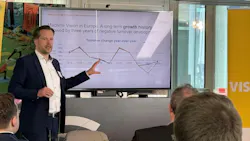
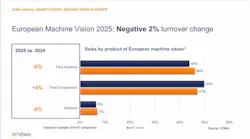
In 2025, the overall European machine vision market shrank by about 2%. While component manufacturers return to growth with a 4% increase, system integrators and service provider space declines, reflecting broader economic and geopolitical uncertainty as a significant factor is the concentration of machine vision sales tied to European manufacturing, where contraction continues, contrasted by growth opportunities opening up in the Americas and Asia.
Looking ahead, VDMA's carefully calibrated forecast anticipates a modest 3% growth in 2026 for the European market. This predicted rebound is fueled by ongoing automation trends and the accelerating adoption of AI technologies and industrial applications. Nevertheless, lingering risks from international competition, geopolitical unrest, and potential supply chain disruptions temper expectations.
For those designing, deploying, and integrating machine vision solutions, the VISION 2026 trade show will serve as a forum where cutting-edge technologies, industrial strategies, and innovative startups will converge.

Following Seiler’s market data presentation and forecast, a roundtable of experts in the field—Dr. Olaf Munkelt, CEO of MVTec Software; Dr. Kai Jens Ströder, CTO of Basler; and Dr. Martin Klenke, market development leader at Teledyne Vision Solutions—offered valuable perspectives on navigating these changes.
The past three years have presented a downturn in European machine vision sales, reflecting both cyclical economic forces and deeper structural shifts. Munkelt noted that the industry’s decade-long growth streak slowed as companies perhaps became less customer-focused and more inward-looking amid broader economic headwinds. He said that signs of hope emerge, particularly from sectors such as semiconductors, electronics, pharmaceuticals, and medical where rising customer demand hints at a return toward more normalized market cycles.
Ströder said that while the medical sector faces regulatory and business model uncertainties, consumer electronics remain stable with promising growth potential. The semiconductor industry, carrying a significant backlog and ongoing supply chain challenges, also stands out as a key growth driver. Notably, geopolitical shifts push major economies such as Europe, the US, and China toward greater autonomy and hardware development—a trend expected to fuel increased demand for vision components as automation becomes imperative.
The conversation shifted to consumer buying behavior, where Klenke talked about increasing market complexity. Customers now seek more than standardized components, and understanding their end goals is paramount. “It's not enough to just sell a standardized component anymore,” he said. “You have to really think about what is before (you) and what your customer really wants to do with that. That's very important.”
While traditional capital expenditures remain dominant, emerging business models hint at pay-per-use and other operational expenditure approaches, though widespread adoption remains limited. The evolving landscape demands that vendors deliver integrated, AI-compatible solutions simplifying deployment and enhancing value rather than merely offering hardware.
Ströder added that today's customers demand reduced complexity, faster time to market, reliable delivery, and strong supplier relationships. Managing these expectations and fostering trust through consistent delivery and engagement is essential, particularly when intellectual property and custom solutions involve significant upfront investment.
Competing and Differentiating in a Global Market
Competition from Asia is no longer just about price—it involves reliability, trust, and service quality. The panel agrees that European machine vision providers can differentiate by embracing deep customer centricity, focusing on niche applications, and maintaining strong commitments to their customers. Munkelt stressed that Europe has technological capabilities comparable to other regions. The differentiator lies in understanding and meeting precise customer needs, aligning technology with value and cost expectations.
Klenke said the importance of intimate problem solving with selected customers and delivering on promises is also necessary for global competitiveness. Ströder agrees, noting the fragmented nature of the market: while large customers are well resourced and exacting, numerous smaller niche players benefit from vendors who leverage networks and strategic partnerships to provide comprehensive, tailored solutions.
The Rise of Tech Giants and the Need for Partnerships
The entrance of large technology firms such as Google, NVIDIA, and Microsoft into the machine vision space introduces both risk and opportunity. These companies primarily bring AI technologies and vast computational resources but do not currently serve as direct customer interfaces. Instead, they are viewed as vital partners. Klenke advocates a collaborative approach where the traditional machine vision industry embraces these platforms and aligns offerings accordingly.
Munkelt reflects on prior waves of platform entrance and sees this current AI-driven wave as a chance to integrate and add value rather than compete head on. He forecasts the near future will feature multiple coexisting AI and industrial platforms, driven by significant capital investment requiring sustained commitment.
Ströder positions the industry as an essential intermediary between giant tech providers and the end user, tasked with translating powerful but complex offerings into usable, trustworthy solutions. This intermediary role offers machine vision companies an opportunity to grow by educating customers and managing risks associated with new technologies.
Standards and interoperability are keys to integration. As the industry transitions beyond hardware toward complex ecosystems and software platforms, standards become ever more important. The panel highlighted several emerging and existing protocols, including the 10GigE vision standard for high-speed camera data transfer, OPC UA for industrial data interoperability, and efforts around asset administration shells. They also recognize the challenges of AI's rapid evolution outpacing strict standardization, suggesting future flexible, software-driven integration frameworks that can adapt to individual customer needs while still leveraging standardized building blocks.

An important emerging theme is the valuing complexity of data sharing. While companies hold increasing volumes of production data critical for AI applications, concerns over ownership, confidentiality, and regulation limit broad sharing. Industry initiatives like those within VDMA seek to create frameworks that enable secure and monetizable data exchange, potentially unlocking new business models. New regulations such as the Cyber Resilience Act, Data Act, and the EU AI Act mandate heightened security, safety and transparency requirements.
The roundtable participants shared their approaches—starting early, focusing efforts efficiently, and viewing compliance not merely as overhead but as a way to build customer confidence and protect markets. While resource-intensive, compliance also differentiates companies in the eyes of demanding buyers.
CHECK OUT VSD's ONE-ON-ONEs:

About the Author
 Sharon Spielman
Sharon Spielman
Head of Content
Sharon Spielman joined Vision Systems Design in January 2026. She has more than three decades of experience as a writer and editor for a range of B2B brands, most recently as technical editor for VSD's sister brand Machine Design, covering industrial automation, mechanical design and manufacturing, medical device design, aerospace and defense, CAD/CAM, additive manufacturing, and more.