Bitsensing Unveils ADAS Kit for Commercial Vehicles
Key Highlights
- Designed for retrofit, the ADAS kit can be installed on existing commercial vehicles without vehicle redesigns.
- System provides real-time safety warnings such as blind spot alerts, rear collision warnings, and lane change assistance.
- Deployed on Korean buses, the system has reduced pedestrian collision warnings by 24% and improved driver safety scores by over 50%.
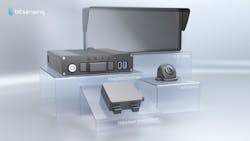
Bitsensing (Seoul, S. Korea), a company that specializes in radar solutions, has launched an advanced driver assistance system (ADAS) kit designed for commercial vehicles.
Commercial vehicles in South Korea, indeed, pretty much everywhere, often operate in densely populated urban areas and high-risk conditions, noted Bitsensing officials in a press release. Commercial vehicle drivers often deal with such daily hazards as major blind spots, longer braking distances, and unexpected events involving pedestrians and/or other vehicles.
According to the European Commission’s 2024 Buses and Heavy Goods Vehicle report, of some 21,000 road fatalities in the European Union in 2022, 2,940 (14%) occurred in crashes involving heavy-goods vehicles such as tractor trailers while another 413 (2%) involved crashes with buses and motor coaches. Half of the crashes that involved buses occurred in urban settings. And according to 2023 U.S. National Highway Traffic Safety Administration data, 5,472 people were killed in crashes involving large trucks.
“Commercial vehicles operate in some of the most demanding road environments, yet many fleets still lack access to modern driver warning systems,” Bitsensing CEO Jae-Eun Lee told Vision Systems Design in an exclusive interview. “Our ADAS Kit was developed to close that gap, delivering a complete, system-level ADAS solution that can be deployed on existing vehicles without redesigning the vehicle platform.”
Bitsensing’s system, a kit designed especially for retrofit onto existing commercial vehicles, utilizes radar, cameras, and AI-software to provide a range of safety warnings to drivers while they are operating these vehicles. The system is not an autonomous driving solution but is meant to significantly augment and assist human drivers, especially those whose vehicles have minimal or no ADAS systems, Lee said.
Related: Nautitech, Sea.AI GmbH Adding Machine Vision Safety Features to Seafaring Sailboats
Kit Contents and How They Function
Lee says the kit includes three radar units, four 2 MPixel RGB cameras with wide angle lenses, and AI software.
“This is a sensor fusion system designed to enhance driver situational awareness by combining surround-view monitoring with multiple radar sensors,” he said.
The radar units and cameras are manufactured by local partners whom Lee was unable to name due to contractual obligations. The software was developed by Bitsensing and encompasses a host of safety monitoring and warning situations, including blind spot monitoring, surround view monitoring, rear collision warning, front vehicle start alert, forward collision warning, and moving off information.
The radar units are mounted at the front and on the sides of the vehicles; cameras are mounted at the front and both sides of the vehicle as well, with the fourth camera mounted at the rear of the vehicle. All sensors, cameras, and radars, are hard-wired to a controller unit loaded with the AI software and a display screen positioned in the vehicle near the driver. When the driver starts the vehicle, the sensors and computer automatically “awaken” and begin to scan the areas around the vehicle, capturing image data and transmitting it to the computer. The AI software analyzes the image data and generates warnings for the driver if any potential safety issues are detected.
“All sensors are synchronized, and the system runs in real time,” Lee says. “So, if there's any safety risks or collision risks, such as when you are performing a lane change, the sensors scan the blind spots and send warnings to the driver if there's any collision risk.”
Challenges, Accomplishments and Next Steps for the ADAS System
When it comes to radar, particularly automative radar, the Bitsensing team has significant talent and experience. The core members working on this project, including Lee, were among the first to develop automotive radar in Korea, he says. Nonetheless, the team “started from nothing and developed the system from A to Z” because there was really nothing quite like it from which they could start, Lee says.
“We already have a lot of experience in developing radar sensors, and we have a lot of customers, and because of that we are very confident to develop new innovative radar systems,”Lee said, adding that it took him and his team about a year and a half to develop this system.
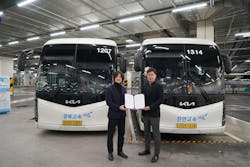
The system is working as intended. The team deployed ADAS system kits on three buses owned by Koreawide Express Group in November 2025. These buses run approximately 1,000 km a day for around seven hours per day in downtown Daegu, S. Korea, a city of some 2.3 million people.
“According to the feedback they have given us, they are very satisfied with the system,” Lee says. “They are seeing positive results—they have reduced their driver safety score by over 50%, and they have reduced pedestrian collision warning events by 24%.”
In fact, Lee says that Bitsensing has signed a contract to install ADAS systems on more than 500 Koreawide Express Group buses later this year. The company is also in discussions with several Korean insurance companies regarding lowering insurance rates for commercial carriers whose vehicles are equipped with an ADAS system, Lee says.
About the Author
 Jim Tatum
Jim Tatum
Senior Editor
VSD Senior Editor Jim Tatum has more than 25 years experience in print and digital journalism, covering business/industry/economic development issues, regional and local government/regulatory issues, and more. In 2019, he transitioned from newspapers to business media full time, joining VSD in 2023.