Ubiquitous Lasers
May 05, 2026 - Fraunhofer Institute for Laser Technology ILT
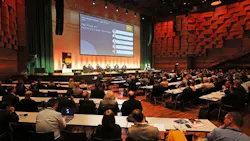
For three decades now, the AKL – International Laser Technology Congress has been established as a key platform for exchange within the laser community. From April 22–24, 544 experts from 21 countries, around 90 speakers, and 57 exhibiting companies and institutions flocked to AKL’26 in Aachen. There, during the Gerd Herziger Session, a panel of high-caliber experts reviewed the developments of the past 30 years and looked ahead to the future of increasingly ubiquitous laser technology.
Lasers are ubiquitous. They have become indispensable across all industries: from data centers and telecommunications, clinical diagnostics and therapy, the increasing production of electric vehicles, smartphone factories, semiconductor manufacturing, to the marking, labeling, structuring, and functionalization of surfaces, and material processing—from cutting and drilling to welding and soldering. New growth markets with, in some cases, enormous economic potential are emerging thanks to fusion, quantum technologies, and the use of lasers in agriculture, mining, offshore and underwater applications, or in the field of humanoid robotics and for the lightning-fast defense against entire swarms of drones.
Added to this is the rapid expansion of data centers, nearly two-thirds of which is driven by the exponential rise in the use of artificial intelligence (AI). In his presentation during the Gerd Herziger Session, Dr. Hagen Zimer, CEO of Laser Technology and member of the Executive Board of TRUMPF SE + Co. KG, outlined why this expansion is giving the industry a boost: “A wide variety of laser processes are required for AI chips, cooling, connections such as CPU parallel connections, hole drilling, and the cutting of the sheet metal from which such data centers are largely constructed.” The growth potential in this field extends far beyond EUV technology for structuring wafers with feature sizes soon to reach 2 nanometers (nm)—technology that TRUMPF also supplies to the Dutch system integrator ASML for the next generation of AI chips—and whose development required tremendous perseverance. Indeed, TRUMPF, ZEISS, the Fraunhofer IOF in Jena, ASML and other partners spent 15 years researching and developing this key technology for microchip manufacturing.
Finding an ant in Manhattan
Extreme ultraviolet (EUV) radiation generated by CO₂ lasers is indispensable for producing nanometer-scale chip structures. According to Dr. Christopher Dorman OBE, Executive Vice President Industrial at the Coherent Group in Europe, short-wavelength lasers are also needed for quality control in the microelectronics and semiconductor industries. “Twenty years ago, wafers were inspected using wavelengths in the green spectral range,” he reported. Instead of these wavelengths around 500 nm, 266 nm is used today, and even shorter wavelengths will be employed in the future for even faster and more precise inspection. This is urgently needed, because in-process defect inspection for today’s nm-structured wafers with a 300 mm diameter is akin to scanning Manhattan in twenty seconds and not only detecting a single ant, but also identifying its individual species.