Practical Insights on Embedded Architectures and Machine Vision Innovation
Key Highlights
- TI's hybrid SOC architectures balance processing power, latency, and energy constraints by combining general-purpose cores with hardware accelerators for optimized performance.
- Emerging trends like machine systems that learn and adapt in real-time excite Gehlani, as they promise to revolutionize multiple industries through smarter, more autonomous applications.
- Gehlani advocates for cultivating diversity in engineering teams, emphasizing that varied perspectives foster innovative solutions and better problem-solving capabilities.
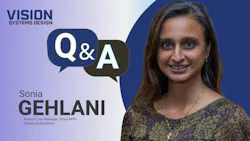
Embedded processing powers the intelligence that enables smarter, faster, and more efficient machine vision applications across industries. Vision Systems Design reached out to Sonia Gehlani, product line manager, Sitara MPU, at Texas Instruments, who has shaped and driven innovation in this space, to learn more about the topic and about her.
From a lifelong fascination with how things work to tackling the complex trade-offs that define embedded system design, Sonia offers an insider's view on blending technical rigor with authentic leadership.
For engineers and integrators working in machine vision today, her insights offer inspiration and practical guidance for building the intelligent vision systems of tomorrow.
Editor's note: The following Q&A may have been edited for style and/or clarity.
Vision Systems Design (VSD): What inspired you to pursue a career in embedded processing engineering, and how did your journey lead you to work specifically with machine vision technologies?
Sonia Gehlani (SG): As a child, I was always fascinated by electronics and the whole world of science and math. STEM subject areas were a strength of mine and an area of curiosity. I very much enjoyed understanding how things worked, whether it was in technology, science, math or even history.
As I grew older, my interest evolved to wanting to learn about the “brain” behind these systems. This ultimately led me to my career in embedded processing engineering and as a product line manager, Sitara MPU, for Texas Instruments.
If you look at TI’s embedded processing portfolio, you’ll notice that a lot of what we do is focus on that brain of the application. We ask ourselves how it works, what it can do, what it can't do and so on. Because of that, pursuing a role in embedded processing felt like a natural pairing.
I feel very lucky to be able to pursue something I've been interested in since I was a kid.
VSD: How did your education and early professional experiences prepare you for tackling the challenges in this field?
SG: My education and early career at TI prepared me for tackling challenges by teaching me to view them as part of the fun. At the end of the day, if the challenges were easy, we wouldn’t be needed and engaging in these complex challenges is what helps us continue to develop innovative technologies.
I’ve also learned that solving challenges requires more than just having technical skills and knowledge. It is knowing how to approach the problem, asking the right questions, working with peers, thinking outside the box and understanding the end goal.
When you come to the table ready to tackle the challenge with that “fun” approach, it makes finding the solution all the sweeter.
Solving challenges...is knowing how to approach the problem, asking the right questions, working with peers, thinking outside the box and understanding the end goal.
- Sonia Gehlani
VSD: What unique challenges have you faced as a woman in embedded engineering, particularly in machine vision, and how have mentorship or support networks helped you overcome them?
SG: People always tend to look for role models when there's something they want or aspire to be. As a woman in embedded engineering, finding those role models and people I can see myself in early on wasn’t always easy.
I used to believe I had to fit into a specific mold and suppress my true self to find those mentors and succeed. Thanks to the culture at TI, I soon realized that is not the case as I was encouraged to be myself and take up space in the room.
If you walk the halls of TI today, you will see a lot of strong female engineers who are contributing and making a real impact. This is a testament to the leaders who have given opportunities and created space for that mold to expand, allowing for more diversity in perspectives and strength of thought to solve our customers’ problems.
VSD: Can you walk us through a recent project where embedded processing was crucial in a machine vision solution? What were the key technical challenges, and how did you address them?
SG: It’s difficult to think of just one example as embedded processing and machine vision go hand in hand across a variety of systems. At its core, machine vision solutions are about taking signals from the outside world as analog, processing them, turning them digital, and then doing something with that data. Understanding that data and then acting on it is what embedded processing technologies do, which is why they continue to be crucial in machine vision.
However, there are always constraints to consider. Whether it is thermal, software, hardware, performance, power, timeline, or other budgets and complexities, we are constantly working with these varying levels of constraints. Now as more applications move toward greater autonomy, other considerations emerge such as safety and security. These are the types of problems we solve day in and day out at TI.
To address these complex challenges, it is important for us to work closely with customers and understand their constraints so we can come up with the best solution and ultimately help them build smarter, more capable systems.

VSD: What embedded architectures, programming languages, and tools do you rely on most in your work with machine vision integrations? How do you balance processing power, latency, and energy constraints?
SG: It’s a mix between finding the right tool for the right job while also maintaining a high level of flexibility for customers to develop their own.
At TI, we tend to build SOCs (systems on a chip) with hybrid architectures. They typically have a general-purpose compute core that gives customers the flexibility to develop their own application or program, but you’ll also see one or more hardware accelerators on the chip. These accelerators take fixed functions and make them work faster, better, and smarter, allowing end applications to be more power- and cost-efficient.
Understanding the full signal chain and how our customers are developing their systems is important, as it helps us figure out the pieces of the system where flexibility matters to them and where we can be more efficient. We take the same approach to balancing constraints. Accounting for varying levels of processing power, latency, and energy cannot be solved with a one-size-fits-all approach, which is exactly why understanding the full signal chain matters so much.
Across TI, whether it is a DSP (digital system processor), microcontrollers, or the Sitara processors we work with on my team, understanding our customers’ needs is how we help optimize their systems and integrations.
VSD: Which emerging trends or technologies excite you the most?
SG: What I’m seeing more and more of that excites me is the ability for our applications to "learn” and become better, smarter and more efficient. Until now, we have been putting intelligence into systems ourselves. Now, our systems can smartly detect where they can be stronger or more optimized based on data.
This is something that is going to touch almost every single industry, bringing markets and applications to the next level.
At TI, we are enabling this type of learning through our comprehensive embedded semiconductor portfolio, making it that much more exciting to not only witness this technology evolution but to be actively contributing to it as well.
What...excites me is the ability for our applications to 'learn' and become better, smarter and more efficient.
- Sonia Gehlani
VSD: What advice would you offer to engineers and integrators entering or advancing in embedded machine vision? What skills and experiences should they focus on developing?
SG: As I look at the next generation of engineers coming into the market, my advice is to focus on developing your ability to ask the right set of questions, stay curious, and have the motivation and drive to learn. These are skills that are invaluable and will follow you wherever you go.
The engineers who are curious, who are asking questions and are eager to drive change are the ones that are going to be able to take things the furthest and truly make an impact in the field. As technology trends continue to evolve as well, they are the ones who will adapt and move things forward.
VSD: How can machine vision companies and engineering teams cultivate greater diversity and inclusion, and what benefits do you see from having diverse perspectives in technical innovation?
SG: It’s hard to explain to someone what “thinking outside the box” means because no one can really define the box. However, the more talented and diverse people you can put in the room, the better you can think outside the box. That is how innovation occurs.
Everyone approaches a problem with a different lens or perspective. Putting these different perspectives and backgrounds together is what drives diversity of thought, and therefore better solutions.
Teams can cultivate this by creating an environment where different perspectives are not only welcomed but actively sought out. This helps them bring out the best in their teams and bring the most competitive ideas to the marketplace.
Putting these different perspectives and backgrounds together is what drives diversity of thought, and therefore better solutions.
- Sonia Gehlani
VSD: Looking ahead, what are the most exciting possibilities or challenges for embedded processing in machine vision over the next several years, and how do you see engineers shaping this future?
SG: Like I mentioned before, the most exciting possibility I see for embedded processing in machine vision is the ability to improve learning rate, at both the point of deployment and afterward.
The ability to push software upgrades to essentially update the brain of a system over its lifetime and evolve its capabilities is fascinating and will cause a huge acceleration in what these different machine vision applications can do. Figuring out how it accelerates and how fast—that's where the fun is.
As engineers, we will shape this future of machine learning by making sure safety and security guardrails are in place so this learning can happen in the most constructive way possible.

Editor’s Note: Vision Systems Design’s WISE (Workers in Science and Engineering) hub features our coverage of workplace issues in engineering as well as insights from equity-seeking groups and subject matter experts across disciplines.
About the Author
 Sharon Spielman
Sharon Spielman
Head of Content
Sharon Spielman joined Vision Systems Design in January 2026. She has more than three decades of experience as a writer and editor for a range of B2B brands, most recently as technical editor for VSD's sister brand Machine Design, covering industrial automation, mechanical design and manufacturing, medical device design, aerospace and defense, CAD/CAM, additive manufacturing, and more.