Inside Automate 2026: Cutting-Edge Trends in Humanoid Robots, AI Integration, and Automation Solutions
Key Highlights
- Automate 2026 will feature a new Humanoid Robot Forum, showcasing real-world applications and technological breakthroughs in humanoid robotics.
- Standards and interoperability are key themes, with ongoing efforts like humanoid safety standards and demo areas for mobile robots to address deployment challenges.
- Cutting-edge machine vision technologies, including deep learning and AI integration, are central to advancing manufacturing inspection, classification, and defect detection.
- Attendees can participate in extensive technical sessions, workshops, and free expo events, including innovation stages and keynote addresses, to deepen industry knowledge.
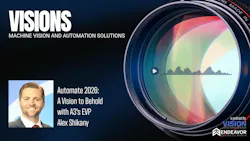




In this episode of Visions: A Machine Vision and Automation Solutions Podcast, A3 Executive VP Alex Shikany joins Vision Systems Design's head of content Sharon Spielman to preview Automate 2026 in Chicago (June 22–25). They discuss the new Humanoid Robot Forum, the convergence of vision, AI, and robotics, and how standards, interoperability, and practical demos will shape real-world deployments.
The conversation highlights key sessions and free expo events—certified vision tracks, innovation stages, demos in the NVIDIA-sponsored pavilion, daily keynotes, and networking opportunities—offering engineers and managers a one-stop view of the latest machine vision and automation trends.
Related: Explore Cutting Edge Vision, AI, and Humanoid Robotics at Automate 2026 in the Windy City
Related: Exploring Innovation at Automate 2026: Humanoid Robots, Machine Vision, and More
Related: Automate 2026: Educational Opportunities and Innovation Highlights
Visions: A Machine Vision and Automation Solutions Podcast, is the podcast for engineers, designers, integrators, and end users who want to keep an informed eye on the imaging and machine vision industry. Every second and fourth Tuesday we will explore the latest in imaging trends, developments and solutions. Here you will find interesting, useful insights and observations from expert interviews, solo episodes, even the occasional panel discussion, all of which aim to expand your knowledge on imaging and machine vision.
Transcript
Well, hello and welcome to visions, a machine vision and Automation Solutions podcast. I'm your host, Jim Tatum, senior editor of Vision Systems design and visions is an endeavor business media production from your friends at Vision Systems Design. Here you'll find the latest on everything from end user machine vision solutions to trends, developments, and perspectives on all things machine vision and imaging. Whether you've been working in the industry for a while or you're just starting to take a closer look at it, this podcast is designed to grow your knowledge and bring greater focus to your understanding of the imaging and machine vision industry. And now on to our show.
Well, hi everybody, and welcome to visions. I'm Jim Tatum, senior editor of Vision Systems Design. You know, one of the highlights of the year for anyone in our industry, especially me, is the Automate show, organized and hosted by A3, the Association for Advancing Automation. The Automate Show is the biggest robotics and automation show in North America. Automate is always a great experience. Hundreds of vendors, all showing off the biggest variety of cutting edge innovations to be found anywhere in the world, across so many sectors and genres. Not to mention keynotes and seminars conducted by literally the best and brightest to be found in automation related industries anywhere in the world. And as for surprises, I mean, where else are you going to walk through a door into a space the size of, say, several football stadiums, only to be initially greeted by a quadruped robot that seems to be asking you for a belly scratch like a dog?
Sounds funny? Well, it's happened to me twice now. And at the leaps, bounds and crazy pace technology is advancing these days, it wouldn't surprise me at all if a humanoid robot walked up to me, took my coat and offered me a drink. I know I exaggerate, but only a little. Fortunately, visions has an antidote to my occasional flights of fancy. Today we have Alex Ciccone, executive vice president of A3. He recently spent a few minutes with VSDs head of content, Sharon Spielman, to talk about some of the fantastic opportunities attendees will have at Automate 2026, coming up June 22-25 in the Windy City of Chicago.
Welcome, everyone. Today we're going to be looking into the cutting edge machine vision, image processing, and robotics technologies that will be showcased at Automate in Chicago next month. Joining us is A3's Executive Vice President Alex Cecchini. Thank you for joining us today, Alex.
Hey, Sharon, it's good to be with you. Thanks for having me.
Absolutely. So we got a lot of ground to cover. So I'm just going to dive right in. All right. So first of all, I saw that we have that humanoid forum, which is new this year. So that's so intriguing to me. Can you share some insights into the current state of humanoid robotics technology and the specific applications or break breakthroughs that will be featured?
Well, sure. Happy to do it. We're excited to have the Humanoid Robot forum co-located at automate this year. We most recently did it in Seattle as a separate event last fall. And it's it's perfect to be linked to automate this year just because of how much interest and attention that the technology is getting and how well it fits into the, uh, the automate ecosystem. I'll say it's an interesting time as well for humanoid robots. Um, they're kind of moving from the initial hype and concepts and kind of proof of concept into more practical applications and evaluation of companies. So we're seeing more and more technology is actually being up and moving around and actually doing real world applications in facilities and things like that, which is really interesting to our automate attendees, of course, and other exhibitors, because those are some of the main questions we had for humanoids when it first started coming on the scene was, where are these going to be deployed? Are they for real? You know, is all this investment, um, you know, really going to make an impact? And while some of those questions are still open, of course, we're going to tackle them at the event in our humanoid robot forum and in our programming on, on the show floor in the pavilion that's sponsored by Nvidia. We have an excellent array of different humanoid robot technologies in that pavilion and who are going to be on stage. So for someone who's considering coming to automate, I would say it's a no brainer. One stop shop. I mean, they're going to get their questions answered. They're going to get to see, you know, the humanoids up and, and, uh, talk to the, the companies in the booths to see if it's a fit for their applications or it will be in the future. I know Vision Systems Design. I know you guys well. You're a partner of ours for a long time now. Um, one of the more exciting things when I think of humanoids is the convergence of all these technologies. They're kind of a great microcosm of what we've been saying for a long time, which is automation. Technology is converging. Right? Um, back in the day it was, I may need just a robot or I may need just a vision system or these things happened a little bit more in isolation. But at a show like automate, where the topic of, of the at hand is solutions, you get to see in one hardware package with a humanoid robot vision system, sensing articulation, you know, um, robotics, you get to see it all mobility in one, uh, in one package. So that's why I think it embodies a lot of what we talk about. And, and, uh, you know, present at automate with increasing system complexity.
How are challenges like vision, system calibration, robustness and interoperability being addressed, particularly through emerging standards and integration strategies? I know when I talk to Jeff Bernstein, last year, uh, they were working on the humanoid standard. So where, where are we with that?
Yeah, the, the work on the, uh, dynamic stability, uh, standard for humanoid robots is still ongoing. We're still plugged in with that effort. Um, the importance just sticking with humanoids for a second. It's critical for, if you are to believe that humanoid robots are going to be deployed at scale, um, across various industries, we believe that it starts with safety, certainly from a, from an organizational perspective, as we have shown with our work in the AR fifteen oh eight and oh six, you know, robotic safety standards up through collaborative and mobile and all of that. And so, um, that's super important work that we continue to be plugged in on. Um, when it comes to robust, I believe the way you worded it was robustness and interoperability, those types of things, those themes on the show floor. So those are still incredibly important just to talk about interoperability for a moment. That continues to be one of the main themes that we see brought up is as more automation technology is available to customers from more brands and more, uh, different types and form factors of solutions for the customers, it's increasingly important for them to be able to, over time, deploy those various technologies and be able to control them in concert with one another in their facilities. And so there is a big emphasis right now being placed on the ability for them to work, you know, and operate, um, with each other and play nice, so to speak. So we do have an Amr specific to autonomous mobile robots. We have an AMR demo area at the show where we're going to be running some of these demos. Um, actually. And so there'll be periodic times where, you know, attendees to the show and exhibitors, if they want, can come over and actually see this demonstrated real time in front of them so they can ask their questions and see, you know, what standards apply here.
How does this actually work? What software, if any, do I need in order to, to make this a reality for me?
Um, so I would say your question is, is apt because those things that you mentioned, there's increasing complexity standards are becoming more important. Interoperability is more important. All those things are going to be present on the show floor to automate and, uh, and being discussed during that week.
What do you feel that are the most innovative machine vision and image processing technologies? Um, and how are they pushing the boundaries of the current manufacturing applications?
Yeah, absolutely. So vision has moved. Uh, it never, it was always a major, you know, integral piece of what we do in automation and, and what's possible and with today's hardware and software, but it really, truly is kind of at the center of what's possible with some of these, you know, AI, uh, software algorithms, programs and things that are, you're seeing now deep learning, uh, and also the hardware in order for the hardware to do some of the things that are, I would say the most cutting edge or, or modern move around, uh, become modular in their application, um, understand their environments, you know, vision is often critical to, to all of those things happening successfully. And so, you know, traditional machine vision as one might think of it when you say it that way, traditional machine vision is going more from like simple pass fail inspection applications to a more flexible, dynamic, adaptive, intelligent, understanding environments, being able to, um, to process things very quickly, but, you know, integrate with all the other software and sensing that, you know, is working in concert with, with just the vision system itself. So I think it's a super exciting time for, for the vision industry because they're kind of, they find themselves at the center of all that that's taking place. So they're going to be in demand for, for many of these, uh, exciting applications that we talk about.
Yeah, that segues perfectly into my next question, which is, um, explain to our audience the latest advancements in that AI and in deep learning integration within the vision systems. And if you can think of any of the standout demos or vendors at the show that will be leveraging these technologies.
Yeah, absolutely. So it's, uh, uh, vision, as many of our board members have told me over the years, uh, vision is as much an art as it is a science. You know, it's, uh, you have to get the environmental factors, right. Lighting and the optics and the, the processing and, uh, the data collection and the software that runs on top. It's a, it's a concert. It's a, it's an artistic, uh, portrait of, of a good system when it's developed. And when, when I remember AI and deep learning really kind of first becoming on the, let's say, the automate scene and being shown in booths at large and build like this is your, You know, this is the answer to all your your problems or all your questions kind of thing. I remember there was some skepticism there or there was some hang on. Let's you know, that's not the answer. It's not a one size fits all. And I certainly think that that's true to some extent. You know, AI has come a long way. AI vision can do so much more in terms of classification and detection and, you know, different types of, um, like segmentation and defect detection, things like that. It can do a lot of those things better now than it could in previous years. And it obviously can do them at greater speed and with more accuracy. We've seen that along the trajectory, but it's also working in concert with the foundational elements of a successful vision system, right? So it, it needs to come together in the whole picture with good system design, the proper hardware that it's using. You know, the lighting conditions, all of that. Um, so all of that is super important still. And so someone coming to automate who may have just seen or heard that AI is maybe the answer to all my problems and I'm excited about it. They can explore that thread at automate, certainly, but what they're going to find is a lot of that practical, foundational knowledge from, from our industry that's going to help them even more and actually deploy the vision system and within their automation system in a much more successful manner. So I think that's one of the main, uh, value propositions of automate is it's a one stop shop for all of that. They can tackle it all within the week in Chicago.
For our audience at Vision Systems Design, the engineers and the managers that are looking to dive deep into these technologies. What technical sessions and workshops and showcases would you recommend that they attend?
Absolutely. So we have a tremendous lineup of conference sessions, over two hundred, I believe. It's probably that's probably low. My conference team would probably be like, no, say two fifty or something. It's it's in the hundreds I know of sessions available from sticking. Just envision for a moment. We have our industry leading, you know, certified vision, professional, basic and advanced curriculums going, uh, during the week. So just to be more specific for your audience, if they're, if they're coming at this in a, in kind of an earlier stage, and they want their engineers or themselves to be able to understand vision technology better, the certified vision professional basic curriculum courses are phenomenal at doing that. They're broken into, you know, the fundamentals of machine vision, beginning lighting, optics, you know, cameras, those types, those types of topics. So it's great. Uh, you know, getting started raising the bar of, of your knowledge on your team. But if you're already coming at it and you want an advanced look or you want to dive deeper, we have our certified advanced, as I mentioned, our certified vision professional advanced. Those are what you might expect deeper drill downs on all the important areas within vision, even including other courses like, you know, high speed and, uh, real time machine vision and advanced vision system integration courses and things like that. Um, and in addition to those CVP tracks, we have a host of different vision, in particular vision related topics that roll in things like AI and advanced inspection. You know, I think we have, uh, we have some, uh, like 3D vision, uh, courses as well, uh, not courses, but sessions within our conference so they can learn about how AI is impacting the vision industry, what solutions they should be aware of or considering, uh, to leverage AI and vision. Um, and then of course, as you move down the list, you see things like hyperspectral imaging and not, you know, non-visible imaging techniques and things like that. Also, in addition to the conference conference sessions, which are, uh, like an add on to the actual, um, expo, uh, on the expo floor, you're also going to have an innovation stage, correct?
Yeah. That's a really, so that's another way that they can, I know we, we here at Vision Systems Design will be presenting our innovator awards on that, uh, beginning of the first day on that stage. And so I would imagine there's also a ton of other, uh, events happening on that stage.
Yes. Way to keep me honest, Sharon, I appreciate it. You. I dove right into the conference sessions and forgot to mention the free to attend innovation stage, which you mentioned, which has the latest and greatest, you know, innovative solutions and as well as the innovator Awards, um, from VSD, but we also have our automate show theater as well, which is another theater that has a whole lineup of free to attend panel discussions, uh, topical areas on all the technology we've mentioned so far in the interview. Um, the full schedule is up on our website as well. And we have another theater. It's, uh, as well. It's more of a demo stage that's present within the humanoid robot pavilion sponsored by Nvidia, which throughout the course of the show is going to allow the humanoid robot companies who are in that pavilion to demonstrate their technology. So if you want to drop in and see, you know, see and hear about the what what they're seeing in that pavilion, they're going to be able to do that throughout the course of the show. And like you said, those are all free to attend. Those aren't add ons for any cost as well.
Terrific. All right. So we covered a lot already. But did I miss anything that you think our audience should not miss when they go to automate in Chicago June 22 through 25?
Yeah, we did cover a lot of ground. Um, the only things we really haven't talked about yet that I would make sure to, that would flesh out the whole experience for someone who wants to attend automate is make sure to attend the keynote sessions that, that begin every day. And, uh, they're really impactful. Some of the biggest names, some of the biggest topics, um, in this industry right now, they really set the stage for the day at the show. It's really a cool thing to, to see. And those are free to attend. They're usually held at nine a m every morning before the show opens. Uh, so just on timing there. And then we have, you know, we have other events running throughout the course of the week as well. So if they're interested in our automate networking party, that's available to them for a very nominal ticket cost to if you're there at the show that day and you want to attend that it brings in well over a thousand people. It's a great way to network and just kind of debrief or relax with some food and drink after, you know, a day at the show. And we have our Engelberger awards. Joseph Engelberger awards ceremony, the Nobel Prize in Robotics, which we we host the Wednesday of that week, which the date. I'm blanking on it. I believe it's the twenty fourth. If uh, if I'm not mistaken, there. I believe that's correct. Yes. So that those I would mention, in addition to everything we've talked about so far.
Terrific. Well, I can't thank you enough, Alex, for spending time and going over, uh, the preshow to the, to the big event. I'm looking forward to seeing you and and anybody who's listening to this, uh, next month in the Windy City. And so we'll see what McCormick Place, uh, June 22 through 25. Looking forward to it.
Thanks, Sharon. Appreciate it.
Thank you so much. Thank you all for listening. Thank you Alex. And until next time I'm Sharon Spielman with Vision Systems Design. Stay curious.
Well, that's a wrap for this episode of visions produced by Endeavor Business Media, a division of endeavor B2B. Thanks very much for tuning in. If you enjoyed today's show, be sure to subscribe to the podcast and share this episode with a colleague who would find it helpful. Until our next episode, you can find us at vision dash systems dot com or on LinkedIn, Facebook or X. For more insights, updates, and breaking news to keep you in the know, thanks for tuning in. Until next time, stay focused on your visions.
About the Author
 Jim Tatum
Jim Tatum
Senior Editor
VSD Senior Editor Jim Tatum has more than 25 years experience in print and digital journalism, covering business/industry/economic development issues, regional and local government/regulatory issues, and more. In 2019, he transitioned from newspapers to business media full time, joining VSD in 2023.