How Siemens/Nvidia Partnership for Industrial AI, Manufacturing Will Affect Machine Vision Industry
Key Highlights
-
Following their expanded alliance announced at Consumer Electronics Show, Siemens and NVIDIA outlined how their industrial AI operating system will reshape advanced machine vision workflows.
-
GPU-accelerated simulation and generative AI will enable companies to train, test, and validate vision systems in physics-accurate digital twins before deployment.
-
AI-driven digital twins will synchronize real-time machine vision data with simulation environments to support autonomous optimization on the factory floor.
-
New tools and infrastructure from both companies aim to improve interoperability, scalability, and energy efficiency across next-generation AI-powered manufacturing environments.
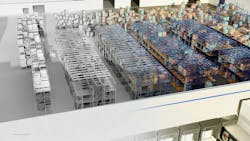
At the Consumer Electronics Show (CES) in January, Siemens and NVIDIA announced a major expansion of their strategic alliance aimed at transforming industries with artificial intelligence integrated deeply into physical and industrial workflows. Combining Siemens expertise and industrial hardware software and AI with Nvidia's leading AI infrastructure, simulation tools, and accelerated computing, the companies seek to build a new industrial AI operating system that redefines design, production, and operations across sectors.
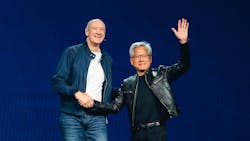
Roland Busch, Siemens CEO, said, “Together, we are building the industrial AI operating system—redefining how the physical world is designed, built, and run—to scale AI and create real- world impact."
Jensen Huang, Nvidia’s founder and CEO, added that the role of generative AI and accelerated computing “have ignited a new industrial revolution, transforming digital twins” into active intelligence that will close the gap between digital innovation and physical execution. He added, “Our partnership with Siemens fuses the world's leading industrial software with NVIDIA's full-stack AI platform to close the gap between ideas and reality — empowering industries to simulate complex systems in software, then seamlessly automate and operate them in the physical world.”
A key aim of this collaboration is creating AI-accelerated industrial solutions spanning the entire product and production lifecycle, according to a joint press release. Beginning in 2026, Siemens Electronics Factory in Erlangen, Germany, will serve as the first AI-driven, adaptive manufacturing site prototype. Powered by an “AI brain” built on software-defined automation, Nvidia Omniverse Simulation libraries, and advanced AI infrastructure, factories will continuously analyze digital twins, simulate improvements, and implement validated operational changes.
Additional efforts include fully GPU-accelerated simulation portfolios from Siemens, support for Nvidia CUDA- X AI physics models, and generative simulation capabilities that facilitate autonomous digital twins for real-time engineering optimization. The companies also plan to inject AI-driven enhancements into electronic design automation workflows to accelerate semiconductor design, verification, and manufacturability, aiming for speedups of two to 10 times.
The expanded partnership promises to accelerate AI- driven industrial innovation across multiple verticals and notably supports customers like Foxconn, HD Hyundai, KION group, and PepsiCo who are already evaluating related capabilities.

To provide deeper insights into the collaborations impact on advanced machine vision and industrial AI workflows, Vision Systems Design reached out to Frank Hagen, head of product and portfolio management for AI and robotics at Siemens Factory Automation Business. His answer shed light on how this partnership will drive adoption, integration, and innovation in AI- powered manufacturing environments.
Editors note: This Q&A may have been edited for clarity and style.
Vision Systems Design (VSD): How will Nvidia's AI infrastructure and Siemens accelerated simulation portfolio support the development and deployment of advanced machine vision algorithms?
Frank Hagen (FH): There is a global trend in which before building and deploying Physical AI in production, customers use simulation and digital twins for the design and optimization of their factories and production lines. While Siemens already offers an extended Simulation portfolio for customers, this portfolio would now be accelerated to take advantage of Generative AI techniques to offer customers faster and precise real-world simulations. Siemens would leverage existing and new advanced machine vision models and take advantage of Nvidia AI Infrastructure (e.g., Nvidia GPUs, IGX, Jetson devices) along with Siemens PLCs for a seamless experience for our customers.
VSD: In what ways will AI-driven digital twins and autonomous models integrate with real-time machine vision analysis on the factory floor?
FH: AI‑driven digital twins and autonomous models will integrate with real‑time machine vision on the factory floor by continuously synchronizing live visual data with Siemens high‑fidelity digital twins, enabling physics‑accurate simulations that reflect shop floor processes in real time. This connection allows AI agents to simulate, test, and refine system changes using machine-vision data and identifying potential issues before physical modifications occur. The Industrial AI Operating System jointly developed by Siemens and NVIDIA provides the AI‑accelerated infrastructure needed to merge simulation, real‑world machine‑vision data, and autonomous decision‑making into a unified, adaptive manufacturing environment.
VSD: Will there be dedicated resources or support to facilitate adoption of these AI-driven solutions by machine vision professionals?
FH: Siemens and NVIDIA will provide substantial dedicated resources to help machine‑vision professionals adopt these AI‑driven solutions, including Siemens commitment to provide industrial AI experts and leading hardware and software to support development and deployment, as well as NVIDIA’s contribution of AI infrastructure, simulation libraries, models, frameworks, and blueprints to accelerate integration across existing workflows. Additionally, Siemens is launching new tools such as industrial copilots and the Digital Twin Composer, which offer guided, AI‑powered assistance that simplifies adoption and enables professionals to incorporate advanced machine‑vision and simulation capabilities into their operations more easily.
VSD: How is the partnership addressing integration and interoperability challenges with existing machine vision systems?
FH: The partnership is addressing integration and interoperability challenges with existing machine‑vision systems by creating a unified, AI‑accelerated ecosystem that connects diverse visual data sources through Siemens software backbone and Nvidia’s scalable AI infrastructure. Siemens Digital Twin Composer unifies real‑time, real‑world engineering data, including vision inputs, into physics‑accurate digital twins, ensuring machine‑vision feeds can be consistently represented in simulation environments. In parallel, the jointly developed Industrial AI Operating System provides a standardized platform that supports AI‑accelerated industrial solutions across the entire lifecycle, reducing compatibility issues between legacy machine‑vision systems and new AI‑driven workflows.
VSD: How will this partnership affect the scalability and energy efficiency of machine vision solutions in next-gen AI-driven factories?
FH: The partnership will enhance both scalability and energy efficiency of machine‑vision solutions by combining Nvidia’s AI infrastructure with Siemens advanced simulation tools to optimize machine‑vision workloads before deployment and reduce real‑world compute demands. Nvidia provides accelerated computing, simulation libraries, and AI models that allow vision algorithms to train and run more efficiently at scale, while Siemens Digital Twin Composer enables physics‑accurate virtual testing that identifies issues prior to physical implementation thereby reducing wasted energy, minimizing trial‑and‑error on live equipment, and streamlining scaling across next-gen AI driven factories.
This partnership will therefore lead the path towards next-gen AI-driven factories, enable the scalability of Physical AI, machine vision, optimize energy efficiency and increase the productivity and flexibility of these factories.
VSD: What role will generative simulation and PhysicsNeMo models play in advancing autonomous machine vision systems within industrial AI workflows?
FH: Generative simulation and physics‑accurate models delivered through Siemens Digital Twin Composer and Nvidia’s Omniverse‑based simulation stack will advance autonomous machine‑vision systems by enabling them to train, test, and optimize perception algorithms in high‑fidelity virtual environments before deployment. These simulations turn digital twins into active intelligence systems that allow AI agents to explore variations in lighting, motion, equipment behavior, and failure scenarios, identifying issues prior to physical changes and significantly improving robustness and autonomy of machine‑vision workflows.
About the Author
 Sharon Spielman
Sharon Spielman
Head of Content
Sharon Spielman joined Vision Systems Design in January 2026. She has more than three decades of experience as a writer and editor for a range of B2B brands, most recently as technical editor for VSD's sister brand Machine Design, covering industrial automation, mechanical design and manufacturing, medical device design, aerospace and defense, CAD/CAM, additive manufacturing, and more.