Cognex’s Brian Benoit Answers Our Questions about the In-Sight 6900 Vision Controller
Key Highlights
- Supports interchangeable cameras, lenses, and lighting for tailored inspection setups, with automatic discovery and intuitive configuration tools.
- Powered by NVIDIA Jetson, it delivers up to 157 TOPS and real-time inference, ensuring high-speed, deterministic AI processing directly at the inspection point.
- Utilizes transformer-based models that require as few as 10-20 training images, enabling rapid deployment of new inspection tasks.
- Integrates with the OneVision platform for centralized model management, facilitating collaboration and deployment across multiple manufacturing sites.
- Offers SDKs and APIs for custom application development, allowing integration into existing factory workflows and operator interfaces.

Cognex Corporation (Natick, MA), a provider of industrial machine vision solutions, has released the In-Sight 6900 vision controller. The modular device is designed to allow configuration of cameras, lenses, and lighting specific to inspection requirements, rather than relying on fixed system setups.
The In-Sight 6900 is powered by NVIDIA Jetson technology, enabling AI processing at the edge. This allows industrial inspection applications to run locally on the controller without the need for external PCs or distributed computing architectures.
Matt Moschner, president and CEO of Cognex, said in a press release: “As manufacturers accelerate their adoption of AI, they want solutions that are both powerful and easy to deploy.”
Technical Features and Capabilities
The In-Sight 6900 vision controller incorporates AI tool modes designed to address inspection challenges such as variable part sizes, a wide range of defect types, and varying production line conditions.
Key capabilities include:
- Modular Vision Architecture: Supports interchangeable cameras, lenses, and industrial lighting. It integrates with Cognex’s lenses, optics, cameras, and accessories (LOCA) product portfolio to enable customized system configurations.
- Few Sample Classification: Uses transformer-based classification models that require as few as 10–20 training images, reducing the time needed for data collection and training.
- Pixel-Level Segmentation: Provides segmentation of critical features to support analysis on textured or challenging surfaces with consistent results.
The controller is also compatible with Cognex’s OneVision collaborative AI platform. This platform enables engineering teams to develop, test, and deploy inspection applications from one common environment, facilitating consistent deployment across multiple production lines and sites.
NVIDIA Jetson-Powered AI Processing at the Edge
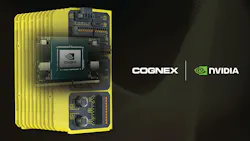
The In-Sight Vision Controller integrates a NVIDIA Jetson module to provide AI processing performance suitable for demanding industrial inspection tasks.
Performance specifications include:
- Up to 157 TOPS (Tera Operations Per Second): Supports running multiple AI models in parallel for complex inspection workflows.
- Real-Time Inference: Integration with NVIDIA TensorRT enables synchronized AI decision-making within the timing requirements of high-speed production lines.
Vision Systems Design had some questions, so we reached out to Brian Benoit, director of advanced vision products at Cognex, for some answers.
Editor’s note: The following Q&A may have been edited for style and/or clarity.
Vision Systems Design (VSD): Can you explain how the modular vision architecture works in practice—specifically, how engineers configure interchangeable cameras, lenses, and lighting to meet diverse inspection requirements without compromising system performance?
Brian Benoit (BB): Image formation is a critical first step in any vision application, and the In Sight 6900 is designed to give engineers maximum flexibility in how that image is created. By offering interchangeable cameras, lenses, resolutions, and lighting options, the system can be tailored to virtually any inspection challenge and accommodate wide variability in parts, surfaces, and production conditions.
What makes this modular approach practical is that it operates as a unified embedded ecosystem. The In-Sight 6900 automatically discovers connected cameras and lighting, and all configuration options are presented through an intuitive interface—without requiring scripts, custom code, or deep vision expertise. Engineers get PC-level flexibility in designing image formation techniques but in a plug-and-play embedded workflow that significantly lowers the barrier to deployment while keeping the entire imaging pipeline deterministic and industrial grade.
VSD: How does the real-time synchronization of AI inference with microsecond-level timing work on high-speed production lines, and what challenges did you overcome to achieve this performance?
BB: The In Sight 6900 is designed to keep inspection as close to the production line as possible, with image capture, triggering, AI inference, and decision making all happening locally on the controller itself. Because the controller sits directly at the point of inspection, there is no network or cloud latency introduced into the loop. Triggering and processing occur in real time, allowing AI inference to stay synchronized with high-speed production lines.
This localized execution is especially important for advanced AI models, which must run deterministically to maintain line timing. With the In-Sight 6900, Advanced AI inference runs directly on the device, ensuring consistent, repeatable performance even in fast moving or dynamic environments. By eliminating external PCs and network dependencies, Cognex enables customers to deploy powerful AI vision systems that remain tightly synchronized with line timing without sacrificing real time responsiveness or industrial reliability.
VSD: How do the transformer-based few-sample classification models reduce training data needs, and what impact does this have on speeding up deployment of new inspection applications?
BB: The transformer based few sample classification models supported by the In-Sight 6900 dramatically reduce the amount of data required to deploy effective AI inspections. Instead of spending hours collecting large image datasets, searching for every possible variation, and carefully labeling images, customers can achieve high accuracy using just a small number of representative samples per class.
With Few Sample Mode, training and validation happen in minutes rather than hours, significantly shortening the time from setup to production. This is especially valuable for applications involving rare defects, feasibility studies, or frequently changing parts, where large datasets may not be available. By minimizing data collection, labeling, and retraining effort, these models allow operators and engineers to bring new inspections online much faster while maintaining precise, explainable results through tools like visual heatmaps.
Engineers get PC-level flexibility in designing image formation techniques but in a plug-and-play embedded workflow that significantly lowers the barrier to deployment while keeping the entire imaging pipeline deterministic and industrial grade.
VSD: Could you describe how the In-Sight Vision Controller integrates with the OneVision AI platform to enable engineering teams to develop, refine, and scale vision applications across multiple locations?
BB: The In Sight 6900 integrates seamlessly with OneVision through the standard In-Sight vision system interface, giving engineering teams a consistent development and deployment experience. By hosting OneVision in the cloud, customers gain a central environment where AI models can be developed, validated, and managed independently of where inspections ultimately run at the edge.
The key value is centralized model management. Teams can collaborate on labeling and validation from different locations, with models stored, versioned, and archived in one place. Once validated, those models can be deployed to In Sight systems across multiple lines, plants, or regions by any authorized user. This approach allows customers to scale applications globally without fragmenting workflows, while maintaining control, traceability, and consistency across sites.
VSD: What development tools, SDKs, or APIs are available for engineering teams to customize or extend the vision applications running on this platform, and how do you support them during system integration?
BB: The In-Sight 6900 supports customization through SDKs and APIs available within the In Sight Vision Suite, allowing engineering teams to build and extend vision applications beyond the standard out of the box interface. Many customers use the integrated HMI provided by Cognex, which is sufficient for a wide range of applications and enables rapid deployment.
For more specialized needs, the SDKs enable teams to build custom HMIs and workflows tailored to specific factory environments or operator requirements. This allows vision results, controls, and adjustments to be presented in a way that fits seamlessly into existing production processes. By offering both ready to use interfaces and deeper development access within the same platform, the In-Sight 6900 supports a wide range of integration scenarios while preserving the reliability and simplicity of an embedded vision system.
About the Author
 Sharon Spielman
Sharon Spielman
Head of Content
Sharon Spielman joined Vision Systems Design in January 2026. She has more than three decades of experience as a writer and editor for a range of B2B brands, most recently as technical editor for VSD's sister brand Machine Design, covering industrial automation, mechanical design and manufacturing, medical device design, aerospace and defense, CAD/CAM, additive manufacturing, and more.