Three Days, Three Keynotes: Trends and Insights from Automate 2026 in Chicago, June 22-25
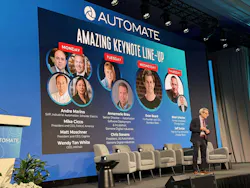
Automate 2026 brought together a range of industry participants across robotics, AI, digital enterprise, and workforce transformation. While the event covered broad automation trends, many of its core messages directly impact engineers and managers responsible for the design, development, manufacturing, and integration of machine vision and image processing subsystems.
Over the first three days of the conference, three keynotes provided complementary perspectives on the current state and near future of automation. Together, they offer a clear lens on how AI and software-defined automation are shaping new operational and strategic demands on manufacturing. Notably, they highlight how machine vision systems—central to robotics and automation—are evolving within this changing landscape. Let’s take a look at each.
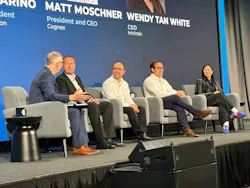
The State of the Automation Industry: Leadership Roundtable
The conference began Monday with a panel moderated by Robert Huschka, vice president of education strategies at A3 and featuring Mike Cicco, president and CEO, FANUC America; André Marino, senior vice president industrial automation North America, Schneider Electric; Matt Moschner, president & CEO, Cognex; and Wendy Tan White, CEO, Intrinsic.
During the keynote, each panelist outlined key industry shifts driven by AI, robotics, and evolving software platforms.
Main points for machine vision and integration roles include:
- Automation is moving from complex, brittle, and highly specialized systems to more adaptable, AI-driven solutions where vision tools can be trained and improved incrementally post-deployment.
- There is increased adoption by smaller and medium-sized manufacturers, facilitated by reduced software complexity and cost, broadening the market beyond traditional automotive and electronics sectors.
- A fundamental transition toward software-defined automation is underway, decoupling hardware from software and enabling more flexible, interoperable systems that can orchestrate entire factories rather than isolated machines.
- Human-centered design and inclusivity are important considerations for workforce enablement, trust-building, and expanding adoption of AI-enabled vision and robotics systems.
- The diversity of emerging robotic forms, from multi-armed cells to humanoid-inspired systems, will continue to evolve according to task-specific requirements rather than following strict human form factors.
For VSD’s engineers and engineering managers, these trends indicate the importance of developing vision systems that support modular architectures, incremental AI updates, and open integration.
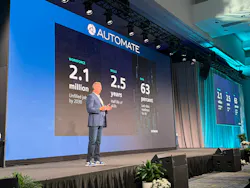
The Automation Impact: AI, Automation, and the Human Element
On Tuesday, Annemarie Breu, senior director, automation software deployment and incubation, and Chris Stevens, president of U.S. automation at Siemens Digital Industries, presented on the role of the digital enterprise as the foundation for scaling AI-driven manufacturing.
There were several highlights that machine vision professionals might find valuable, including:
- Digital twins provide detailed virtual representations of production lines, enabling the simulation and validation of vision workflows and plant layouts before physical execution.
- AI orchestration frameworks allow multiple AI models—including vision algorithms—to propose actions, which are validated through simulations, policies, and operator input before being applied, ensuring reliability and safety.
- Combining AI flexibility with deterministic control systems and fail-safe design is critical for confidence and trust as automation scales.
- Workforce considerations—especially training, cultural adaptation, and psychological safety—are key enablers of technology adoption and long-term success.
- New engineering approaches that facilitate simultaneous development and real-time user feedback significantly shorten deployment timelines for AI-augmented automation systems.
Vision teams benefit from collaborating closely with controls engineers and operations, aligning AI model development with deterministic validation and human-in-the-loop workflows.
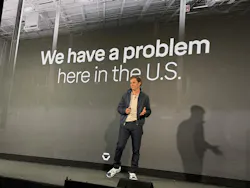
Show Your Robot How It's Done: How Physical AI Automates What Nothing Else Can
On Wednesday, Evan Beard, co-founder and CEO of Standard Bots, addressed the competitiveness challenges in U.S. manufacturing and presented AI-native robots as a practical solution to workforce shortages and automation adoption barriers.
After watching a live demo of the technology, machine vision experts can benefit from these takeaways.
- AI-native robots leverage learning-based approaches to handle task variability and reduce programming complexity, enabling broader deployment beyond large manufacturers.
- Vision tools demonstrated allow rapid object recognition model creation through “click-to-train” and end-to-end task training via demonstrations, making vision system retraining faster and more intuitive.
- Integration of diverse datasets, including large-scale video, enhances vision model generalization and robustness against real-world variability.
- Edge computing for vision algorithms ensures low-latency operation, reliability, and independence from continuous internet access.
- Standard Bots emphasize domestic manufacturing, extended product support, and responsive customer service as part of making robotics scalable and dependable.
This keynote highlighted a practical shift toward vision systems designed for usability and continuous learning, with a clear focus on supporting wide manufacturing adoption in real environments.
Leadership, Trust, and Real-World Impact in Machine Vision Automation
The future of machine vision and robotics is not just about new technology—it is about leadership, authenticity, and real impact within manufacturing organizations and their workforce.
Moschner from Cognex said, “Systems are simpler and easier to use, meaning they can be put in more places...much more robust and adaptable, and they can improve over time.”
Stevens of Siemens noted the importance of trust in automation. “Combining AI’s flexibility with fail-safe industrial control creates the foundation for scaling with confidence,” he said. His reflections went beyond technology to workforce culture, too. “Creating a psychologically safe environment and amplifying skills are key to turning fear into excitement and accelerating adoption.”
From Standard Bots, Beard’s message underscored the democratization and human focus of AI-native robotics: “Robots are the power tools of the 21st century...designed so that the average worker can pick them up and use them.” He added a tangible measure of commitment by extending warranties from one to three years and prioritizing responsive support to build long-lasting customer confidence.
As Fanuc’s Mike Cicco put it, the automation industry is on the brink of an “explosion of growth,” driven by AI lowering entry barriers and broadening application reach—but only if engineers and leaders deliver solutions that work reliably in the real world and are embraced by the people who use them.
About the Author
 Sharon Spielman
Sharon Spielman
Head of Content
Sharon Spielman joined Vision Systems Design in January 2026. She has more than three decades of experience as a writer and editor for a range of B2B brands, most recently as technical editor for VSD's sister brand Machine Design, covering industrial automation, mechanical design and manufacturing, medical device design, aerospace and defense, CAD/CAM, additive manufacturing, and more.