Simplifying Machine Vision: Exaktera's Integrated Approach
Key Highlights
- Exaktera combines multiple specialist brands to simplify machine vision system development.
- The company offers configurable platforms and rapid prototyping to accelerate deployment.
- Deep technical expertise and hands-on support are core to Exaktera's strategy.
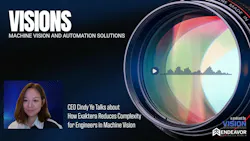



In this episode of Visions: A Machine Vision and Automation Solutions Podcast, Sharon Spielman chats with Cindy Ye, CEO of Exaktera, about how the company reduces complexity for engineers by combining multiple specialist brands, deep technical expertise, and hands‑on support.
Ye explains Exaktera's outcome‑focused approach—providing configurable platforms, rapid prototyping, on‑site commissioning, and long‑term troubleshooting—to help OEMs and integrators deliver reliable machine vision systems.
Related: Visions Podcast: Machine Vision Markets Update
Visions: A Machine Vision and Automation Solutions Podcast, is the podcast for engineers, designers, integrators, and end users who want to keep an informed eye on the imaging and machine vision industry. Every Tuesday we will explore the latest in imaging trends, developments and solutions. Here you will find interesting, useful insights and observations from expert interviews, solo episodes, even the occasional panel discussion, all of which aim to expand your knowledge on imaging and machine vision.
Transcript
Well, hello and welcome to visions, a machine vision and Automation Solutions podcast. I'm your host, Jim Tatum, senior editor of Vision Systems design and visions is an endeavor business media production from your friends at Vision Systems Design. Here you'll find the latest on everything from end user machine vision solutions to trends, developments, and perspectives on all things machine vision and imaging. Whether you've been working in the industry for a while or you're just starting to take a closer look at it, this podcast is designed to grow your knowledge and bring greater focus to your understanding of the imaging and machine vision industry. And now on to our show.
Well, hey everyone, and welcome to visions. You know, if you're in machine vision, especially as an engineer or an integrator, then you know all about how machine vision systems are built on a wide range of technologies, from cameras and image processing software to lighting, optics and AI. Consequently, you also know that sometimes getting all those pieces to align properly can be pretty challenging. Fortunately, there are solutions. For example, recently Vision Systems Designs head of Content Sharon Spielman got to spend a few minutes with Cindy Ye, CEO of Exaktera, who talked about her company's approach to meeting some of those challenges. Exaktera brings together multiple specialist brands under one roof, which helps customers navigate complexity, accelerate development and build better machine vision systems.
Thank you for joining us today, Cindy.
Hi.
Nice to have you. So first of all, can you share the vision behind Exaktera and how the company differentiates itself in this competitive landscape of machine vision and image processing technologies?
Absolutely. Well, Exaktera exists to reduce complexity for engineers and the engineering teams of our customers. In addition to producing, uh, platforms that offer spec sheets options, which many of our competitors do, we here combine the flexible, configurable, uh, platforms that we have with deep cross technology expertise. For us, it's not just a portfolio of products with specs for us, we offer the help and a steady pair of hands behind it, the technology, the deep technology expertise to help our customers to find the right solution for the real world problems. Um, we collaborate really from the very beginning, early concept to deployment of all of our products and to production every step of the way. And from, from our perspective, what really differentiates us is I personally think we are here. Not as just someone who sells you a product. We are here as a trusted advisor. And then I do think there are two aspects that can qualify a trusted advisor, and that is that, you know, we have the breadth of knowledge and we're neutral towards any particular solution. Many of our competitors only offer one or the other technology solution. They're either LEDs or they're lasers. But from us we are neutral. So we have our customer in mind the customer's best outcome in mind. We're neutral in terms of what we offer. Um, so from that perspective, I do think that we are very differentiated and we look for a great way of serving our customers in this way in this particular market.
Okay. Well, why don't you talk a little bit about the specialized brands under your umbrella that do enhance the value that you deliver to the engineering teams.
Yeah. So from our perspective, we have quite a few different specialized brands and our specialized brands goes for a very configurable standard product platform like our advanced illumination that their core strengths is speed to market. They're able to get you the flexible products that you need for the spec that you need very quickly with two day turnaround to a very specialized, uh, ProPhotonix where they focus on special chip on board capability that offer customized solutions to real world challenges ranging from applications of curing to, uh, food sorting to specialty issues that you face in this particular market. And we offer AutoVimation such as this is the enclosure, the specialty enclosure for the cameras that help our customers in ruggedized environments. We have customers in underwater. They have submersion requirements for their cameras. And this is where we come in. Into a watertight solution. And also we have a customers that requires hygienics because their food and beverage processing require a special IP rating for the enclosures. That's what we come in. And to offer that as a package. But overall, I think, um, the idea isn't the each individual specialty because they stand behind their product portfolio, they stand behind the exceptional quality, but what exact terror come together? Bringing them together stands for the outcome of our customers. Ultimately, the customers are for them. It's not the spec and the product that they care about. It's their own outcome. They need a working, reliable system. That's what they care about. And that's what we are here for, right?
So I understand that Exaktera is placing a stronger emphasis on building its own brand identity alongside the well established individual brands in your portfolio. So can you talk about that and what this means for your overall strategy and how you envision the Exactera name resonating with your customers?
Yeah. This is what I was trying to push for each individual ones who has a long history with their own individual brands, they stand for the exceptional product portfolio that they have developed over decades with their customers. But what we hear is it's not just like what I what you noticed, you know, technology works until it doesn't. Our customers are facing very complex challenges in real life issue when they're on their production lines. Issues can come from all different areas. Connectors not working. You have too much dust in the in the air. You require bacteria levels under certain levels and all different kinds of things that people don't don't even realize. But what Exactera stands for is we bring expertise, um, from all our special brands and then putting them together to look at it from an outcome based, um, perspective. What we care about is these are the problems that challenges that our team have seen repeatedly over and over again over, over different decades. And they see it from different applications, different end markets, different technologies. And so putting them together and combining that as a team, um, to offer that to our customers. I think that what we have is, uh, an understanding of delivering the right solution for the customer's specific real life problems. Then here's a spec sheet. Um, so from, from my perspective, um, what we offer here is the overall support across the technology, across the product portfolios, across the different applications, um, which I think is unique among the market.
So what would you say is the biggest pain point that engineering teams face when designing and integrating machine vision systems?
I think their biggest pain point ultimately is their reputation. Our customers, their reputation depends on a reliable working system. Right? And they have tremendous amount of pressure to recommend or implement a solution that needs to work reliably. But on the other hand, when they're in real life production environment, things are complex. You have problems all over the place. And frankly, when everybody else is in their vacation or in, let's say that you, you we just have Memorial Day, right? This is the time that people commission a new systems. And when people are expecting those production lines to run smoothly and when it doesn't, you get a frantic call. Our customers get frantic calls from the production line, people saying, hey, what's going on here? And they're under a tremendous amount of pressure to deliver that, to offer something, to offer a solution, to recommend something or implementing something that really needs to reliably work. Um, and that pressure can be immense. Uh, from my perspective, this is why I think that we are here as a pair of steady hands that helps them.
Can you go more into detail about how you support the OEMs and the system integrators to reduce that complexity and accelerating that time to market for their products.
Absolutely. So I actually think ultimately it roots from true understanding of customer needs. Um, and from my perspective is we have a few situations that where it comes in. So we have customers who already know exactly what they need and what they need is the speed to the market is something that fits their spec and stand behind their quality. And that's what we can offer from a standard perspective. We also have customers who needs some tweaks, some configurations, and what what we are very good at is to quickly navigate what the customer will require, given the environment that they're facing, given where the products that they're going to be installed, given the maintenance access that will require or even abilities of the operators that are running these systems, giving all these Situations and variables combined will be able to quickly navigate through a sea of options down to exactly what they are going to be needing. And after that, what we also have is that we have integrated team that isn't just a sales team. We have the technology team, the technology application team that comes in, um, testing out the solution that are recommended. Um, in a real life situation, you know, physical, uh, application lab in a real life situation. And then we have our team that work with these customers hand in hand, saying from concept all the way to deployment to production to making sure that they can confidently stand behind their solutions. And from my perspective, it's from product perspective, we have different product portfolios from standard configurable to highly customized that fits every situation that they will be meeting. And then more importantly, from our team's expertise, they with the understanding of what they need, we will be able to work with them in every situation to get to what they can reliably stand behind.
Okay, so I'm going to move on to, um, maybe looking into your crystal ball here. So what key industry trends do you see shaping the future of machine vision and image processing over? Let's give it five years over the next five years.
Absolutely. Well, um, everyone talks about AI and how it actually will revolutionize, uh, different industries. And I definitely see that in our industry as well. Um, people are going to use AI to help them implement and speed up their implementation and scalability of their machine vision system. But what AI is very good at is AI, as you probably have used it yourself, they're very good at to get you eighty five percent of the way there. And what I think will differentiate a good player within the market is how they treat the remaining ten, fifteen percent of the situation. And what AI would do is that they get you there with two of the options that you have to work with. Well, we won't get you is they won't sit with you when you're at five a m in the morning and trying to figuring out what is not working. Right. And then I think, and that's the edge case. That's the ten, fifteen percent of the cases that, uh, or in certain situations, maybe even one percent of the cases that, uh, what you would really require is not only someone who with breadth of knowledge, but someone who can actually think outside of what the norm is, what, what outside of the box, and to give you the best fit to give you the right solution for that practical situation. Um, and that is what I see it as a differentiator, uh, going to be the differentiator in the market. I think. Yes, people will say whoever use AI the fastest and the earliest will get ahead. And I absolutely agree with that. But I also think that people will quickly catch up on how to use it. But it is toward the end, um, five, ten percent who can conquer that is going to be the winner of the market. And then, um, another trend which we find is people are going to, particularly in our, in our industry, we start to see, uh, integrated technology requirements for the same application. Um, we have plenty of situations where it used to be, okay, we have sizing that we have to do. Then we use either LED or we use either laser or there's one specific, um, technology that we apply to a particular problem. But what we find is instead of doing that, the industry, ah, or the end users, the OEMs are starting to see value of bringing different technology into the same application so they can get to their outcome much faster than, than what it is, for example, that we have situations where, um, both lasers and, and LEDs are using the exact same application, one measuring the depth of volume and one measuring the sizing and, uh, irregularities in the situation. Um, and within the same application, you get to the outcome because end users and customers. I think there will be less, there will be more expectations that they can solve more problems with one tool, instead of instead of having to buy this one and that one, and a whole bunch of different ones to solve all the problems, they want to see an integrated solution. And then we see that on our side as well. Um, if they want the end customers are looking for integrated solutions for the machine vision market. And the machine vision market itself is looking for integrated solution on the technology front.
Can we talk a little bit about that? Um, so when you're collaborating with your customers during the product design and the development stages, do you enlist people outside of Exaktera?
We don't need to. Uh, well, we for, for one, I have to say, we work collaboratively with our customers. Um, right. And we work also collaboratively with our partners, our distribution partners, our integrator partners. I think from a way that we collaborate is we pinpoint the problem to be solved, and then we offer different technology options with clear pros and cons from the customer perspective, not from our perspective, but from the customer perspective. And this is where we potentially have the partners coming in because from their perspective, they have different set of pros and cons, and we work together to face the end customer as a whole. And then once they pick the most practical and the best fit solutions, we have team here to help them to do real life environment troubleshooting. And in that case, this, I think it's where we're really makes us different is, is not only that we have application labs within and we actually do have technology team that, that, that are willing to travel to customer sites to get the reliable working system commissioned and going. And we after. But that's not done. Ultimately, as I said, um, you know, things technology work until it doesn't. So we also have long term support that stand behind the quality of our products and go ahead. And in that case, I don't see us as one stop shop in that in that sense, I see us as a good collaborative partners to integrators, distributors and customers on engineering team.
Can you think of an example? And you don't have to, you don't have to give a company name. You can, you know, you keep it, keep it proprietary, keep it secret. That's fine. Um, but can you give an example of, you know, where somebody had a problem and you were able to really come through for them? Can you think of an example or two of that?
Oh yeah. absolutely. I can think about one interesting examples is we have a customer that had issues. They have a trade show that they have to push through. And then, um, they're under a little bit of a tight schedule for what they needed to come up with the demos. And what we are willing to do is not only helping them in terms of shoring up the supply challenges that they have to go through and then build the demo for them, but also at the same time, uh, we have our own internal team flying over to make sure that nothing gets blocked at custom. So the amount of, uh, hoops that we're willing to do for our customers in that. And then the other one, I can see this as. A good example as well. We have a situation where we were faced with, uh, Um, a newly discovered, uh, non-conformance issue. Um, but. We are heading into not with our, this is through the distribution partners, but, uh, we don't push the, uh, responsibility to the distribution partners. We work with our partners to figuring out exactly, um, what the issue is and what caused the issue and what, and in turn, we fly to the end customers to work through really installing the situation, installing the product and looking through at each step of the installation to find out what actually caused the non-working system at the end. And that's where I see, um, the expertise start to really shine through. And I think even after, after these kind of situations where we have, It's not just typical sales. I would say that our salespeople are. Probably the most experienced salespeople in the industry. But in addition to those experienced salesmen, we also have a technology team that comes in. These are engineers to start, but who understand the problem not only from a product perspective, but also from, hey, I know this particular technology in real life would be subjected to variabilities in environments such as you have the heat issue, you have the dust issue, you have connectors issue, you have cables issue, you have, um, you have different wrappings around the inspection objective that you're looking for. And all of these kind of real life issue is what we are here to answer.
And you have a such a wide range of those technologies and those brands under your umbrella. Um, so you're able to give it maybe like you were saying, not a one stop shop, but a good portion of it, right?
Uh, yeah, it's like this when you go to a photo shoot, right? Let's say, say from your perspective, you hire your cameraman to say, hey, I want to look great in my photo shoot, but we are the best partners to those cameramen. And the cameraman knows they're not going to be able to get a great photo shoot unless they have a good lighting. They have a great makeup artist, they have the whole team supporting it. And what we are here is the first port of call to the cameraman. We come in there with the lighting, with the makeup artist. But you see what I was what I was cables. Yeah. Yes. The other aspects of what makes a great system. And we know how the lighting works with different cameras. We know how the enclosures is required in different situations, and we know how the system will operate collectively. And we stand behind because the different specialty that we have in terms of the different applications that we use to see, we see, we're able to recommend, um, a solution to our partners and to the end customers. And I think this is where I see our, uh, our differentials, but from my perspective, um, we're neutral, uh, from what, because some camera, uh, machine vision system will have both providers will have a strong preference one way or the other, but it's not necessarily from a customer's perspective. What brings the best outcome? From our perspective, we focus on the customer outcome and by doing, by bringing them, um, technology neutral set of options, we're able to deliver the best outcome.
Well, that's a wrap for this episode of visions produced by Endeavor Business Media, a division of endeavor B2B. Thanks very much for tuning in. If you enjoyed today's show, be sure to subscribe to the podcast and share this episode with a colleague who would find it helpful. Until our next episode, you can find us at vision dash systems dot com or on LinkedIn, Facebook, or for more insights, updates, and breaking news to keep you in the know. Thanks for tuning in. Until next time, stay focused on your visions.
About the Author
 Jim Tatum
Jim Tatum
Senior Editor
VSD Senior Editor Jim Tatum has more than 25 years experience in print and digital journalism, covering business/industry/economic development issues, regional and local government/regulatory issues, and more. In 2019, he transitioned from newspapers to business media full time, joining VSD in 2023.
 Sharon Spielman
Sharon Spielman
Head of Content
Sharon Spielman joined Vision Systems Design in January 2026. She has more than three decades of experience as a writer and editor for a range of B2B brands, most recently as technical editor for VSD's sister brand Machine Design, covering industrial automation, mechanical design and manufacturing, medical device design, aerospace and defense, CAD/CAM, additive manufacturing, and more.