Designing the Blur Budget: Continuous-motion as an Imaging System Lever
Blur is a budget—and it may be okay to go over. Conventional scanning microscopy invests in mechanical finesse to prevent image defects, with motion blur among the most undesirable. Consider the familiar “stop-and-stare” approach: the specimen moves, the stage stops, vibration settles, the camera exposes—snap—and the sequence begins again. This style is commonplace and dependable, but it places inordinate weight on mechanical precision.
Computational imaging permits a bolder strategy: treat motion blur as a controlled input to the system rather than an accidental defect discovered at the end. This is not an invitation to arbitrary blur, but a special guest pass for selected, measurable elongation. It is a deliberate stretch, a calculated daub—a technical “sprezzatura”—and a systems-engineering choice in which optics, motion, illumination, sensor timing, reconstruction, and validation are designed together around a simple AI-inspired premise.
The key is to define a blur budget before choosing the model. For a specimen translating at velocity v during an exposure time t, the first-order smear length is approximately b = v × t. At 5,000 µm/s and 7.8 ms, for example, the specimen traverses about 39 µm during a single exposure. Whether that smudge length is recoverable depends on much more than distance alone: objective magnification and numerical aperture, effective sampling at the specimen, illumination stability, signal-to-noise ratio, motion direction, spatial content, and the task the resulting image must support.
Start with the Information that Must Survive
An imaging pipeline should first define the measurement or decision it must above all preserve. A network trained to make membrane patterns visually plausible does not automatically retain the quantitative evidence needed for a biological score. Conversely, a model that performs adequately for one bounded classification task may not produce an image suitable for an unrelated task.
This distinction separates two questions that are often blended:
- Did the reconstruction restore an image that agrees with a sharp reference under standard metrics?
- Did the end-to-end system preserve the information required for the ultimate downstream task?
The answers may differ, although a successful system should ideally satisfy both. Restoration fidelity can be tested with paired sharp controls, spatial-frequency analysis, structural measures, and expert review. Task performance requires its own patient-level or specimen-level testing, repeat scans, confidence limits, indeterminate handling, and explicit separation between training and evaluation data. A careful demonstration should show both where the method works and where it begins to falter.
Design the Acquisition and Reconstruction Together
A continuous-motion system is a coupled pipeline. Changing one variable moves pressure elsewhere:
Stage velocity. Higher speeds extend the smudge and may change frame overlap, synchronization demands, and the model’s input distribution.
Exposure time. Shorter exposure reduces motion blur but collects fewer photons. Additional illumination may restore signal, but it can introduce heating, photobleaching, nonuniformity, or safety constraints depending on the specimen and modality.
Optics and sampling. Objective NA, magnification, sensor pixel size, and relay optics define which spatial frequencies can reach the camera. Computation cannot recover information that the optical and training chain never similarly recorded in the first place.
Motion profile. Constant velocity is easier to characterize than acceleration, reversal, backlash, or vibration. Training data should be capture at repeatable intervals and represent the actual motion path rather than an idealized kernel.
Focus. A deblurring model is not automatically a defocus model. If focus error is not included and validated, motion recovery may fail even when velocity and exposure are nominal.
Stitching and frame selection. Continuous video creates overlap and redundancy, but it also demands reliable frame-to-position correspondence. Reconstruction quality can be undermined by timing jitter, incorrect cropping, or accumulated stitching error.
The model belongs inside this budget, not after it. Training pairs should come from the same specimen preparation, optical configuration, motion range, exposure range, and preprocessing path that the deployed experiment will encounter.
Synthetic blur can be useful for controlled studies, but it should not be assumed to reproduce stage vibration, rolling-shutter effects, illumination fluctuations, defocus, tissue variation, or sensor noise unless those effects are rigorously modeled and tested.
Use the Physical Variables as Metadata and Gates
A practical system should record the variables that define each acquisition: objective, illumination, exposure, gain, stage speed and direction, focus state, frame timing, preprocessing version, and model version. This metadata supports reproducibility, but it also enables a more important function: refusing to process data outside the validated package of acquisition conditions.
The most useful quality-control layer may therefore be a gate rather than another feature-refinement network. It can ask whether the current frame resembles the distributions represented during validation; whether stage velocity and exposure remain in range; whether focus, saturation, signal, or stitching metrics have crossed a threshold; and whether a repeat acquisition is required. The system should be able to say “indeterminate” rather than generate a confident-looking output from unfamiliar input.
This principle matters because learned restoration can engender plausible detail. Plausibility is not measurement. When spatial frequencies have been strongly attenuated or removed, a neural network uses learned regularities to estimate what may have been present. That estimate becomes scientifically useful only when the relationship between input, reference, failure modes, and intended task has been measured.
What the Published Systems Established
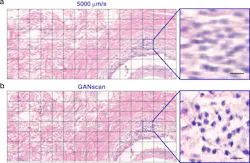
In GANscan—work I led with the late Professor Gabriel Popescu—a conventional microscope recorded video while the specimen moved continuously. A conditional generative adversarial network was trained on registered motion-blurred and sharp images. The published experiments demonstrated restoration at stage speeds up to 5-10 mm/s, reported acquisition throughput thirtyfold times that of the stop-and-stare comparison in the specified experimental setting, and achieved inference below 20 ms per frame.
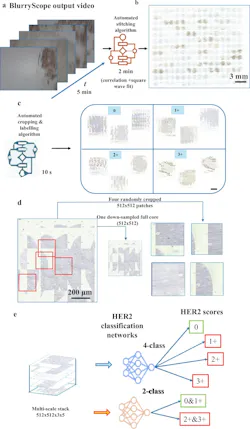
The subsequent BlurryScope work at at UCLA asked whether this acquisition philosophy could be embodied in a compact, task-specific research instrument. The prototype combined continuous brightfield scanning, automated stitching and cropping, and neural analysis of motion-blurred, immunohistochemically stained breast-tissue microarrays.
Translation without Conflation
Research provenance and product claims must remain separate. FanousPhotonics is developing SCANIMUS as a research-use-only product informed by this broader computational-imaging direction. SCANIMUS is not identical to the GANscan or BlurryScope research prototypes, and a feature or performance statement about one should not be silently transferred to another. UCLA and the cited laboratories and publications are the provenance of the research; they are not represented as endorsing FanousPhotonics or SCANIMUS.
The broader lesson for machine vision engineers is not that neural networks can counterbalance every optical or mechanical flaw. It is that a precise amount of imperfection can sometimes be admitted during acquisition when the full pipeline is designed, measured, and bounded around it. The wilder architecture is also, in some ways, the tamer one: define the information that must survive, expose the physical variables, preserve sharp controls, test realistic failure modes, report indeterminate cases, and keep the system inside its validated domain of fixed glitches.
When those conditions are satisfied, continuous-motion imaging can redistribute complexity across mechanics, optics, electronics, and computation. Sometimes the correct result will still be to stop the stage. In other cases, the blur budget may be exactly what makes a faster, smaller, or more accessible imaging architecture possible.
Sources
Source 1 — GANscan paper, Light: Science & Applications
DOI: 10.1038/s41377-022-00952-z
https://www.nature.com/articles/s41377-022-00952-z
Source 2 — BlurryScope paper, npj Digital Medicine
DOI: 10.1038/s41746-025-01882-x
https://www.nature.com/articles/s41746-025-01882-x
Source 3 — “Not Quite a Microscope, Not Quite a Scanner, And Pathologists Love It,” The Pathologist, May 8, 2026
https://thepathologist.com/issues/2026/articles/may/not-quite-a-microscope-not-quite-a-scanner-and-pathologists-love-it/
Disclosures
The author is the founder and CEO of FanousPhotonics, which is developing SCANIMUS as a research-use-only product. The cited BlurryScope publication discloses pending patent applications related to the research. UCLA, the Bio- and Nano-Photonics Laboratory, and the cited publications are not represented as endorsing FanousPhotonics or SCANIMUS.
This article was written with the assistance of artificial intelligence.
About the Author
 Michael John Fanous, Ph.D.
Michael John Fanous, Ph.D.
Michael John Fanous, Ph.D., is the founder and CEO of FanousPhotonics, which is developing SCANIMUS as a research-use-only product. He is the lead author of the peer-reviewed GANscan and BlurryScope papers.