Engineers Report High Satisfaction Amid AI‑Driven Change
Key Highlights
- Most respondents believe that the career outlook remains promising, though slightly less optimistic than in previous years, with many recommending engineering to young people.
- AI and machine learning are seen as both beneficial and challenging, with a majority of respondents noting positive impacts on tools and processes, but concerns about regulation and job security persist.
- Some respondents are actively incorporating AI into their work, using it for research, design, and collaboration, though many are still evaluating its full impact.

The results of the 2025 Vision Systems Design Salary and Career Survey are in, and while the numbers don’t yield any unexpected findings, there are, as always, some caveats to the general opinion that engineering is a fulfilling, lucrative career path with a bright future.
VSD’s editors asked our readers about a number of issues in the latest survey, which included roughly 60 questions touching on topics from job satisfaction to professional challenges and worries. Some 138 people responded, with varying numbers of respondents answering each question.
Of 89 respondents who answered the question “how satisfied are you in your current position,” 34 (38.2%) reported being satisfied, 23 (25.84%) reported being very satisfied, and 22 (24.72%) extremely satisfied, with 9 (10.11%) reporting they were not very satisfied and one (1.12%) reporting they are not at all satisfied.
Sixty of 89 respondents (67.42%) say they believe that a career path in engineering is as promising today as it was five years ago and 79 of 83 respondents (95.18%) say they would recommend engineering as a career path to a young person looking to choose a profession.
“I think engineering will always have a good career path because it is all about creating solutions to problems,” notes one respondent.
Another respondent says that “there is always a demand for smart, adaptable engineers.”
These numbers are down slightly from the previous year’s survey. According to VSD’s 2024 Salary and Career Survey, 88 of 117 respondents (75.12%) said they believe a career path in engineering and the potential for salary advancement was as promising as it had been five years prior, and 100 of 103 respondents (98%) said they would recommend engineering as a career path for a young person.
Advancing Technology Drives Discussions
As technology evolves, so does engineering, most respondents seem to agree. Indeed, new technologies tend to present new opportunities. “The technology always changes,” says one respondent. “It’s exciting to learn new things and build unique solutions.”
So, how will AI affect the future of engineering? As is so often the case with frequently discussed topics, it depends on whom you ask.
“Even with AI coming into play, good engineers cannot be replaced, which causes their market value to rise,” notes one respondent.
VSD’s survey did present questions as to whether AI affects the engineering profession, if so, how, and what a future that includes AI might look like. And opinions of VSD readers appear to run the gamut from excitement and acceptance to ambivalence and outright distrust.
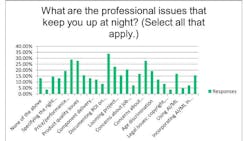
Some 40 out of 83 responding to the question “what are the professional issues that keep you up at night?” indicated AI-related issues worry them, including using AI, losing employees to AI, verifying AI quality, and incorporating the technology into the job or a product or service.
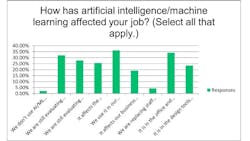
Of 47 respondents who answered questions about AI and engineering, 31 (65.96%) say that AI/machine learning has had a positive effect on their tools and processes, and 22 respondents (46.81%) say AI/machine learning has had a positive effect on their products. Another 18 respondents (38.3%) say that AI/machine learning gives a competitive advantage.
However, 23 respondents (48.94%) say that AI/machine learning needs regulation, with 7 respondents (14.89%) saying it will reduce staffing requirements, and two respondents (4.26%) saying it is causing problems for them.
“AI is slowly invading technical areas, (so that) a lot of jobs will be doable by people who don’t have deep training,” says one respondent, who further observes, “my salary has been pretty flat to down in the last few years.”
Of 47 respondents who answered questions about AI use, 28 (59.57% say they use AI/ML copilot/assistants, 19 (40.43%) use AI/ML for searching and research, and 38.3% say they are incorporating it into applications.
AI is slowly invading technical areas, (so that) a lot of jobs will be doable by people who don’t have deep training.
As far as how AI and machine learning has affected respondents’ jobs, of 47 respondents who answered this question, 17 (36.17%) say they are using it in their products, 16 (34.04%) say it is in their office and collaboration tools, 11 (23%) say it is in their design tools, and 12 (25.53%) say it affects the applications they are designing.
The jury is still out for 28 of the respondents, with 15 (31.91%) reporting that they are still evaluating AI and machine learning for their business and 13 (27.66%) reporting that they are still evaluating it for use in their products.
One respondent (2.1%) said they currently do not use AI/machine learning at all.
Who Took the VSD Salary and Career Survey?
Some 138 VSD readers took the survey, although the number of people responding to individual questions varied. Of the 138 respondents, 95 (68.84%) identified as being employed full time, 8 (5.8%) as part time, 4 (2.9%) as contractors, and 19 (13.77%) as entrepreneurs or self-employed.
Of 76 respondents who provided education levels, 25 (32.89%) had bachelors degrees, 24 (31.58% had masters degrees, and 10 (13.16%) had doctoral degrees. Another 11 (14.47% reported having a bachelors and some graduate studies, while 2 (2.63%) reported associates degrees, 2 (2.63%) said they attended some college, and 2 (2.63%) said they had high school diplomas or less.
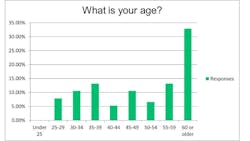
The ages of those 76 respondents ranged from 25 to 60 years old and older. The top three cohorts were as follows: 25 (32.89%) identifying as being 60 years old or older, 10 (13.16%) 55-59, and 10 (13.16%) 35-39 years old.
I think engineering will always have a good career path because it is all about creating solutions to problems.
Of 114 who identified their principal job function, 35 (30.7%) said they are in Design and Developmental Engineering, 19 (16.17%) executives or operating management, and 13 (11.4%) engineering management. Twenty-four respondents identified as “other.” Sixteen (14.04% identified their job titles as president/CEO/owner/executive management, 11 (9.65%) identified as group leader/project team leader, or project manager, and 10 (8.77%) identified as department head or section head. Ninety-eight (87.5%) said they are in the same job as last year.
Of 90 respondents, 16 (17.78%) said they have been working in engineering for 10-14 years, 12 (13.33%) for 40 or more years, and 11 (12.22%) for 30-34 years. Of these 90, 27 (30%) said they have been with their present company for 1-4 years, 22 (24.44%) for 5-9 years, and nine (10%) for 15-19 years.
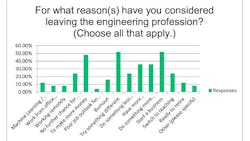
Of 89 respondents, 62 (69.66%) said they’d never consider leaving engineering.
About the Author
 Jim Tatum
Jim Tatum
Senior Editor
VSD Senior Editor Jim Tatum has more than 25 years experience in print and digital journalism, covering business/industry/economic development issues, regional and local government/regulatory issues, and more. In 2019, he transitioned from newspapers to business media full time, joining VSD in 2023.