Key Highlights
- The project aimed to scan the original Liberty Bell and create a virtual twin to enhance research and public access.
- Multiple advanced imaging tools, including LiDAR, high-resolution cameras, and handheld scanners, were used to capture detailed data of the bell.
- Strict time constraints and museum regulations required careful planning and rapid data collection during limited access windows.
- The collected data includes millions of points and thousands of high-res images, processed both onsite and in the cloud for accuracy and detail.
- Future plans involve sharing the data freely with institutions like the Smithsonian and developing immersive virtual reality experiences for broader engagement.
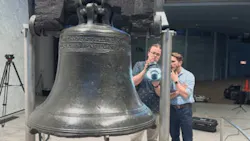
There’s an old joke: how do you clip the toenails of an 800-pound gorilla? Very carefully.
For Christoper Shelton, Remington Orange, and Alexander Fisher, that 800-pound gorilla happened to be one of the most iconic—and priceless—historic artifacts in this country: the Liberty Bell.
Yes, that Liberty Bell, giant crack, and all.
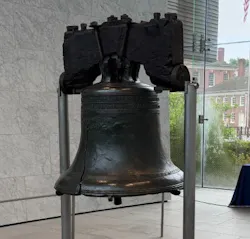
Shelton, an associate professor of psychology at The Pennsylvania State University at Erie, The Behrend College, heads the university’s Virtual and Augmented Reality (VAR) lab, an emerging technologies hub that often undertakes research projects in a variety of fields using a wide array of technologies. The goal of the VAR lab is to make these technologies—and the information they provide—accessible to students, professors, and the public.
“Probably 70% of what we do has nothing to do with my line of work, which makes it really interesting, because it means I get to dabble in everything,” Shelton says.
By way of example, Penn State Behrend’s Applied Research Lab requested a scan of a replica of the Liberty Bell housed at the university. And, as is often the case, one scientific inquiry soon led to another.
“They wanted a scan of the replica that they could then slice down the middle, do a profile of, and look at, and try and determine the thickness at the various points of the bell so that they could use that for acoustic simulations that they were doing,” he explains.
Based on the metal, he did not know how well it was going to work. Shelton's team did the scan of the replica, which in and of itself was successful, but one detail bothered him. The bell they scanned was a replica, therefore, it very likely wouldn’t give an accurate representation of the information the Applied Research Lab wanted, because it was not known if that replica had the exact dimensions and characteristics of the original. In other words, the sound of the replica bell would not accurately replicate the sound of the original if the materials and methodology were significantly different from the original, Shelton says.
“It got me thinking, what's out there for the actual bell? And I'll be honest; I was a bit surprised to find that there wasn't a whole lot,” he says.
In fact, while Shelton says he is aware of one scan performed more than a decade ago, there is no publicly available data set of any kind for the original Liberty Bell. Shelton wanted to change that, so he decided to take on an ambitious project: Scan the original Liberty Bell, develop a virtual twin of it, and make the data available free to the public.
“We reached out to the National Park Service to gauge their interest,” Shelton says. “And, at first, they thought they had a model that worked. Turns out they didn't."
From "Hurry Up and Wait" to "Hurry Up"
Shelton said the VAR Lab could do the scan; however, it took some time for NPS to approve it. And when they did, there were strict caveats, starting with the time frame of the project.
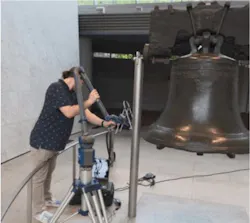
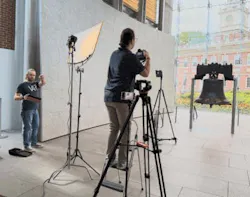
“We had six days from the day we agreed on a date that they could have staff there,” Shelton says. Furthermore, he says, his team, which, in addition to Shelton included project manager/creative lead Alexander Fisher and technical lead Remington Orange, could only work for a couple of hours before and after regular operating hours, and park personnel had to be on site with the team—never more than six feet away—the entire time.
"Technically, we approached the project with a strong emphasis on accuracy, coverage, and respect for the artifact," Orange notes. "The Liberty Bell’s shape, supporting structure, reflective surface, and restricted access created challenges, particularly when capturing areas underneath and around the metal supports. We had to work carefully without touching the bell or interfering with its surroundings. Our mindset was that obtaining a usable scan was important, but protecting the artifact and respecting the National Park Service’s requirements were always the priority."
The Liberty Bell is housed inside an active public museum, the Liberty Bell Center, which is located inside an active public park, Independence National Historic Park, and it is monitored constantly by NPS personnel. The bell has an internal bracing network inside of it, which supports it without causing pressure points, but also makes it difficult to position cameras inside it. In addition, there is a prescribed distance one must keep from it. And of course, no one is allowed to touch the bell, Shelton says.
The team decided that, given the limited windows of time, the best strategy was to “hit it with everything we had.”
Lab Partners’ Imaging Hardware and Technologies
The team used a wide array of imaging technologies and techniques, thanks to assistance from some of the VAR Lab’s partner technology companies, Shelton says. Hardware used included:
• Matterport Pro 3 3D LiDAR Scanning Camera—used to build digital twins and reality capture.
• Insta Pro 2 360° VR camera—used for immersive 360° virtual reality capture.
• Insta360 X5 360° VR camera—used for immersive 360° photo and video capture.
• Kandao QooCam 3 with VR180 Mod—The Kandao QooCam3 is a 360°action camera designed for immersive photo and video capture. The VR180 Mod transforms the camera into a VR180° stereoscopic camera that records 180° FOV with separate left and right eye imaging.
• FARO Quantum Arm—a robotic arm equipped with encoders in each joint, used for precision metrology and dimensional inspection applications. This is capable of detailed imaging of an area as small as 10-25 microns. By comparison, a single human hair is about 70 microns thick.
• Canon EOS R5 45 MPixel CMOS camera—used for high-resolution photography and video capture.
• Artec Eva Scanner—handheld device used for scanning larger objects, such as tools, or in this case, the bell itself.
• Artec Space Spider Scanner—handheld device used for scanning smaller objects, such as pottery shards. In this case, used to capture detailed scans of small features of the bell, such as tiny hairline fractures and flaws within the metal.
• Lenovo Legion 9i laptop computer with NVIDIA 5080
Scan after Scan Yielded Diverse, Dense Data
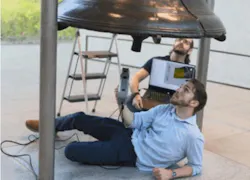
Since the team was pressed for time and had relatively little space to set up equipment, they performed scans with the various hardware items one after the other, Shelton says.
“We were trying to essentially get it with as many scans and as many different types (of technologies and methods) as we could,” Shelton says. “So we were capturing it for photogrammetry with the Canon (high resolution CMOS camera). We were trying to capture a virtual reality walkthrough of the center, that has depth in it, with the Pro two. And then the X5 would give us the 360-degree imaging.”
“They all offered a little something different. And we went in and just tried to capture as much as we could.”
The team used the Lenovo Legion 9i to analyze the data onsite, which enabled the team to gather much more image data than they would have been able to if they had to process it all remotely, Shelton says.
“For a laptop, this thing is a beast,” Shelton says. “It had the 5080 (NVIDIA GeForce RTX graphics card) series in it, so it had the capabilities to capture as much as we could throw at it. So it allowed us to get a quick look at almost all of our data that needed to be run and processed on local hardware. Some of the data was processed on cloud hardware like the Matterport, but outside of that, everything was local, which meant we needed something as fast as possible.”
The team captured scans that were made up of millions, sometimes tens of millions, of data points, and thousands of high resolution 30 MPixel images. While they are still doing post processing work on some of the data, much of what they captured was processed on-site, he says.
What’s Next for the Liberty Bell Project?
The overarching goal of this project, says Shelton, is to make the data they have gathered available to the public.
"We were not the first group to scan or study the Liberty Bell in 3D," Orange notes. "What made this project significant was that, to my knowledge, it resulted in the first detailed 3D model of the Liberty Bell to be made publicly available. Making the model accessible was an important part of the project because it allows educators, researchers, historians, and members of the public to examine the bell in a way that would otherwise not be possible."
The team is working with Open Heritage 3D and potentially the Smithsonian Institute 3D Shelton says. “There are talks about them looking into potentially sectioning the data sets to ensure that in perpetuity, these data sets remain free and widely available to as many folks as possible. That way, any expert from any field that wants it, not just for folks at Behrend or at Penn State, but anyone, can access the raw data and do their own analyses,” Shelton says.
For example, a metallurgist might want to look at how the lettering is flaking off in certain areas.
“All of that information is there at a scale that hasn't been available to the public before,” Shelton says.
Shelton says he not only wants to move forward with the 3D prints of the bell but wants to make more versions available as well.
“We have Matterport tours,” he says. “We have the 3D models, and with the Matterport we have tours of the entire Liberty Center as well as the bell. But I'd like to also work it within a number of different immersive technologies.”
Examples include photogrammetry data sets and Gaussian splatting that can be explored on personal browsers.
“So, there's a number of new immersive technologies that are always coming out and I'd like to try and make it available on as many of those as possible,” Shelton says. “We'll also be working to post-process and publish the virtual reality 180-degree walkthrough. We have a lot more work and a lot more post-processing to do.”
About the Author
 Jim Tatum
Jim Tatum
Senior Editor
VSD Senior Editor Jim Tatum has more than 25 years experience in print and digital journalism, covering business/industry/economic development issues, regional and local government/regulatory issues, and more. In 2019, he transitioned from newspapers to business media full time, joining VSD in 2023.