What You Should Know about the Design Certification of the MQ-25A Deck Control Device
Key Highlights
- Machine vision systems in such environments must deliver glare-resistant visuals and real-time processing despite electromagnetic noise, challenging lighting, and environmental factors on naval carriers.
- Shielding techniques like Faraday cages, electromagnetic gaskets, and specialized materials can protect sensitive electronics from high EMI and harsh maritime conditions.
- The human-machine interface (HMI) emphasizes ergonomic, intuitive controls and displays that adapt to ambient lighting, reducing operator workload and enhancing situational awareness.
- Successful deployment relies on precise operational flow definitions, rigorous requirement flowdowns, and integrated hardware-software frameworks ensuring deterministic, responsive, and safe system performance.

SECO USA, in partnership with Boeing, recently achieved a major milestone by securing design certification for the deck control device (DCD) used with the U.S. Navy's MQ-25A Stingray unmanned aerial refueling system. This ruggedized control system plays a key role in safely managing carrier-based unmanned aircraft, and it brings some important lessons and design consideration for engineers working on vision and control systems in tough environments.
Why the MQ-25A and Its Deck Control Device Matter
The MQ-25A Stingray is a carrier-based unmanned aircraft designed to refuel other planes midflight. Operating this vehicle requires precise control on the fast pace, complex environment of an aircraft carrier deck. The DCD, now certified for operational use, is the operator’s direct interface with the unmanned aerial vehicle (UAV) and was developed over several years to meet demanding military standards. SECO created several core hardware elements, including:
- a rugged, operator held control grip
- an arm-mounted display designed for clear visibility in harsh conditions
- a waist-worn processor unit handling both computing and communications
- a military-grade radio for secure, reliable linkages.
All these pieces were designed with key performance factors in mind: electromagnetic compatibility (EMC), durability against environmental challenges, ergonomic human factors, and responsive real- time control.
Machine Vision and Situational Awareness on a Moving, Noisy Carrier Deck
While SECO hasn't shared specifics on the machine vision tech used inside the DCD, we know the display is ruggedized to combat the tricky lighting and electromagnetic interference prevalent on carrier decks. “We cannot provide comment or details regarding specific machine vision technologies that may or may not be employed,” Rodney Feldman, vice president of products innovation and marketing at SECO North America, told Vision Systems Design. “The deck control device includes a ruggedized display, designed and constructed with specialized methods, for meeting challenging environmental, electromagnetic, and ambient lighting conditions.”
For those in vision systems design, this highlights the challenge of delivering readable, glare-resistant visuals in environments that are simultaneously bright, salty, and electronically noisy.
The system also supports complex operational workflows where manned and unmanned vehicles share tight space and timing. To make that work, embedded computing and communications are set up to guarantee timely, accurate awareness—most likely pulling in critical visual and sensor data to give operators a clear picture of what's happening. Achieving deterministic, real-time machine vision processing in such a mobile and chaotic environment is no small feat.
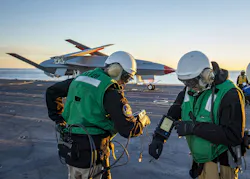
When asked how the system manages real-time image processing and situational awareness in the moving and challenging environment of an aircraft carrier deck, Feldman acknowledged that the aircraft carrier deck environment is challenging “with tight conops (concept of operations) between a number of manned aircraft and other operations, and now adding a remote-controlled unmanned vehicle.”
He added: “We can’t get into specific implementation details, but there are provisions within the computing and communications methodologies to ensure timeliness, responsiveness, and integrity of the system to facilitate seamless operations combining manned and unmanned vehicles on the carrier deck.”
We can’t get into specific implementation details, but there are provisions within the computing and communications methodologies to ensure timeliness, responsiveness, and integrity of the system to facilitate seamless operations combining manned and unmanned vehicles on the carrier deck.
- Rodney Feldman
Tackling EMI and Harsh Conditions
Naval carriers are not only a high-EMI environment, with countless active electronic systems packed close together, but they also are subject to environmental factors such as vibration, deck motion, saltwater exposure, and temperature extremes.
Although Feldman could not comment on any specific implementation details in how SECO has addressed these challenges for onboard vision systems amid naval carriers, he did say it is generally known that there is a great deal of electronic noise on naval vessels, and electronics used within noisy electromagnetic environments require enhanced protections. He says well-known strategies include:
- Shielding to deploy a Faraday cage around susceptible electronics
- Electromagnetic gaskets and shields around seams in the package
- Electronic filtering of critical signals
- The use of materials that offer electromagnetic filtering benefits, etc.
While specific ruggedization details are kept under wraps, Feldman said, “In general, materials are selected to accommodate vibration and mechanical shock and temperature extremities, not degrade due to salt or sun exposure, and provide ingress protection against water and other contaminants. Device assembly and maintenance schedules ensure reliable, ruggedized operation.”
This is good guidance for machine vision engineers to keep top of mind when specifying housings, lenses, and sensors for maritime or aerospace applications.
HMI, Agile Iteration, Integration
The DCD isn't just hardware; its controls and display are thoughtfully designed to reduce operator workload. When asked how the human machine interface (HMI) incorporates or leverages vision system outputs to improve operator situational awareness and ease of use, Feldman said that operator visual awareness and intuitive controls are key for controlling the MQ-25 within the delicate “dance” of air vehicles and other deck operations.

“The human-machine interface includes a number of finger-activated controls and the wrist-worn rugged display. Each control was analyzed with respect to its placement, function, and analogous impact on the MQ-25 air vehicle, and implemented for intuitiveness, ergonomics, and reliability, “ he said, adding, “The display accounts for a wide variety of ambient lighting and environmental conditions, designed to be easily readable. Accompanying software ties it all together in a way that simplifies usage within a stressful and difficult environment.”
When asked to describe the hardware and software framework supporting machine vision processing that allows for agile iteration while maintaining military-grade redundancy, Feldman notes that although he cannot comment on the implementation, careful consideration has been made for deterministic, responsive, real-time operation of the system, in addition to proper and safe response in case of anomalies or failures.
So, how is the vision system integrated with communications, control grips, and processor units to deliver a seamless user experience for operators on the deck? Feldman says that all aspects of the DCD, including the control grip, communications, and display are coordinated via the processor unit. “A careful blend of software determinism, device ergonomics, and attention to fitting in with carrier deck operations offers a seamless experience for the user of the deck control device and for everyone else on the carrier deck,” he said.
When asked about key lessons learned regarding machine vision deployment in naval aerospace environments that might influence future projects or industry best practices, Feldman said, “Due to the need to integrate into existing deck operations in a hectic operational environment in unforgiving environmental conditions, careful attention to defining precise use cases and operational flows was critical to the success of the device. From there, a flowdown of requirements that impact the vision deployment is critical.” Indeed, outdoor environments with a very wide temperature range, salt, humidity, and ambient lighting conditions have a great influence on the design of vision-related functions, he said.
About the Author
 Sharon Spielman
Sharon Spielman
Head of Content
Sharon Spielman joined Vision Systems Design in January 2026. She has more than three decades of experience as a writer and editor for a range of B2B brands, most recently as technical editor for VSD's sister brand Machine Design, covering industrial automation, mechanical design and manufacturing, medical device design, aerospace and defense, CAD/CAM, additive manufacturing, and more.