Rethinking Weed Control in Modern Agriculture
Key Highlights
- The system uses AI-driven machine vision to distinguish crops from weeds and identify weed types for targeted removal.
- Multiple independent manipulators perform precise weeding actions, exceeding manual speed and consistency while minimizing soil disruption.
- Field data from diverse regions ensures the system’s adaptability across various soil types and environmental conditions.
- Results show 80-85% weed removal without herbicides and a 70-80% reduction in soil disturbance, supporting soil health and moisture retention.
- Farmers can program the system in real time, adjusting its operation to specific crops and field conditions for optimal results.
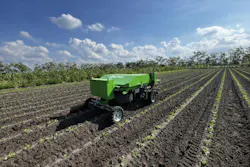
Weed control remains a persistent challenge in agriculture, directly impacting crop yields and global food security. Traditional approaches—widespread herbicide use, intensive soil tillage, and manual labor—are increasingly unsustainable. Herbicides contribute to resistance and environmental toxicity, tillage accelerates soil erosion, and labor shortages limit the viability of manual weeding.
AgriPass addresses these limitations with an autonomous robotic solution built on adaptive, AI-driven machine vision. The AgriPass RHIC (robot of human-inspired cultivation) AI weeding system is designed to replicate human weeding precision while enabling scalable, consistent operation in the field.
Human-Inspired Cultivation, Mechanized
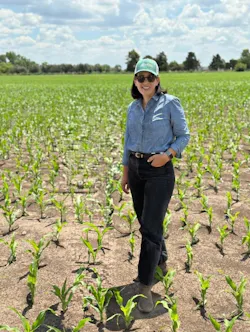
AgriPass is grounded in the concept of “human-inspired cultivation.” As CEO Liron Yanay told Vision Systems Design, the system performs “a simple mechanical action, just like hand hoeing by a crew,” but with automation and speed.
The robotic platform uses multiple independent manipulators, or “hands,” each capable of making discrete, real-time weeding decisions. Operating with precision comparable to human workers, these manipulators exceed manual labor in both speed and consistency.
Vision-Guided Decision Intelligence
At the heart of the system is its machine vision architecture. Cameras mounted approximately 60 cm above the soil capture a continuous video stream of the field. The system relies on off-the-shelf cameras that are integrated and optimized for reliable operation in challenging outdoor conditions, Yanay said.
This visual data feeds AI models that perform detailed semantic analysis—not just distinguishing crops from weeds but also identifying specific weed types. This level of classification is critical, as different weed morphologies require different removal strategies. As Yanay noted, “Some have wide leaves, and you need to cut them differently.”
The image stream is processed by an onboard edge computing system capable of real-time inference. This allows the platform to make immediate decisions: whether a robotic hand should engage, how deep it should cultivate, or when it should avoid disturbing a nearby crop.
Maintaining crop integrity is a core requirement. The system achieves less than 3% crop disturbance by combining precise segmentation with adaptive control logic. As Yanay described, the robot can “decide to skip a crop…or clean around it.” Each manipulator operates independently, Yanay said, “really like managing a crew on one solution.”
Data, Mechanics, and Field Performance
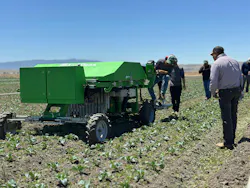
Building robust AI models required extensive and diverse field data. AgriPass collected training datasets from multiple regions, including California, Ohio, Florida, Italy, and Israel, capturing a wide range of soil types—from sandy to heavily compacted.
This geographic and seasonal diversity enables the models to generalize effectively across environments. “Since December 2024, we were constantly in the field…and insisted on multi-state operation,” Yanay said, stressing the importance of varied data in achieving reliable performance.
The robotic manipulators translate machine vision insights into physical action. After evaluating multiple designs, the team selected a “T1” hoe shape that balances effective weed removal with minimal soil disruption.
The manipulators are engineered for speed and adaptability across varying soil conditions. Encased for durability, they maintain performance even when encountering differences in soil density, enabling consistent operation in real-world environments.
Accessibility was a key design consideration. The system is built to serve small- and medium-sized farms, which often face barriers to adopting advanced agricultural technologies.
To accelerate deployment, the platform is currently diesel-powered and self-propelled. This decision prioritizes the core weeding technology, with the option to transition to alternative power systems in the future.
Sustainability, Programmability, and Operator Control
Results from the privately held industrial group FYELD trials show the system achieves approximately 80% to 85% weed removal without herbicides, while reducing soil disturbance by 70% to 80%.
These improvements extend beyond weed control. Reduced soil disruption helps retain moisture, preserve soil biology, and minimize carbon release. As Yanay explained, “Less disruption in the soil means we release less carbon, keep more moisture, and preserve the biome—the worms and soil life.” These factors contribute to up to 20% improved water retention and increased resilience to climate variability.
The system is designed for dynamic, field-level programmability. Farmers can adjust parameters in real time, including how closely the system operates around crops or the tolerance for specific weed types.
“A farmer can say, ‘I want you to go closer to the crop,’ or ‘keep 1-2 cm away,’ or ‘don’t come close at all,’” Yanay explained. This flexibility allows operators to tailor performance to specific crops, field conditions, and management strategies.
Balancing Performance and Compute Constraints
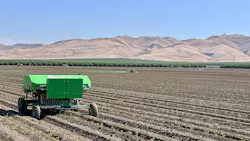
A key engineering challenge was balancing the computational demands of real-time vision processing with the constraints of field deployment. Development evolved from laptop-based systems to more advanced embedded computing as hardware matured.
This approach leverages edge computing to continuously refine the balance between model complexity, latency, and power consumption—ensuring the system remains both high-performing and practical for in-field use.
Scaling the Platform, Designing for Real-World Use
AgriPass continues to refine its technology, with plans to scale the platform for larger agricultural operations by 2027. This expansion will involve replicating the modular vision-guided architecture across wider beds while preserving its selective, adaptive capabilities.
The company is also exploring the extension of its machine vision and AI platform into adjacent agricultural applications beyond weed control.
Yanay emphasized the importance of close collaboration with end users during development. “Try to really get into the world of your client,” she advised, noting that long-term partnerships with design collaborators were critical to success.
Continuous field validation and user-centric design ensure the technology aligns with the realities of agricultural environments—where variability, durability, and usability are essential to adoption.
About the Author
 Sharon Spielman
Sharon Spielman
Head of Content
Sharon Spielman joined Vision Systems Design in January 2026. She has more than three decades of experience as a writer and editor for a range of B2B brands, most recently as technical editor for VSD's sister brand Machine Design, covering industrial automation, mechanical design and manufacturing, medical device design, aerospace and defense, CAD/CAM, additive manufacturing, and more.