Choosing 3D Vision for Dimensioning in Warehouse Automation
Key Highlights
- 3D dimensioning supports storage allocation, shipping cost calculation, and truck loading optimization.
- Choosing between time-of-flight and stereo cameras depends on working distance, required accuracy, object properties, and installation constraints.
- Reliable dimensioning requires validation of the complete measurement system. Where measurements are used for billing, applicable legal metrology requirements must also be considered.
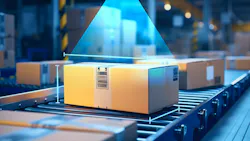

Measuring the length, width, and height of packages and pallets supports storage allocation, shipping cost calculation, and truck loading. For irregular loads, the volume of the smallest enclosing rectangular box is often more relevant than the physical volume of the goods.
A reliable dimensioning system must produce consistent measurements across the expected range of object sizes, packaging materials, and operating conditions. A stationary cardboard carton presents different challenges from a stretch-wrapped pallet or parcels moving on a conveyor.
Time-of-flight (ToF) and stereo cameras can both provide depth data for these tasks. When choosing between them, consider the required measurement accuracy, field of view, working distance, object motion, and surface properties. The final result also depends on camera placement, calibration, and the software that converts depth data into dimensions.
Define the Measurement Requirements
Start with the smallest and largest objects, the dimensions to be measured, and the acceptable error for each dimension. Specify whether protruding labels, loose film, or pallet overhang must be included. These details affect both the camera setup and the measurement software.
Next, define the measurement area and available mounting positions. The field of view must cover the entire object at every permitted position. Working distance varies with object height, so check both the nearest and farthest surfaces. Additional viewpoints may be needed where edges or protrusions are hidden.
For moving parcels, conveyor speed, exposure time, and acquisition timing influence the result. Test representative packaging under the expected lighting conditions, including dark materials, glossy film, and daylight at loading docks.
Selecting a Depth Sensing Technology
ToF and stereo vision capture depth across an area and can support stationary or moving-object measurement. Other approaches, such as laser line triangulation, are also relevant, particularly for conveyor-based scanning. The following sections focus on ToF and stereo cameras.
Time-of-Flight for Area Coverage
ToF cameras determine distance from the travel time of emitted light. Indirect ToF cameras, such as Basler blaze, measure the phase difference between emitted and reflected modulated light. Each acquisition provides depth data across the camera's field of view, supporting tasks such as pallet dimensioning and load occupancy checks.
Performance depends on distance, reflected signal strength, ambient light, and scene geometry. For example, Basler specifies typical depth accuracy of ±5 mm for blaze-101 between 0.5 m and 5.5 m under defined test conditions. The achievable accuracy of package dimensions must be assessed separately in the complete system.
The blaze-101 uses 940 nm illumination to improve robustness to daylight. Strong ambient light can still reduce measurement quality. Dual Exposure HDR combines measurements with different exposure times to extend the usable range of surface reflectivity. Motion between exposures needs consideration.
Reflective wrapping and indirect light paths can introduce depth errors that HDR alone cannot resolve. Where several cameras illuminate the same area, coordinated acquisition can reduce mutual interference, although time-sharing may limit the available measurement rate.
Active Stereo for Detailed Surface Measurement
Stereo cameras calculate depth by matching corresponding features in two images and triangulating their positions. Depth accuracy depends on factors including baseline, focal length, image resolution, and matching quality. For a given configuration, depth uncertainty generally increases with distance.
Plain cardboard and other low-texture surfaces can make matching difficult. Active stereo projects a pattern onto the scene to provide additional features for stereo matching. The Basler Stereo ace combines this approach with high-resolution image sensors and different baseline options to suit the measurement volume.
Projected texture can improve the depth data’s completeness, but its effectiveness depends on the surface returning enough light to both cameras. Very dark, glossy, or transparent materials remain challenging. Reflections, occlusions, and strong ambient light can also reduce matching quality.
For dimensioning, evaluate how reliably the system captures object boundaries and surfaces across the full measurement area. A dense point cloud alone does not establish the accuracy of the resulting dimensions.
Compact Stereo for Limited Installation Space
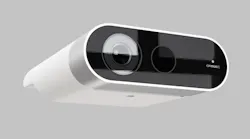
At compact measurement stations or on robot-mounted setups, camera size and weight can constrain the design. Basler Stereo mini cameras combine stereo depth sensing and RGB imaging in a compact housing, with onboard depth processing. Active illumination supports low-texture scenes, while passive stereo uses available surface texture.
A compact camera still needs sufficient viewing distance and overlapping views from both stereo sensors. A shorter baseline can support close-range operation, while a larger baseline can improve depth accuracy at greater distances, depending on the optical configuration.
For robot-mounted measurement, account for camera pose and mechanical stability. If several views are combined, errors in pose estimation and calibration contribute to the final dimensional error.
Turning Depth Data into Dimensions
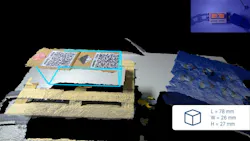
Measurement software must separate the object from its surroundings, establish a reference such as the conveyor plane, and calculate the required dimensions. For irregular loads, this may involve fitting an enclosing box. Missing edges, loose wrapping, and adjacent objects can affect the result.
Validate the complete system using reference objects with known dimensions. Include various positions, orientations, materials, and operating speeds. Assess measurement error, repeatability, and the proportion of objects that cannot be measured reliably. Define how the system handles incomplete or uncertain results.
Combining Dimensions and Identification
Linking dimensions to a barcode or matrix code enables tracking through warehouse processes. Tools such as pylon vTools can support code reading from suitable 2D images. Whether one camera can provide both depth data and readable code depends on image resolution, viewing angle, illumination, and code location. Some installations require a separate identification camera.
Measurement for Billing
Where dimensions determine freight or storage charges, establish the applicable legal metrology requirements for the target market early in the project. Relevant frameworks include OIML R 129 and, in the EU, the Measuring Instruments Directive, MI-009. Compliance concerns the complete measuring instrument, including software and operating conditions. A camera's depth accuracy specification alone does not establish suitability for legally regulated billing.
Validating the Camera Setup
Select the camera and optical configuration against the required measurement volume, dimensional accuracy, and installation constraints. Test candidate setups with representative objects under actual operating conditions before committing to a design.
The decisive result is whether the complete system delivers reliable dimensions at the required throughput. Include calibration, measurement software, and handling of unsuccessful measurements in that assessment.
About the Author
 Martin Gramatke
Martin Gramatke, Product Manager for 3D Systems at Basler, explains how to select 3D vision for dimensioning in warehouse automation. He compares ToF and stereo cameras, and discusses measurement requirements, operating conditions, and validation.