Beyond the Spiel: A Robotic Quarterback and the Case for Repeatability

While watching the Chicago Bears beat the New England Patriots last Thursday night, I found myself wondering whether NFL teams were using robots during practice. My son quickly assured me they were. He had heard about a robotic quarterback and then forwarded me some information about Monarc Sports’ The Seeker.
A robot throwing passes might sound like a novelty, but it seems that in football practice it addresses a practical problem: how to deliver repeatable, game-like reps without asking a quarterback, punter, or kicker to deliver every repetition.
According to the company’s website, that’s the idea behind the robotic football-training system. It can deliver programmed passes, punts, and kicks, with coaches able to save drills and track usage through a web-based platform. The robot doesn’t replace the coach or the athlete; it helps make a part of practice more repeatable and easier to schedule.
The same principle applies in manufacturing. Automation’s value is not simply that a machine performs a task. It’s that an engineered system can perform a defined task consistently, at a required pace, and as part of a process designed around people, products, and production goals.
A3’s latest North American robot-order figures suggest more manufacturers are investing in those systems—and that the demand is coming from a wider range of industries.
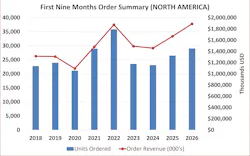
Interest in repeatable, engineered automation continues to grow across manufacturing sectors. Companies ordered 10,989 robots valued at $723.5 million in the third quarter of 2026, according to A3. That’s a 24.8% increase in units and a 26.1% increase in value compared with the third quarter of 2025. Orders for the first nine months of this year reached 28,984 robots, up 9.6% in units year over year.
A Broader Lineup of Applications
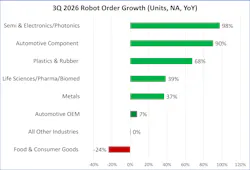
The sector figures reveal a market with several strong contributors. Automotive component orders rose 90.4% in Q3, while semi and electronics/photonics orders increased 97.6%. Plastics and rubber grew 67.7%, life sciences/pharma/biomed rose 38.7%, and metals increased 37%.
Automotive OEM orders also returned to YoY growth, up 7.5% in Q3 after declines in the first half of the year. The gains were not universal: food and consumer goods orders fell 23.7%.
The robot is only one part of the solution. End effectors, sensing, machine vision, controls, safety, data exchange, and downstream process requirements all shape how the cell performs.
The NFL has also publicized its use of player-tracking data and collaborations with AWS involving AI, machine learning, and computer vision for player health and safety analysis. Those initiatives are distinct from robotic training devices, but they highlight how physical and digital technologies often work together in modern systems.
In manufacturing, robotics and vision similarly play complementary roles. A robot can move, orient, or manipulate a part; a vision system can locate it, inspect it, or help determine what action should happen next. The engineering challenge is making the pieces work together reliably under real operating conditions—not treating “robotics” or “AI” as a complete solution on its own.
That combination is increasingly relevant as robot orders grow across sectors with different production and inspection demands. Engineers evaluating automation projects must look beyond individual technologies to understand the full requirements of the application, including handling, inspection, decision-making, throughput, accuracy, maintenance, and integration.
The Value of Repeatable Performance
A robotic quarterback is compelling because the purpose is easy to grasp: deliver consistent practice opportunities so coaches and players can focus on performance. In a factory, the objectives are different, but the engineering principle is familiar. Automation works best when hardware, sensing, software, and process design are matched to a specific task.
A3’s Q3 results point to stronger robot demand across multiple industries, rather than a story driven by automotive alone. For the teams designing and integrating those systems, the challenge isn't simply deploying more robots. It's engineering applications that are safe, maintainable, and matched to the realities of the production environment.
About the Author
 Sharon Spielman
Head of Content
Sharon Spielman joined Vision Systems Design in January 2026. She has more than three decades of experience as a writer and editor for a range of B2B brands, most recently as technical editor for VSD's sister brand Machine Design, covering industrial automation, mechanical design and manufacturing, medical device design, aerospace and defense, CAD/CAM, additive manufacturing, and more.