Smart Thermal Imaging for Risk Management
Key Highlights
- Supports Ethernet and LTE connectivity for flexible deployment in both wired and remote locations.
- Features proprietary real-time algorithms for early fire hazard detection and differentiation of heat sources.
- Enables remote configuration, firmware updates, and AI model enhancements via over-the-cloud management.
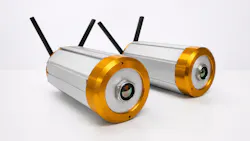
As manufacturing expands into perception systems and edge computing, moviTHERM has launched the Irley IoT thermal camera—a practical example of integrating smart, connected sensors for improved safety and operational awareness.
The camera is designed to provide early detection of fire hazards, equipment malfunctions, and thermal anomalies in industrial and commercial environments. The device consolidates thermal imaging, continuous monitoring, and alarm notifications into a single platform aimed at supporting preventive maintenance and risk management efforts.
Irley supports Ethernet and LTE connectivity, enabling deployment both within facilities that have wired network infrastructure and in remote or hard-to-reach locations where cellular connectivity is required. This flexibility allows integrators to position the camera in critical zones without requiring additional network setup.
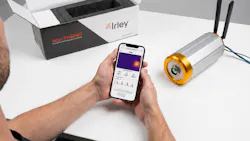
From a machine vision and embedded systems perspective, Irley provides continuous thermal image streaming and temperature trend data accessible remotely. Its software interface allows configuration and adjustment without the need for onsite intervention, supporting operational efficiencies, and reducing system downtime.
Additionally, the system automatically logs thermal events and alert histories, generating documentation that can assist with post-incident analysis and regulatory or insurance compliance. This functionality supports risk assessment workflows by ensuring verifiable records without manual data collection.
Target use cases include manufacturing facilities, warehouses, and other sites with critical assets vulnerable to heat-related failures or fire risk. By enabling earlier detection through integrated thermal sensing and networked alerting, Irley represents a platform-level solution leveraging IoT connectivity and embedded imaging for risk mitigation.
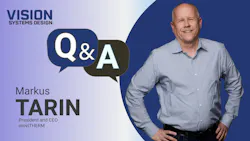
Vision Systems Design had some questions about the thermal camera, so we reached out to Markus Tarin, CEO of moviTHERM, for some answers.
Editor's note: the following Q&A may have been edited for style and/or clarity.
Vision Systems Design (VSD): What specific types of image processing or machine learning algorithms are implemented in this thermal camera to distinguish between normal heat variations and genuine early warnings for fire or equipment failure?
Markus Tarin (MT): moviTHERM has developed several proprietary algorithms, which makes Irley unique; it is not just another thermal smart camera. The smarts in the camera perform pixel-by-pixel analysis in real time at 30 fps. The camera can run up to 80 fps for specialty applications with fast-moving objects. Irley can analyze the rate of rise and vector-based hotspot detection with directional spread, to name one of the many algorithms. But almost more important than detecting a fire early is Irley's ability to figure out what not to trigger on: for example, moving vehicles with hot exhaust pipes or hot engine components. It is an all-in-one solution for busy areas where it needs to differentiate friend vs. foe.
VSD: How do you plan to manage software updates and incorporate ongoing improvements or new AI models in the system over time, especially for embedded hardware deployments?
MT: Our team has built in an over-the-cloud firmware update function. Irley comes with a built-in LTE cellular modem and is always reachable. We can push updates or new AI models to any Irley camera remotely with a push of a button.
VSD: Can you describe the security architecture used to protect the thermal data, alert signals, and device control commands transmitted over Ethernet or LTE networks?
MT: We thought this through very carefully, as we deal with critical infrastructure monitoring with stringent cyber security regulations. The data transfer uses a 2048-bit encryption. Our cloud server runs on a secure and dedicated AWS server. We manage our own SIM cards and data plans. Our SIMs run on a first-responder network with redundancies. We use a dual-core, multi-carrier SIM that automatically switches over to the next strongest provider, in case one goes down. We also have a secure and encrypted remote tunnel interface that allows us to support our customers anywhere in the world. This also allows our customers to configure the camera via the cloud interface—all through one and the same interface.
VSD: What calibration methods or environmental adaptation techniques are included to ensure consistent detection accuracy across diverse industrial settings that have variable temperatures, humidity, or potential infrared obstructions?
MT: The thermal camera has an automated self-calibration built in. It is a so-called NUC (non-uniformity correction). During a NUC operation, which just takes a second, a small flag drops in front of the thermal detector, and the camera electronic performs a pixel-by-pixel non-uniformity correction. This ensures that the camera stays within the accuracy specification. The NUC is triggered based on timing and environmental conditions. It can also be performed manually via the cloud interface. Like with any camera, if something is truly obstructing its view, there is nothing the camera can do to circumvent that.
VSD: How do you balance real-time processing demands on embedded systems within the IRLEY camera against power consumption and hardware constraints?
MT: Great question! This was a major engineering challenge. The challenge extends further; and that is thermal management due to heat dissipation. We tackled this from the firmware perspective by selecting the right embedded computing architecture and with the right mechanical design to sink heat away from the CPU and the camera. We went through extensive testing. The performance of this camera is incredible.
VSD: Are there plans to enable user-customizable machine vision models or alert parameters that can learn and adapt based on the specific equipment or environment monitored?
MT: This platform is definitely capable. Its architecture has room for a lot of customization. We look at Irley as a platform. There are currently 14 models available with different resolution and lens options. For the right OEM opportunity, we would consider some customization. However, the business case needs to make sense. Irley is primarily intended as an extension to our existing iTL Cloud Ecosystem. It is a powerful and flexible platform that can take on different applications and use cases.
VSD: Could you share insights on the challenges you faced in designing this IoT thermal camera with both ease of deployment for non-experts and the robustness needed for critical industrial use cases?
MT: Certainly. We here at moviTHERM are really good at simplifying the complex. We understand that technology is only as useful as its ability to drive adoption. Thermal imaging is complex; cameras are complex; and IoT is complex. Making this all work together seamlessly in a plug-and-play sort of a fashion was no small task.
Luckily, we already had our own IoT Infrastructure (iTL Cloud) in place for several years. We had previously solved many of the remote support, ease of use, and deployment challenges on that platform. This laid the foundation for Irley. But Irley is on another level. It is a complete monitoring system with cellular communication and cloud platform all in one.
I challenged the team and said: "All I want to have a customer do is to plug in power and start monitoring" and that is exactly what we have achieved with Irley. But we took it a step further. This system also has a built-in OPC-UA server, allowing our customers to connect it to their control room, SCADA systems, and data historians.
Because it is a high-speed, real-time thermal smart camera system, it is suitable for process monitoring applications as well. And if something goes wrong, the platform even calls you. Peace of mind through innovation.
About the Author
 Sharon Spielman
Sharon Spielman
Head of Content
Sharon Spielman joined Vision Systems Design in January 2026. She has more than three decades of experience as a writer and editor for a range of B2B brands, most recently as technical editor for VSD's sister brand Machine Design, covering industrial automation, mechanical design and manufacturing, medical device design, aerospace and defense, CAD/CAM, additive manufacturing, and more.