Real Voices from VISION 2026: AI, Human Expertise, and the Evolving Role of Integrators
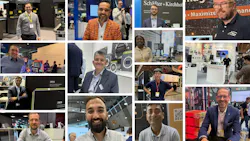
At Vision 2026 in Stuttgart, I spoke with engineers, executives, and technology leaders about the rapid evolution of machine vision in the age of AI. The questions driving these conversations came directly from the Vision Systems Design community, whose insights continue to spark important discussions around industrial AI, automation, and imaging technology.
Their responses revealed a consistent theme: while AI is making machine vision more accessible and capable, human expertise, system integration, and image quality remain fundamental to success.
Integrators: Evolving Partners, Not Obsolete
The rise of AI has many manufacturers investing in in-house vision capabilities, with teams of data scientists developing custom solutions. Yet the consensus among industry leaders was that integrators are not becoming obsolete. Instead, their role is evolving and, in many cases, becoming more valuable.
Simon Stanley, director of technology at Exaktera, put it this way: “AI is helping with data analysis, but integrators add far more than just software. They handle everything from hardware selection to lighting, all the pieces needed to make a project succeed. I can’t say integrators will become obsolete.”
Ritesh Gupta, director of application engineering at Zebra Technologies, observed that integrators are increasingly moving into higher-value roles that combine RFID, mobile computing, and machine vision into comprehensive solutions. “Integrators now solve baseline customer problems, adding more value than ever,” he said.
Matt Moschner, president and CEO of Cognex, echoed that view. “I don’t think systems integrators are going anywhere. They have plenty of value to add. What will change is how much time they spend assembling vision components. That’s becoming a smaller percentage of their work. We are delivering more complete, plug-and-play hardware and software to reduce that burden while strengthening partnerships with integrators to add value elsewhere.”
I don’t think systems integrators are going anywhere. They have plenty of value to add.
- Matt Moschner, Cognex
Several interviewees pointed to the same trend: AI is reducing the effort required to configure and deploy vision systems, but it is not replacing the practical expertise needed to design, implement, maintain, and optimize real-world applications.
Brad Reynolds of JAI summed it up simply: “AI is magical, but you still need humans to control it, understand it, and maintain it.”
Christian Hintze, computer vision engineer at phil-vision, noted how AI is helping integrators improve solution development. “We missed some things in the past. Now with AI, we have better visibility and can deliver better outcomes,” he said.
“If you’re not using machine learning or AI nowadays, you’re less likely to get attention,” added Luca Kuhlmann of Shafter + Kirchhoff. “Being able to integrate AI is crucial to staying relevant.”
Erhan Deniz, solutions engineer and team lead at Edmund Optics, said AI can help generate usable insights from images that might previously have been considered marginal. However, human expertise remains essential for training, validating, and deploying those systems effectively. And Christian Vollrath, managing director at Wenglor, added that integrators must continue evolving alongside customer expectations and increasingly user-friendly vision technologies.
Sadiq Panjwani, COO of the machine vision and sci-cam segment and senior EVP and GM of the machine vision camera group at Teledyne, also highlighted the continuing importance of integration expertise, particularly when navigating complex regulatory, certification, and deployment requirements.
AI is magical, but you still need humans to control it, understand it, and maintain it.
- Brad Reynolds, JAI
Why Lighting Still Matters Most
Despite rapid advances in AI, interviewees repeatedly returned to one foundational truth: image quality remains the cornerstone of machine vision success.
“Lighting is often the last thing people think about,” Stanley said, adding, "and some people think maybe you don't even need it. But machine vision is all about contrast, right? And what makes contrast is the lighting.”
Hintze was equally direct: “If you’re not getting the right image, AI can’t help you.”
Talisa Roberts of Imperx noted that integrators' deep understanding of cameras, lighting, optics, and application requirements remains critical to building effective systems across industries ranging from food packaging to aerospace.
Moschner agreed. “AI is not going to solve all problems. It may make configuration of complex inspections 90 to 95% easier, but defining the correct lighting, optics, and physical setup remains an art.”
The consensus was clear: no AI algorithm can compensate for poor image capture. Lighting, optics, and physical system design remain as important as ever.
Making Machine Vision More Accessible
Several participants also challenged persistent misconceptions about machine vision and AI.
James Falconer, product manager at Pleora Technologies, said that machine vision extends far beyond factory automation. “It powers security, medical imaging, drones, and robotics,” he said.
“Machine vision doesn’t replace people; it educates and equips them. AI won’t replace humans,” Reynolds added.
Kim Jinwoo, creative leader of optical imaging at Vieworks, pointed to AI's role in helping smaller organizations deploy sophisticated vision solutions without requiring large technical teams. While Ashutosh Saxena, Ph.D., founder and CEO of TorqueAGI, described a broader evolution occurring within the industry. “Machine vision is evolving from detection toward intelligence and reasoning,” he said.
Deniz likewise noted that successful deployments continue to depend on a combination of advanced algorithms, domain expertise, and ongoing system development.
[Machine vision] powers security, medical imaging, drones, and robotics.
- James Falconer, Pleora Technologies
Physical AI and the Next Phase of Automation
Several interviewees also pointed toward the next phase of industrial intelligence: systems that combine machine vision, AI, robotics, and edge computing into increasingly autonomous platforms.
Craig Davis of Active Silicon captured both the excitement and reality of this transformation. “With AI and robotics, it feels like living in sci-fi. Smart cameras on robots are pushing technical boundaries daily. AI opens applications once thought impossible. It’s exciting, and a little scary.”
This convergence is helping drive the emergence of physical AI, where sensing, perception, reasoning, and action come together in the physical world. By tightly integrating machine vision, embedded computing, and robotics, physical AI promises more adaptable, flexible, and intelligent automation systems capable of responding to dynamic manufacturing environments.
AI opens applications once thought impossible. It’s exciting, and a little scary.
- Craig Davis, Active Silicon
AI Changes the Technology, Not the Need for Expertise
Vision Systems Design's time at VISION 2026 reinforced a recurring message from industry leaders: AI is accelerating innovation across machine vision, but expertise remains the differentiator.
Lighting continues to serve as the foundation of successful deployments. Integrators are evolving from component assemblers into strategic problem-solvers. And as machine vision becomes more accessible and intelligent, human judgment remains essential to translating technology into real-world results.
Perhaps Stanley captured it best: “Machine vision is all about contrast, and that starts with light. Get the lights right, and everything else falls into place.”
About the Author
 Sharon Spielman
Head of Content
Sharon Spielman joined Vision Systems Design in January 2026. She has more than three decades of experience as a writer and editor for a range of B2B brands, most recently as technical editor for VSD's sister brand Machine Design, covering industrial automation, mechanical design and manufacturing, medical device design, aerospace and defense, CAD/CAM, additive manufacturing, and more.