The Machine-Vision Stack Behind Autonomous Systems
The discussion of autonomous machine vision often starts with AI: how a model recognizes a defect, locates a part, or guides a robot; but every decision depends on the information captured upstream. The optics must reveal useful features, the camera and network must deliver the resulting data, and processing must keep pace with the application.
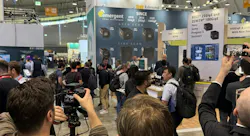
Three conversations recorded at VISION 2026 highlight complementary parts of that challenge—from optical filters and short-wave infrared (SWIR) imaging to 200 GigE cameras, edge AI, and robotics.
Make the Right Information Visible
In an interview with Vision Systems Design, Georg Draude of Chroma discusses optical filters, AI imaging, and the growth of SWIR applications. His conversation points to a foundational consideration for vision system design: before software can interpret a scene, the imaging setup has to capture the features that matter.
Optical filters help manage which wavelengths reach the sensor, while SWIR imaging can reveal information beyond what conventional visible-light imaging provides. As specialized sensors and imaging approaches become more common, choosing the right combination of illumination, optics, filters, and camera sensitivity becomes increasingly important.
That choice affects AI performance, too. A model cannot recover information that the imaging system never captured. The right optical setup can make relevant features more distinguishable, giving downstream software better data to analyze. This makes optics part of the AI system—not simply a component selected after the camera or model.

Move Image Data at Scale
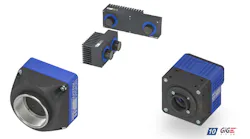
Once a system captures useful images, it must transport them without undermining the performance of the application. In a separate interview, Eric Petz, head of marketing at Emergent Vision Technologies, discusses the evolution of high-bandwidth GigE Vision cameras, including 100 GigE and 200 GigE, and the infrastructure required to support data-intensive AI workloads.
Higher bandwidth can help engineers balance resolution and frame rate, but the camera is only one part of the equation. Ethernet infrastructure, network interface cards, software architecture and data paths to GPU processing all shape whether a system can handle its image stream effectively. Petz discusses GPU-direct processing as one way to move data through the computing pipeline.
He also touches on emerging sensors—including SWIR and line scan—as well as expanding lens and camera options. AI techniques such as foundation models and synthetic data may further support more autonomous manufacturing systems. Potential applications include defect detection, bin picking, PCB inspection, and markerless motion capture.
Different sensors and imaging modes can generate different kinds of data, and the network and processing architecture must be designed to handle the needs of the application.

Turn Perception into Action
The final step is integrating imaging and processing with machines that need to respond. James Falconer, product manager at Pleora Technologies, discusses eBUS Edge and the challenges of bringing image data and AI processing together at the edge.
Edge processing can help systems make decisions close to where data is captured. Falconer describes how eBUS Edge supports developers working with trained or pre-trained AI models while streamlining image data movement across a network. He also discusses how GigE Vision is scaling from 1 Gigabit to 100 Gigabit and beyond as bandwidth requirements grow.
For autonomous manufacturing, however, performance is not only about speed. Systems may need to synchronize information from multiple sensor types, including 1D, 2D and 3D data, so that robots can respond to a more complete picture of their surroundings. Falconer also raises cybersecurity considerations, including requirements associated with the EU Cyber Resilience Act.
These issues bring the pipeline together. Useful optical information must be captured, moved reliably, processed in time and delivered to the systems that act on it. Each stage introduces design and integration decisions that affect the overall result.

An End-to-End Engineering Challenge
The whole pipeline should be evaluted. Does the imaging setup reveal the feature of interest? Can the network sustain the required throughput? Can processing keep up? Are sensor streams synchronized well enough to support a dependable response? And are cybersecurity requirements addressed as systems become more connected?
As AI and robotics advance, building more autonomous systems will depend not only on smarter models, but also on getting the fundamentals of imaging, data movement and integration right.
About the Author
 Sharon Spielman
Head of Content
Sharon Spielman joined Vision Systems Design in January 2026. She has more than three decades of experience as a writer and editor for a range of B2B brands, most recently as technical editor for VSD's sister brand Machine Design, covering industrial automation, mechanical design and manufacturing, medical device design, aerospace and defense, CAD/CAM, additive manufacturing, and more.