Meet VSD’s Editorial Advisory Board: Spotlight on Daniel Lau, Ph.D., IEEE Fellow and Pioneer in Machine Vision Innovation
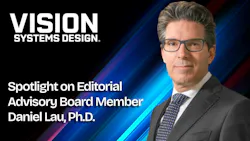
Over the next several months, Vision Systems Design will feature profiles of members of its editorial advisory board. We’ll kick off this series with Daniel Lau, Ph.D., a distinguished expert in machine vision and image processing whose career has spanned signal processing, digital halftoning, cutting-edge 3D imaging, and the integration of AI into practical engineering solutions. From his formative education at Purdue University and the University of Delaware to his pioneering research and entrepreneurial ventures, he has consistently pushed the boundaries of imaging technology.
Dr. Lau is the Databeam Professor of Electrical and Computer Engineering at the University of Kentucky in Lexington, the university’s director of graduate studies, and a certified professional engineer. His work spans diverse applications, including fingerprint scanning, dairy-industry automation, pipeline inspection, and dental imaging.
In 2026, Dr. Lau was elevated to IEEE Fellow in recognition of his contributions to digital printing and 3D imaging. He continues to lead innovative research exploring AI-driven world models for complex process recognition. His collaborative leadership style, enthusiasm for authentic community engagement, and forward-looking approach to AI make him a vital voice in the evolving field of machine vision.
To learn more about Dr. Lau and his approach to innovation, I sent him a series of questions. I hope you enjoy this Q&A as much as I do.
Editor’s note: The following Q&A may have been edited for style.
Vision Systems Design (VSD): Can you share how your career path led you to specialize in machine vision and image processing?
Daniel Lau, Ph.D. (DL): Two classes at Purdue, really. I took signal processing from Neal Gallagher, who's a legend in the field, and I was hooked. Then I took image processing from Jan Allebach—also a giant—and Jan taught us digital halftoning: how you place a limited number of black dots on white paper so the eye reconstructs a continuous-tone image. When Neal moved to the University of Delaware, I followed him there for my Ph.D.
At Delaware I met Gonzalo Arce, who had been one of Neal's Ph.D. students years earlier. Gonzalo knew I'd learned halftoning from Jan, so he handed me a patent on error diffusion with output-dependent feedback and asked me to figure out what was actually going on in it. That question became my dissertation—green-noise halftoning—and it ran as the lead article in Proceedings of the IEEE in 1998. Gonzalo and I have been collaborating ever since; we're on our fourth decade now.
I wanted to be a professor, and when I got to Kentucky in 2001 I met Larry Hassebrook, who was working on structured light scanning. Larry and I developed composite pattern structured light scanning, which produces real-time 3D video from a single continuously projected pattern. We published it in Optics Express in 2003, MIT's Technology Review picked it up, and suddenly people were paying attention.
About five years later, in the wake of 9/11, the National Institute of Justice announced its fast fingerprint capture program. Larry and I proposed structured light for non-contact 3D fingerprint scanning, and that project brought our group international recognition. It also produced our dual-frequency pattern scheme, which got written up in a Prosilica newsletter. Andy Wilson read that article and, with Jimmy Carroll, invited me to give a webinar on 3D vision. It was Vision Systems Design's first, and I've been giving them ever since. (Editor’s note: We are so fortunate and grateful!)
Matt Bellis saw that first webinar and contacted me about starting Seikowave. Matt was president and CEO, I was co-founder and CTO, and we spent 12 years building structured-light products for dental workflows and for oil and gas inspection before Snap-on Tools acquired the company in November 2024. Giving those webinars over the years is also how I met David L. Dechow, who later nominated me for the open seat on A3's vision and imaging board.
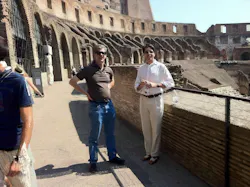
VSD: What are some key milestones or projects you consider defining moments in your professional journey?
DL: A few, and they're not the ones I would have predicted.
The dairy work is the first complete imaging system I've built end to end—cameras, cabling, computers, and software, running fully autonomously, with cloud storage and processing behind it. It started at Kentucky with Jeff Bewley, who was on the faculty in animal sciences. Our first project used a handheld PrimeSense RGB+D camera to measure how much feed a cow ate—image the bin before the animal visits and again after, and difference the two. That replaced putting the bin on a scale. Then we took the same camera, mounted it on the ceiling looking down at cows as they left the milking parlor, and used it to estimate body condition score.
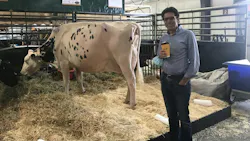
Jeff later left UK for industry, and a few years after that he began working with Holstein Association USA with the express intent of automating body condition and linear trait scoring with machine vision cameras. He roped me in as a consultant. We worked on it quietly for a few years before Holstein introduced it publicly as the Build a Better Cow project. I wrote the software and selected the imaging hardware.
The system puts three time-of-flight cameras in the exit alley from the milking parlor and currently measures 26 traits, including all the linear traits, body condition score, and some locomotion indicators. It's still in research and development, running at three locations, and Holstein expects to have it ready to sell in 2027 or 2028.
The compressive imaging work with Gonzalo is the one I'm proudest of technically. A hyperspectral camera and a 3D camera are normally two separate instruments, and we showed you can get both out of one. Coded aperture snapshot spectral imaging compresses an entire spectral datacube onto a single 2D sensor through a coded mask and a dispersive element, and you recover it computationally. We took a commodity time-of-flight range sensor—the kind you'd buy off the shelf—and used it as the detector in a coded-aperture compressive spectral imager, so a single snapshot carries both the spectral signature and the depth. That work ran in IEEE Journal of Selected Topics in Signal Processing in 2017 and IEEE TPAMI in 2020, with a patent in between.
And then in 2018 I changed direction. I started working on signal processing and machine learning over graphs and hypergraphs—the same questions about sampling and spectra, but on networks instead of grids. It's now my primary research focus, and it's what my NSF and Department of Energy funding supports. Twenty-five years in, it's the most interesting problem I've worked on.
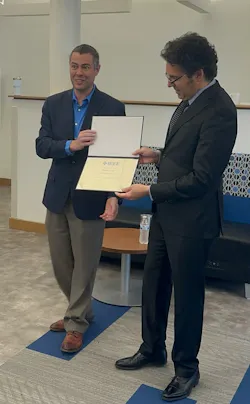
VSD: How has your recent recognition as an IEEE Fellow influenced your outlook or approach to your work?
DL: It's an incredible honor. It's also the one recognition everybody understands—fellow faculty and the machine vision community alike. It's a career achievement, and I'm glad it came early enough in my career to make a difference and open some doors.
What pleases me most is what the citation actually says: "for contributions to digital printing and 3D imaging." The digital printing half is the halftoning work, and that's the research I'm proudest of. It's where I started, and it's the thread running through everything else I've done. The 3D imaging half is the structured light work, and in terms of scientific contribution, the 3D fingerprint scanning is the most recognized of it. So the citation covers both halves of my career, and it covers them accurately.
And if I ever had any doubts that I'm good at my job, those are erased.
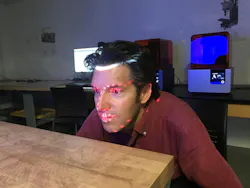
VSD: How do you see the current state of machine vision and image processing evolving, particularly in practical, real-world applications?
DL: Machine vision is benefiting from AI in two ways, directly and indirectly, and I think the indirect one gets less attention than it deserves.
Indirectly, the demand for AI drove an enormous acceleration in computational hardware, and machine vision got to ride along. GPU-class processors are now commonplace in embedded systems that a few years ago would have been built around a low-end CPU—an Intel N-series part or something like it. Now you drop an NVIDIA Jetson into the same box and do real-time processing at the edge. That changes what you can actually build. You're no longer shipping frames back to a server and waiting on a round trip; the inference happens where the camera is.
Directly, it's the ability to recognize what's in the video. In the dairy system we identify the animal and label its anatomy in real time, frame by frame as the cow walks past. That used to be the research project. Now, if you can collect and label your data quickly, you can detect and recognize the objects in a scene almost immediately. That's the real shift: the cost of standing up a new vision application dropped, so there are a lot more places where putting a camera makes sense than there used to be.
There's also a lot of confusion right now that's worth clearing up. Machine vision is still the area of science where we use cameras to measure things. Computer vision—and particularly the AI end of it, the vision-language-action models and world models everyone's excited about—operates on latent representations. A latent image is what we used to call a compressed image. The camera collects a picture and the model reduces it to something that carries meaning but not measurement. You can ask that representation what it's looking at. You can't ask it for the radius of a washer. That information is gone.
Both are valuable and they'll keep converging. But if you're building an inspection system, you need to know which one you've got.
VSD: What technologies or methodologies within machine vision excite you most from a foundational perspective?
DL: World models are what excite me most right now.
A world model learns how an environment behaves—what happens next, given what's happening now—and it's trained with reinforcement learning, which needs a reward: something that tells the model what counts as progress through the task.
The work my group is doing sits in the area of recovering process structure from video. Any real process decomposes into component steps with dependencies among them. One step has to finish before the next can start, and some steps require several things to be in place at once. That structure can be represented as a directed acyclic graph—a DAG—or as a directed acyclic hypergraph, a DAHG, when a step depends on a group of prior conditions rather than a single one. We're working on learning those graphs from video of a process and then using them to define the rewards that train the world model.
It's an active area with a lot of good work going on in it. What draws me is that you don't have to write the reward down by hand. You watch the process, you recover its structure, and the structure tells you what progress looks like.
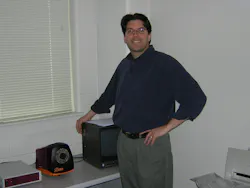
VSD: Can you describe an example where your technical work made a meaningful impact on solving a complex engineering challenge?
DL: Both the green-noise halftoning and the 3D fingerprint work solved a real engineering problem. But Seikowave produced some incredible devices. Our scanners were used all over the world, including in the Saudi Arabian desert to inspect oil and gas pipelines. They were deployed on tethered AMRs to inspect the inside as well as the outside of pipes, and we used an AMR to scan the blades on large wind turbines. We developed a scanner for an underwater drone company to be used 1,000 meters underwater. We co-developed an intraoral dental scanner with Qisda, makers of BenQ DLP projectors, and patented the world's smallest intraoral dental scanner. And we developed an active stereo camera inspection system for measuring tire tread depth at Valvoline oil change retail stores. Measuring tread depth normally means cutting a hole in the concrete floor to sink a scanner the car drives over. Ours just sat on the floor between the driver-side and passenger-side tires, so the tires rolled past the scanner rather than over it. Those scanners were ultimately abandoned by Valvoline.
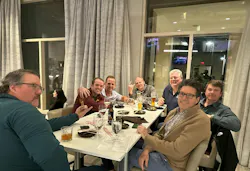
VSD: How would you describe your leadership style when working with technical teams or interdisciplinary groups?
DL: I'm all about collaboration, and about sharing responsibility, duty, and credit.
I always seek collaboration in my research, for the practical reason that it results in more proposals and more funding. Every major award I've had has more than one investigator on it. As an academic, I rely on students to do the bulk of the work, and that's why they become first author on the papers. At Seikowave, I supported a team of engineers.
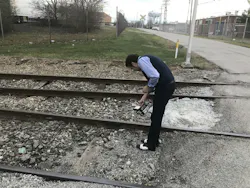
A lot of that collaboration is interdisciplinary. I've had funded projects with animal sciences, power systems, civil engineering, biosystems engineering, neuroscience, medicine, and the fine arts: the dairy work with Jeff Bewley in animal sciences, phase identification on the electric distribution grid with Yuan Liao, rail infrastructure with Reg Souleyrette in civil engineering, UAS remote sensing calibration with Mike Sama in biosystems engineering, NIH-funded assay work with Royce Mohan, augmented reality intubation training for first responders, and work with Mike Winkler in radiology and Siavash Tohidi in the School of Art and Visual Studies to replace real cadavers with 3D-printed mimics for visualization, simulation, and training.
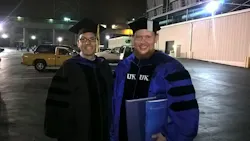
VSD: In what ways do authenticity and confidence play a role in your leadership and collaboration?
DL: On confidence—I'm a shameless self-promoter. Most of my projects have ended up in the news, whether local, national, or international. The composite pattern work got picked up by MIT's Technology Review. The 3D-printed PPE work during COVID ran in Vision Systems Design itself, back in June of 2020.
And that Prosilica newsletter article on our dual-frequency pattern scheme happened because I emailed the newsletter's author and asked them to write something about our real-time scanner. That article is what Andy Wilson read. Everything since—the webinars, Seikowave, the A3 seat—came out of one email I sent asking for coverage.
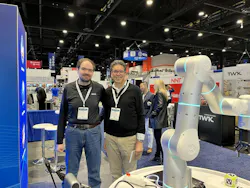
But there's a real reason behind it. Community outreach is an important and often ignored part of the job of being faculty at a land-grant institution, and I take that responsibility seriously. I reach out to industry, to K-12, wherever it's useful. That's also why I serve on the A3 Education Committee, which exists to foster collaboration between the automation industry and education. I'm particularly interested in seeing kids take part in robotics competitions.
And it's genuine. I love meeting new people in this job, and I'm always looking for new ways to use my skills in 3D imaging. The sheer number and variety of projects I've worked on is testament to that—dairy cattle, pipelines, teeth, tire treads, cadavers, wind turbine blades, fingerprints.
VSD: How do you see your role evolving in contributing to the broader engineering community or industry?
DL: AI has changed everything, and I think it reshapes engineering education completely. My expectation is that undergraduate education becomes about becoming a subject matter expert—learning what the real challenges in electrical engineering are—and graduate school becomes almost entirely devoted to using AI to solve them. I don't think a student will earn an advanced degree in engineering without devoting a substantial part of the dissertation to developing an AI model. And I don't think a serious graduate program can exist that doesn't provide Claude Code or comparable AI coding tools to its faculty, staff, and students. The University of Chicago's president announced Claude Enterprise for every academic, staff member, and student, explicitly including Claude Code. Schools that do that become the destinations of choice. Schools that ignore or ban these tools will lose out on the best faculty and the best students.
Since I believe that's where education is going, I'm staying in front of it. I've adopted AI into all three parts of my job—my teaching, my research, and my administration of the graduate program. In my teaching, I'm using AI to develop an extensive set of course materials students can work through on their own, including interactive web pages that quiz them on what we covered in class. My graduate students are using AI in their research, and it's the subject of their journal manuscripts. And as Director of Graduate Studies, I've rebuilt the routine machinery of the job as software, turning plans of study, advising records, and degree-progress tracking into interactive forms that validate themselves.
In my own research and consulting work in 3D imaging, I'm increasingly being asked about the use of AI in machine vision. Clients want to be kept well informed of where the cutting-edge research is heading, and that has become a real part of the job.
VSD: What are some of the consistent challenges engineers face in machine vision and image processing disciplines?
DL: The question that never goes away is: is my problem my camera, my optics, or my lighting?
In my experience, people who aren't vision experts recognize the value of a camera, but they don't really consider the importance of lenses and lighting when they design a vision system. And as people become more reliant on LLMs to guide them through vision system design, I see the problem getting worse.
The move to AI for AMRs and cobots adds another layer of complexity. A lot of the exciting AI models people talk about operate on latent images—compressed coefficients that, if you reconstructed the original image from them, would give you a blurry picture. So, choosing and installing a camera for AI is not the same as choosing one for metrology. Those are different requirements, and treating them as one problem is how people end up spending a lot more money than they need to.
That said, the software side is getting much, much easier, and tools like Claude Code are the reason since Claude Code eliminates, for example, the complexity of managing different camera APIs. It will translate C-like Arduino code into ladder logic for a PLC. It reads a user manual instantly. It automates installing developer tools, building installer packages, all of that. And it lowers the bar in a way I think is good for the field. If you understand Photoshop well enough to use it to solve your vision problem, then you're skilled enough to describe that filtering process to Claude Code and have it convert the process into OpenCV routines. That's a real change in who can build a working vision system.
So the picture is split. LLMs are making the software dramatically easier while making the physics harder to get right, because nothing about a chat window teaches you that your real problem is the lighting.
A Final Word of Thanks
I, for one, am deeply appreciative of Dr. Lau’s ongoing commitment to our community, not only through his ground-breaking research and industry leadership but also by generously sharing his knowledge via webinars and personalized advice.
His willingness to engage so thoughtfully and directly with practitioners and peers alike enriches our field and inspires us all to push forward in machine vision innovation with confidence and authenticity. His expertise and collaborative spirit elevate our editorial advisory board and Vision Systems Design’s mission to bridge cutting-edge science with real-world application.

Editor’s Note: Vision Systems Design’s WISE (Workers in Science and Engineering) hub features our coverage of workplace issues in engineering as well as insights from equity-seeking groups and subject matter experts across disciplines.
About the Author
 Sharon Spielman
Sharon Spielman
Head of Content
Sharon Spielman joined Vision Systems Design in January 2026. She has more than three decades of experience as a writer and editor for a range of B2B brands, most recently as technical editor for VSD's sister brand Machine Design, covering industrial automation, mechanical design and manufacturing, medical device design, aerospace and defense, CAD/CAM, additive manufacturing, and more.