Lucid Vision Labs Launches RGB-D Industrial Camera

Lucid Vision Labs has launched the Helios2 Wide Chroma, an industrial machine vision camera that combines Time of Flight 3D and RGB technology. The camera comes equipped with a Sony IMX556PLR Depth Sense CMOS sensor, which achieves 4024 x 3036, 12.2 MPixel resolution and 9.1 fps frame rate and a Sony BSI Starvis IMX226 CMOS sensor, which achieves 640 x 480,.3 MPixel resolution and 30 fps frame rate; and 4024 x 3036, 12.2 MPixel resolution and 9.1 fps frame rate.
Designed to be compact, versatile, and simple to deploy, the Helios2 Wide Chroma provides overlaid RGB and depth data so that users can integrate the camera quickly, without having to do extensive field calibration.
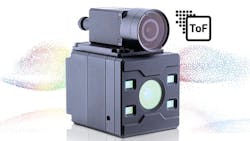
VSD had some questions so we reached out to Alexis Teissie, Lucid’s director of product development, for additional insights into the camera’s design and capabilities.
Editor's note: Q&A may have been edited for style and clarity.
Vision Systems Design (VSD): Lucid points out Helios2 Wide Chroma’s ease of deployment due to elimination of field calibration procedures. Is this a unique feature?
Alexis Teissie (AT): Yes. Within Lucid’s 3D portfolio, this level of factory integration and calibration is unique. Traditionally, when customers combine a 3D Time-of-Flight camera with an RGB area-scan camera, the system integrator must mechanically assemble the components and perform spatial calibration in the field. We still support that approach for customers who need maximum flexibility.
With the Helios2 Wide Chroma, the RGB camera and the 3D ToF camera are fully assembled, precisely aligned, and factory-calibrated as a single unit. The result is a synchronized, pre-calibrated RGB-D system that can be deployed immediately, without additional calibration procedures or specialist expertise. For customers, this significantly reduces integration time, eliminates calibration variability, and lowers the overall risk of deployment.
VSD: What are some other features that are unique compared to other cameras on the market?
AT: Beyond ease of deployment, the device is built on the company’s Factory Tough platform. This encompasses an IP67-rated enclosure, industrial EMC immunity, shock and vibration compliance, and the use of locking M12 and M8 connectors for power, Ethernet, and I/O. The camera is designed and validated for continuous 24/7 operation in demanding industrial environments.
In addition, it supports multi-camera synchronization, allowing up to five units to operate together as a coordinated system. This enables users to expand the effective field of view or eliminate occlusions while maintaining consistent depth and color alignment across all cameras. Because each unit is factory-calibrated, multi-camera systems can be deployed with predictable and repeatable results.
VSD: What are the most compelling features for someone looking to purchase a camera such as this one?
AT: It’s three things, the first one we already mentioned: ease of deployment. The product is a true out-of-the-box RGB-D solution. With factory assembly and calibration already completed, users can focus on application development rather than mechanical alignment and calibration workflows.
Second is software accessibility, which many can overlook. The camera is fully supported by Lucid’s Arena SDK, provided at no additional cost. Arena enables users to visualize real-time RGB-D point clouds, access raw and processed depth data, and build custom post-processing pipelines using standard programming environments. This flexibility is particularly valuable for system integrators developing advanced 3D perception or AI-driven applications.
Third is overall value. By combining two industrial-grade cameras into a single, ruggedized, factory-calibrated unit, the Helios2 Wide Chroma delivers a cost-effective RGB-D solution without compromising performance, reliability, or industrial robustness. Compared to many non-RGB ToF solutions, customers gain additional functionality with minimal impact on system cost or complexity.
VSD: What seems to be the application for which this camera is most frequently deployed?
AT: For the Helios2 Wide, palletizing remains one of the most common deployment scenarios, but the addition of an integrated RGB camera significantly expands what engineers can do within that application. With spatially aligned color and depth data, palletizing systems can now be augmented with OCR, barcode and QR code reading using the RGB image, while the ToF sensor provides accurate 3D position and volume information. The color improves scene details where depth information might be lacking.
Aside from palletizing, other applications include bin picking robotics, material handling, logistics and factory automation. RGB color overlay allows for better detection and classification of objects, enabling more intelligent picking decisions such as part identification, orientation verification, or quality checks before grasping.
About the Author
 Jim Tatum
Jim Tatum
Senior Editor
VSD Senior Editor Jim Tatum has more than 25 years experience in print and digital journalism, covering business/industry/economic development issues, regional and local government/regulatory issues, and more. In 2019, he transitioned from newspapers to business media full time, joining VSD in 2023.