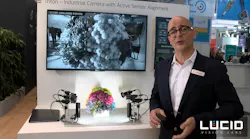
Recorded at VISION 2026, this presentation features Alexis Tiessie, dorector of product managment at LUCID Vision Labs, and highlights two important trends in machine vision system design: the need to move and synchronize growing volumes of image data across multi-camera systems, and the increasing demand for integrated imaging solutions that reduce setup complexity.
Scaling Multi-Camera Vision Systems
As machine vision applications expand beyond a single camera, system architects must address more than sensor resolution and network bandwidth. They must also ensure efficient data movement and precise synchronization across the entire imaging system.
In a Giga 3.0 RDMA demonstration, Lucid showcases a 20-camera architecture connected through a network switch and linked to an NVIDIA DGX Spark system via dual 100 Gb/s uplinks. The configuration demonstrates throughput of up to 200 Gb/s, with image data transferred directly to system memory without per-packet CPU intervention.
Network-Wide Synchronization
The presentation also examines approaches to synchronizing distributed camera systems.
The company combines hardware-based PTP timestamping with camera synchronization to create a shared time base across the network. For applications requiring external triggering, Lucid's E-Trigger technology allows a trigger received by one camera to be distributed to other cameras on the network. Depending on network configuration, actions can be coordinated within microseconds, reducing the need for extensive trigger cabling.
Introducing Triton All-in-One
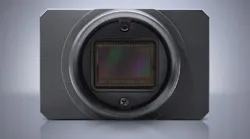
Introduced in Stuttgart, the riton All-in-One is an integrated imaging system that combines a camera, focus-tunable liquid lens, and illumination in a single factory-ready package.
Built on the company's Triton platform, the featured model pairs a 2.5 GigE camera with Sony's 3.2-megapixel IMX900 sensor. The integrated liquid lens enables software-controlled focus adjustment for objects at varying distances, while configurable illumination options support a range of inspection requirements.
The system can independently control left and right illumination, a capability that can help reveal challenging surface features such as embossing and other subtle details.
Designed for Deployment Flexibility
By integrating the camera, optics, and lighting into a single system, Triton All-in-One is designed to simplify deployment for applications including barcode reading, logistics automation, and machine vision inspection.
The platform also supports use cases such as remote focus adjustment and focus stacking while giving system designers flexibility to scale compute resources according to application requirements.
Watch the presentation to learn how high-speed data transfer, network-wide synchronization, tunable-focus optics, and integrated illumination can help simplify machine vision system design.