An Inspection Exception Log Can Teach Judgment Under AI
Key Highlights
- Record part and lot details, station information, inspection settings, original results, images, and any reported confidence metrics.
- Have trainees document their initial assessment and proposed next step before learning the verified disposition.
- Teach operators to flag uncertainty and preserve evidence—not to change inspection settings or make unsupported final decisions.
- Use short, anonymized case reviews to practice identifying missing evidence and choosing appropriate escalation actions.
- Track false rejects, defect escapes, inconclusive cases, and resolution time separately to evaluate the pilot.
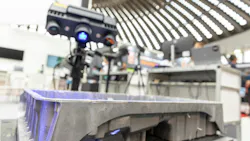
Consider a machine vision station that rejects a machined metal housing after detecting a bright streak that may indicate a scratch. A new inspector sees the reject signal. An experienced colleague asks a different question: Is the streak on the part, or is it an illumination artifact?
Both workers received the same classification. Only one began to diagnose it.
As AI-assisted inspection becomes more common, manufacturers need to train operators not only to respond to inspection results but also to evaluate the evidence behind them. A simple inspection exception log can transform disputed classifications into training exercises that teach when to gather more evidence, quarantine a part, or escalate a decision to engineering.
A false reject occurs when acceptable material fails inspection. A defect escape occurs when nonconforming material passes. Between those outcomes lies a third category: cases where available image data is insufficient to determine the correct disposition. In such situations, neither the system output nor the operator's opinion should be treated as ground truth. Final disposition should remain tied to documented quality criteria and independent review.
Start with the Image
Many inspection problems originate in image acquisition rather than classification.
As a recent Vision Systems Design analysis of image-quality tuning noted, factors including lighting, gain, focus, temperature, and calibration can significantly affect the images presented to a model. Likewise, machine vision lighting guidance from National Instruments highlights the impact of illumination geometry, part presentation, and surface reflectivity. Even the most sophisticated inspection algorithm cannot detect defects that are not captured clearly in the image.
That does not mean operators should modify inspection settings. Their role is to identify questionable results, preserve evidence, and initiate approved review procedures. Investigation and system adjustments belong to engineering and quality personnel.
Building an Effective Exception Log
The same logging process can be used for suspected false rejects, potential escapes, and inconclusive inspections.
Each record should include:
- Part and lot identification
- Station and camera information
- Timestamp
- Inspection recipe or software version
- Original pass/fail result
- Original image and relevant region of interest
- Confidence score or classification metric, if reported
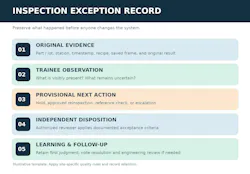
Where a score is recorded, operators should document its meaning and threshold rather than assume it represents a probability of correctness.
The most valuable element, however, may be the operator's initial assessment. Before reviewing the final disposition, trainees should record a brief observation and proposed next action.
For example: Bright reflection extends across multiple edges; surface damage not confirmed.
Possible actions might include holding the part, comparing it with a reference image, requesting a repeat capture, or escalating the inspection.
The final review should document the disposition, supporting evidence, and responsible reviewer. Preserving the operator's original assessment creates a record of how judgment evolves as evidence becomes available.
Use Examples, not Warnings
Consider three similar housings that produce a bright streak near the same polished corner.
A trainee initially classifies all three as scratches. Review shows that two images contain reflections caused by part orientation, while the third contains a physical defect confirmed during secondary inspection. The lesson is not simply whether the trainee was right or wrong. It is learning to separate an observation from a defect claim and identify what evidence is needed to support a decision.
That distinction becomes increasingly important as operators work alongside AI-assisted inspection systems.
Build Judgment through Short Review Sessions
One practical approach is a weekly review led by quality and vision engineering personnel. Select a small set of anonymized cases, including false rejects, confirmed defects, and unresolved inspections.
For each case, present the original image and system output before revealing the outcome. Ask trainees to identify:
- Their preliminary assessment
- Missing evidence
- The appropriate next step
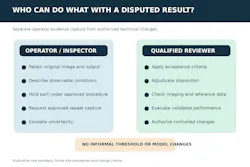
Afterward, reveal the verified disposition and discuss any disagreements. The objective is not consensus but evidence-based reasoning grounded in established inspection criteria.
Research on expert decision-making and AI delegation suggests that experienced professionals often prefer to retain authority over complex judgments while using AI to support routine tasks. Although such studies typically examine knowledge work rather than industrial inspection, they reinforce the value of training workers to evaluate and verify automated results rather than simply accept them.
A Feedback Mechanism for Engineering Teams
Exception logs can also highlight recurring system-level issues. Repeated disputes involving the same field of view may indicate lighting, positioning, or imaging problems. Basler's guidance on machine vision illumination highlights the effects of glare, shadows, and surface reflectivity on feature visibility. Other patterns may point to unclear acceptance criteria, insufficient training data, or weaknesses in validation procedures.
Viewed this way, the exception log becomes more than a training tool. It provides a structured path for identifying opportunities to improve inspection performance.
Measuring Success
Manufacturers considering this approach should begin with a limited pilot focused on a single station or defect category.
Metrics might include:
- Correct identification of inconclusive cases
- Appropriate use of escalation procedures
- Accuracy on independently adjudicated sample sets
- Time required to resolve exceptions
False rejects and defect escapes should be tracked separately, since aggregate accuracy metrics can conceal meaningful shifts between the two.
As discussed in an analysis of AI vision performance metrics between Vision Systems Design and Cognex CEO Matt Moschner, throughput, yield, user interaction, and ongoing KPI review remain important measures of system effectiveness. Training outcomes should complement those metrics, not replace them.
The clearest sign of progress may be an operator who recognizes when available evidence is insufficient and knows what to do next. A well-designed exception log helps develop that judgment while providing quality and engineering teams with a structured record of where inspection systems and workflows can improve.
About the Author
 Gleb Tsipursky, Ph.D.
Gleb Tsipursky, PhD, a behavioral scientist, CEO of Disaster Avoidance Experts, and author of The Psychology of AI Adoption at Work: From Resistance to Results (Georgetown University Press, 2026)