Machine Vision Moves Beyond the Bin in Automated Storage
Key Highlights
- Kardex’s picking assistant uses projected instructions and hand sensing to make workstation interactions more intuitive.
- Vision and other sensors can support scanning and bin-level tasks, but must be evaluated for cycle-time impact and real-site conditions.
- FulfillX coordinates inventory and orders while local equipment handles sensing and actions at the workstation.
- Vision-guided robotics can respond to product presentation and variation, though applications still require validation.
- Uptime depends on lifecycle support, preventive maintenance and practical measures to keep sensors clean.
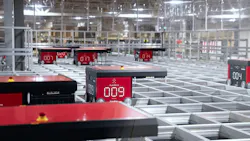
In automated storage and retrieval, vision can do more than identify an item. Integrated with sensors, software and workflow design, it can simplify picking, handle changing inventory and help protect system uptime.
Warehouse automation is under pressure to deliver faster fulfillment without sacrificing accuracy, even as labor availability and product mix change. In a conversation with Vision Systems Design, Fred Fox Jr., president of Kardex Solutions Americas, described how machine vision supports that effort—not as a stand-alone feature, but as one part of an integrated automation system.
Kardex works across a range of warehouse technologies, from vertical lift modules and carousels to pallet handling and AutoStore systems. In its AutoStore deployments, Fox said, the strategy is to let the core system do what it does best, then add tools around it to address specific operational needs.
Vision as Part of the Picking Interface
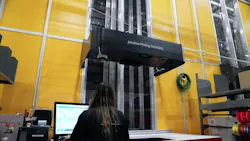
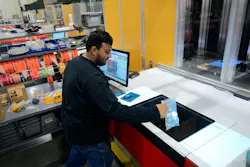
One example is Kardex’s intuitive picking assistant. At an AutoStore carousel port, an overhead projector and camera system present picking instructions directly at the workstation. Sensors detect where an operator’s hand moves, allowing the operator to interact with projected controls rather than relying on a conventional monitor or touchscreen for basic tasks. “How can you increase quality? How can you increase speed, even reliability?” Fox said.
The goal is a more intuitive interface that reduces training demands and helps operators become productive quickly. When we spoke, Fox framed this as a labor and usability challenge. He said warehouse teams need to meet rising service expectations, while reducing the time spent training workers on complex processes.
The system can also support barcode scanning and capture of serial information, such as an IMEI or a medical-device identifier, depending on the application’s business rules. Fox said that the value depends on making identification fast enough to fit naturally into the workflow. If a vision system adds several seconds to every pick, a handheld scanner may be the more practical choice.
That point is relevant to system design: vision should be evaluated not only on recognition performance, but also on its effect on cycle time and operator interaction.
Combining Cameras and Sensors
Fox described a mix of 2D scanning, camera-based sensing and other sensors, with 3D scanning under consideration. At a carousel port, for example, sensors can estimate how much product is in a bin by measuring the distance to the bin and the product surface. The camera and other sensors work together to support the process.
Environmental conditions remain part of deployment planning. Many installations operate well under typical warehouse conditions, Fox said, but unusual light—such as direct sun entering through a window at a particular time of day—can affect performance. “Is this really a one-day thing…or is it actually showing and highlighting a larger issue?” he said.
The response is to assess whether the problem is an isolated event or a symptom of a broader condition that warrants a design change. For integrators, that highlights the importance of testing at the actual installation site. Ambient light, dust, product presentation and workstation layout can all influence performance, even when the underlying equipment is consistent.
Connecting Vision to Warehouse Execution
The picking assistant is integrated with Kardex’s FulfillX warehouse execution system (WES). FulfillX manages inventory, orders and allocations, while the local picking assistant unit handles actions at the port—such as responding when a bin arrives, interpreting a scan or detecting an operator interaction.
Fox described the local unit as a computer that runs machine-level logic and communicates with FulfillX, which controls the overall flow. That division lets the vision-enabled device work within the broader system rather than operating as a disconnected station. It also supports deployment across multiple ports through configuration and integration with the site’s network infrastructure.
The architecture illustrates a practical integration principle: local sensing and response can be handled close to the workstation, while order and inventory decisions remain coordinated by the WES.
Adapting to Changing Products
For basic picking assistance, Fox said, new products are generally not a major issue: the system is primarily concerned with where the item is expected to be and what is present. Robotic picking introduces more complexity, particularly when products arrive in different orientations or shift inside a bin.
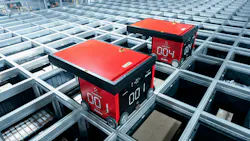
Fox pointed to AutoStore Carousel AI, developed with Berkshire Grey and AutoStore, as an example of a system designed to respond to what the camera sees at the time of picking. Rather than relying entirely on preloaded product dimensions, the system captures an image of the presented bin and uses algorithms and machine learning to determine how to grasp the item.
In a customer demonstration involving aftermarket automotive parts, Fox said, the system picked products that had not been sent in advance for testing—including bags of washers and nuts and bolts—after the team created the SKUs, inventory and order in FulfillX. The example illustrates how vision-guided robotics may help manage variation, though each application still needs to be validated against its own product range and operating requirements.
Design for Uptime, Conditions on Site
Fox identified uptime and availability as the primary measures of success. He said Kardex commits to a minimum 99.8% uptime target for relevant systems and emphasized that deployment is the start of a long-term operating relationship, not the end of a project.
That lifecycle approach includes introducing service and support teams before go-live, regular customer-success reviews and preventive maintenance. “Warehouses are dirty. They have cardboard. They have dust,” Fox said.
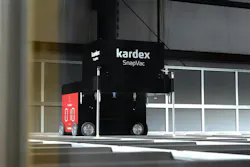
Kardex has also developed tools to reduce maintenance-related downtime. A robotic vacuum can clean the AutoStore grid, where dust and cardboard can contaminate sensors; a sensor-cleaning station uses compressed air to help keep robot sensors clear.
For machine vision and automation teams, these examples highlight that system availability depends on more than the camera or recognition algorithm. Cleanliness, preventive maintenance, support processes and the ability to address faults quickly all contribute to performance in production.
Fox said FulfillX is typically installed on-premises today, with a cloud-based WES in pilot deployments. The software is product-based, and Kardex provides updates—typically once or twice a year—with new functionality available to customers under the licensing model.

Keep the System Simple and Flexible
Asked what operating experience has taught him, Fox said, “Keep it simple, and I guess…another synonym there would be flexibility.” Highly bespoke systems can be difficult to adapt when demand, product mix, or business priorities shift. Standardized platforms, by contrast, can be easier to deploy across sites, while modular additions allow teams to address specific workflows.
The same principle applies to vision. A system should be designed around real operating conditions, not an idealized use case. Integrators need to assess how it behaves with actual products, lighting, dust and layout—and ensure that its contribution to throughput and accuracy justifies the added complexity.
AI’s Value May Come in Small, Connected Improvements
Fox expects machine vision and AI to advance through a collection of focused applications rather than a single technology that solves every warehouse challenge. AI may improve software development and testing, help operations teams evaluate ideas more quickly, and support more adaptive item recognition.
One potential use is identifying differences between a product’s recorded dimensions and what the system observes. If that information can be assessed reliably and used to improve item-master data, it could address a persistent operational problem. Fox cautioned, however, that AI is not a silver bullet. Its impact may emerge as multiple smaller capabilities are integrated into warehouse systems.
For engineers and integrators, the takeaway is that cameras, sensors and machine learning are enabling technologies: their value depends on how well they fit the application, connect to the software stack and support operational goals. As Fox put it, vision may be an “unsung hero”—not always the most visible part of an automation cell, but often essential to making the larger system work.
About the Author
 Sharon Spielman
Head of Content
Sharon Spielman joined Vision Systems Design in January 2026. She has more than three decades of experience as a writer and editor for a range of B2B brands, most recently as technical editor for VSD's sister brand Machine Design, covering industrial automation, mechanical design and manufacturing, medical device design, aerospace and defense, CAD/CAM, additive manufacturing, and more.