Next-Generation Tank Cleaning: Machine Vision, AI, and Custom Nozzles Enhance Efficiency
Key Highlights
- The system uses a custom adaptive nozzle with two rotatable axes to reach all tank areas, including hard-to-clean spots, reducing cleaning time by about 25%.
- An embedded machine vision system detects food residues using primarily UV light, enabling targeted cleaning and reducing resource waste.
- Operators select cleaning paths and parameters via a 2D visual map, allowing customized cleaning strategies for different tank areas.
- Fraunhofer plans to incorporate AI into the control software in version 2.0, enabling the system to learn and improve cleaning efficiency automatically.
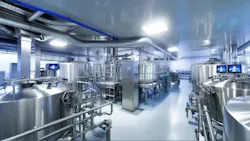
The Fraunhofer Institute for Process Engineering and Packaging IVV (Freising, Germany) developed a machine vision-based approach to jet cleaning industrial tanks, such as those used in food and beverage processing.
The institute, which specializes in applied research on industrial processes, plans to test version 1.0 of the system at a customer’s site beginning as early as February 2026. The customer will likely be either a brewery or dairy.
Fraunhofer also is developing version 2.0, which will be fully automated and AI-enabled, supporting continuous improvement in cleaning efficiency as the algorithms learn.
Inefficient Legacy Tank-Cleaning Processes
Typically, manufacturers perform tank cleaning based on the worst-case scenario. A standard program is performed after a tank has been in use for a specified number of hours. The standard cleaning process is the same for all tanks, which vary in size from 3,000-50,000 L and may have different amounts of contamination. The entire program includes a prerinse, several cleaning cycles, and final disinfecting cycle.
Because the cleaning isn’t customized, manufacturers often clean already-clean areas repeatedly while missing contamination stuck in hard-to-clean areas such as the fill line, sensor connectors, and manholes.
“Basically, all tank cleanings that are happening in the world right now are wasting extraordinary amounts of resources,” explains Max Hesse, chief engineer for processing and cleaning systems at Fraunhofer.
Related: Optimizing Machine Vision Lighting for Food and Beverage Inspection
Hesse and other team members at Fraunhofer set out to change this dynamic. They wanted to cut the volume of resources—such as water and chemicals—used in the cleaning process as well as the amount of time involved. They focused their work on the prerinse and cleaning processes, which occur before the final sanitation cycle.
An Adaptive Approach to Tank Cleaning
The Fraunhofer approach uses the geometry of the tank and level and location of contamination to guide the cleaning process for a specific tank.
Fraunhofer developed an adaptive cleaning nozzle, called AJC. It is in commercial use at food processing companies in Europe and the United States.
AJC has two independent and freely rotatable axes that allow cleaning paths to be adjusted based on the geometry of a tank. The AJC can reach every corner of the tank, including difficult-to-clean areas of a tank. Through control software, an operator can select a specific cleaning path and motion, such as zigzag or spiral.
The preprogramming method reduced cleaning time by about 25% compared to traditional methods.
The Importance of a Machine Vision Approach
Better cleaning coverage of a tank was only a partial solution, Hesse says. What was missing was visual in-line intelligence that is updated as the tank cleaning process occurs. That’s where AJCsens 1.0 comes in. It includes a custom and miniaturized vision system that is integrated into the cleaning head of the AJC. System control is managed by hard-coded software algorithms.
Related: Harnessing UV-C LEDs for Advanced Inspection and Quality Control
The camera system combines visible and UV image data to detect food residue on the surface of the tank. It does not detect individual microorganisms.
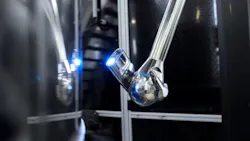
Components of the Vision System
The components in the machine vision system include:
- A custom 5 MPixel global shutter CMOS sensor from Balluff (Neuhausen, Germany). The product, BVS CA-CC1-0051FC, was created specifically for this project.
- Three white-light LEDs from Balluff
- An autofocus liquid lens from Balluff
- An IVV-Spot10W, a high-powered UV LED operating at a wavelength of 365 nm. The custom UV, sold under the LUMIMAX brand, was created by iiM AG (Suhl, Germany) specifically for this project. It has an integrated controller and is designed to operate in harsh environments.
The entire system is sealed in a protective enclosure to prevent damage from the tank cleaning process. Image transmission, camera control, and power supply are provided via a single coaxial cable connection. The power consumption of electronics is around 1W.
How the Vision-Based Automated Process Works
To start the cleaning process, a color image of the tank is captured with illumination from the vision system’s white LEDs, which is then displayed on a computer monitor as 2D map of the tank’s interior.
A human operator uses the 2D map to select specific cleaning paths and parameters for difficult-to-clean areas of the tank. The choices include paths such as intense spiral cleaning for a process connector or concentrated meander path for the filling line. Associated parameters include path spacing and water jet movement.
Related: Lufthansa Developing Vision System to Analyze Food Waste
The system cleans the remaining tank surfaces with a global helical path, moving from top to bottom.
The actual contamination-detection process is carried out primarily using the fluorescence method to detect food ingredients—such as proteins, vitamins, fats, or oils—present on the tank’s surface. These are made to fluoresce by targeted excitation from the integrated high-power UV LED. Because the stainless-steel surface of the tank does not fluoresce, the system delivers a strong signal distinction, and the contamination stands out in the images.
After one round of cleaning, AJCsens uses UV illumination to perform another scan, revealing where the tank is still dirty, and the system cleans only those areas again with a quick standard rinse. This process is repeated until the entire tank is clean.
In November 2025, Fraunhofer began a two-month stress test of the system in which it will run 24/7 and generate “thousands of hours of operating results,” Hesse says.
Next Steps for the System
Fraunhofer’s engineers are building AI capabilities into the control software. By learning continuously as more tank cleanings are performed, Hesse thinks the AI-based version will unlock an additional 10-20% in time savings. Version 2.0 also will be fully autonomous, meaning that operators will not need to choose cleaning paths and parameters manually.
Fraunhofer hopes to release version 2.0 in late 2026.
About the Author
 Linda Wilson
Linda Wilson
former Editor in Chief
Linda Wilson was on the team at Vision Systems Design from 2022-2025.