Is Good Help Hard to Find? It Depends on Whom You Ask
Key Highlights
- More respondents believe there is an engineer shortage than not, but the percentage has decreased from last year.
- Key sectors reporting hiring difficulties include machine learning/AI, software, and systems engineering.

Vision Systems Design’s 2025 Salary and Career Survey is in and VSD readers have spoken, and some of the trends are interesting.
This year’s survey indicates once again that more respondents believe there is a shortage of engineers in the workforce than not. In fact, of 82 of the 138 survey respondents who answered the question “Do you believe there is an engineer shortage?” more than half, 47 (57.32%), said they do believe there is an engineer shortage, while 35 (42.68%) said they do not believe there is an engineer shortage.
However, compared to last year’s survey, the number of people who believe there is an engineering shortage seems to have shrunk. According to the 2024 survey, of 102 respondents who answered the question, 71 (69.61%) answered yes, while 31 (30%) said no.
While there were more who responded to the question in 2024, the percentages indicate a downward trend in the number of VSD readers who believe there is an engineer shortage.
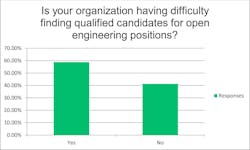
In addition, the number of respondents who say their organization is having difficulty finding qualified candidates for open engineering positions seems to have dropped, as well. In this year’s survey, of 80 respondents, 47 (58.75%) say yes, while 33 (41.25%) say no.
Comparing the number of responses to the 2024 survey, of 100 respondents, 72 (72%) said their organization had difficulty finding qualified candidates for open engineering positions, while 28 (28%) said no.
Related: Engineering is a Great Career. More People Should Get Into it
Related: Engineers Report High Satisfaction Amid AI-Driven Change
Where Are Engineers in Short Supply?
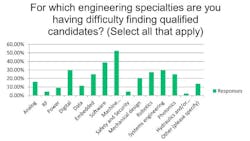
In the 2025 survey, 44 respondents reported difficulty in finding qualified candidates, with the top three sectors reported being machine learning/AI, 23 (52.27%); software, 17 (38.64%); and systems engineering and digital, 13 (29.55%), respectively.
By comparison, of 72 respondents in 2024, the top three sectors that reported difficulty finding qualified candidates were machine learning/AI 39 (54.17%); software, 37(51.39%); and systems engineering, 28 (38.89%).
Of 91 respondents, 30 (32.97%) report that their companies are seeing an increase in hiring staff and another 24 (26.37%) report their companies are increasing in hiring for certain areas of expertise, such as AI.
On the other hand, deciding who exactly is hurting for engineering candidates can be a little tricky. For example, of 80 respondents, 29 (36.25%) say their companies are planning to increase the number of engineering jobs. However, 39 (48.75%) say their companies are planning to maintain its current number of engineering jobs, while another 10 (12.5%) say their companies plan to replace or reduce staff with AI and two (2.5%) say their company plans to scale back engineering staff.
How Much Experience Is Required?
Of 79 respondents, 46 (58.23%) say they are looking for candidates with at least three years of experience, 24 (30.38%) say they are asking for at least five years of experience, and nine (11.39%) are seeking candidates with 10 years of experience.
There was no category for less than three years of experience listed on the survey. However, one respondent notes, “It seems like industry-wide hiring is slowing down and new graduates are having a harder time than ever landing their first position.”
Geography of Respondents
According to the survey, most of the 138 respondents are based in the U.S., with the top three cohorts identifying as follows: 45 (57%) U.S., 13 (16.67%) Europe, and six (7.69%) Asia/Pacific. Other areas respondents identified included five (6.41%) based in Africa, three (3.85%) based in Canada, two (2.56%) based in the Middle East, and one (1.28%) based in India. Another three (2.85%) identified as “other.”
About the Author
 Jim Tatum
Jim Tatum
Senior Editor
VSD Senior Editor Jim Tatum has more than 25 years experience in print and digital journalism, covering business/industry/economic development issues, regional and local government/regulatory issues, and more. In 2019, he transitioned from newspapers to business media full time, joining VSD in 2023.