Building Trust in Intelligent Automation: How Yaskawa’s ISO Certification Enhances Data Protection
At a time when AI, robotics, and connected automation are rapidly changing manufacturing, the security of information has become as important as the innovations themselves. Yaskawa America, Inc. recently solidified its commitment to information security by earning independent certification to the ISO/IEC 27001:2022 standard—the global benchmark for managing and protecting sensitive data.
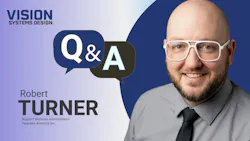
This accomplishment crowns a dedicated three-year effort led by Support Services Administrator Robert Turner, involving cross-functional teams and rigorous third-party auditing. It signals a deep investment not only in technology but also in the organizational culture and processes that underpin secure, reliable automation.
For engineers and leaders in machine vision and image processing—fields at the cutting edge of AI-driven manufacturing—Yaskawa’s certification offers more than compliance; it represents a strategic foundation empowering customers and partners to confidently embrace the potential of intelligent robotics and software-driven automation.
To learn what this ISO/IEC 27001:2022 certification means for Yaskawa and the broader automation ecosystem, VSD reached out to Turner.
Editor’s note: The following Q&A may have been edited for clarity or style.
Visions Systems Design (VSD): How does achieving ISO/IEC 27001:2022 certification enhance the security posture of Yaskawa’s machine vision and image processing solutions?
Robert Turner (RT): Our journey to ISO 27001 certification provided us with a foundation for structured risk assessments, helping to identify gaps in documentation and best practices. We used this data to develop a priority list of implementation and security enhancements, providing the organization and customers with higher confidence that their information is protected.
VSD: What are the unique information security challenges faced in integrating AI and robotics within connected automation systems?
RT: The risks associated with AI primarily involve ensuring the integrity and accuracy of outputs and protecting the confidentiality of both inputs and training data. Many AI solutions today are susceptible to threats such as prompt injection, sensitive data leakage, and improper output handling. We are balancing innovation and security through an AI Steering Committee, ensuring proper oversight and involvement across the business to support future AI initiatives.
VSD: How does Yaskawa’s information security framework support the shift toward more open, flexible, and software-driven automation architectures?
RT: Our Information Security Management System has driven the organization toward a more standardized workflow for updating and maintaining systems. Establishing secure baselines and standardized procedures helped to identify legacy controls that required updating in order to increase the agility and adaptability of systems to future change.
VSD: In what ways does the certification influence the development and deployment of AI-enabled machine vision systems with evolving learning capabilities?
RT: While this certification does not directly apply to the development and deployment of AI vision systems, our path to certification has reinforced a security culture throughout the organization, encouraging security considerations across the project lifecycle.
VSD: How is Yaskawa training engineers and technical teams to embed security best practices during the design and implementation of automation solutions?
RT: We have implemented a "security by design" approach to software development for internal processes and are investigating additional tools to support our developers and mitigate vulnerabilities throughout the software development lifecycle.
VSD: Can you share insights on future threats or vulnerabilities in machine vision and robotics that Yaskawa is preparing to address through continuous security improvements?
RT: The research on computer vision attack methodologies is rapidly evolving, and we continue to monitor emerging publications and industry guidance to strengthen our security posture and improve our ability to protect against these threats.
VSD: How does this certification reinforce Yaskawa’s leadership in delivering secure, reliable automation that meets the rigorous demands of modern manufacturing environments?
RT: Our Information Security Policy states that "We Protect Information," and that is the foundation of our Information Security Management System (ISMS). We continue to strengthen the security of our organization and systems against emerging threats while enabling strategic initiatives and maintaining the high level of service and ease of doing business that our customers expect.
About the Author

Sharon Spielman
Head of Content
Sharon Spielman joined Vision Systems Design in January 2026. She has more than three decades of experience as a writer and editor for a range of B2B brands, most recently as technical editor for VSD's sister brand Machine Design, covering industrial automation, mechanical design and manufacturing, medical device design, aerospace and defense, CAD/CAM, additive manufacturing, and more.