The Future of Physical AI: Networks as the Foundation
Key Highlights
- Manufacturers are redesigning networks to meet the demands of vision systems and robotics.
- Networks are now the backbone for deploying physical AI in industrial environments.
- Key bottlenecks such as latency, bandwidth, and security must be addressed to scale AI effectively.
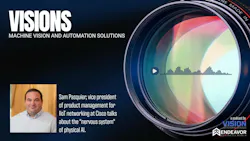




In this episode of Visions: A Machine Vision and Automation Solutions Podcast, VSD's Jim Tatum interviews Cisco's Samuel Pasquier about why networks are becoming the foundational infrastructure for physical AI as vision systems and robots move from pilot to production. They discuss Cisco survey findings, key bottlenecks such as latency, bandwidth, lifecycle management, and security, and real-world lessons from manufacturers who had to redesign networks to scale AI.
Visions: A Machine Vision and Automation Solutions Podcast, is the podcast for engineers, designers, integrators, and end users who want to keep an informed eye on the imaging and machine vision industry. Every Tuesday we will explore the latest in imaging trends, developments and solutions. Here you will find interesting, useful insights and observations from expert interviews, solo episodes, even the occasional panel discussion, all of which aim to expand your knowledge on imaging and machine vision.
Related: Embedded AI and Smart Cameras: The Next Decade of Machine Vision
Transcript
Well, hello and welcome to Visions: A Machine Vision and Automation Solutions Podcast. I'm your host, Jim Tatum, senior editor of Vision Systems design and Visions is an Endeavor Business Media production from your friends at Vision Systems Design. Here you'll find the latest on everything from end user machine vision solutions to trends, developments, and perspectives on all things machine vision and imaging. Whether you've been working in the industry for a while or you're just starting to take a closer look at it, this podcast is designed to grow your knowledge and bring greater focus to your understanding of the imaging and machine vision industry. And now on to our show.
Well, hi everybody, and welcome to Visions. You know, when people think about AI and manufacturing, they usually focus on the models, the cameras or the robots. But as AI moves from generating text to controlling physical systems, another technology is becoming mission critical: the network. On this episode of visions, we're joined by Cisco's Samuel Pasquier, vice president of product management for industrial IoT networking. And we're going to talk about what happens when machine vision and robotics move beyond pilot projects into production, and why AI is creating new demands on industrial networks, and what manufacturers need to do now to prepare for the era of physical AI. So let's get started. Welcome, Samuel. Thanks very much for joining us today.
Thank you. Thank you. Very nice to be here.
Okay. Well, first thing we'll get into is I'm understanding this. You're saying the network rather than the hardware is rapidly becoming the foundation of physical AI. So if you would, if you could talk a little bit about that, for example, what changes when AI starts controlling machines instead of simply generating information?
Yeah, sure. Thank you for asking. So first, you know, what I would like to share is look, Cisco has been a in a IT company for more than forty years. And we are very well known for that. We have been in the industrial network for more than twenty years, and what we did two years ago is we wanted to get the state of industrial network, what's happening, where are things going, and so on. So in 2024, when we did the report, State of Industrial Network, and a significant portion of the people we asked told us that AI will change everything. So guess what? Last year we came back and we did another survey, this time on the state of industrial AI, what's happening in Asia? So we asked more than one thousand customers, three hundred and fifty of them were manufacturing leaders to share their view. So what I'm going to share today is not Samuel's or Cisco's opinion. It's more what we've learned from a survey of a thousand people working in industrial companies, 350 of them being in manufacturing. Right. So to go back to your question on what is changing and what are people doing, I think a majority of the customer have been, uh, I would say exploring with the eye and are now deploying AI. So what we've learned is 59% of manufacturer customers are deploying AI. And AI can come in different shape and form. It can come from doing what we call device driver analytics, getting more data to be able to optimize the process, optimize the quality. Or it can be use AI to control the machine. It's more what we now call physical AI. I camera see something, we take action. You act on the physical world and no matter what. You look at the network is a key element of deploying AI into your industrial environment. If it's about collecting data, the key things that people are going to be thinking of will be okay, if I start to collect the data out of this machine will create bottlenecks somewhere else in my industrial environment. And unfortunately, sometimes it does because the industrial network has been not, I would say, upgraded to the level they should.
Now, when you talk about physical AI, I want the robot to move the robotic arm to move based on something. I see. The latency matters because you don't want, you know, there is a safety implication when things are moving and when a robotic arm is moving. You don't want that to touch a human body, you know, for example. So the latency is the safety, all of that matters. And the network is enabling to connect all of that. So let me stop here for now. We can talk more.
Okay. Well, I know our initial contact with you all had to do with Cisco's research, which found that 97% of industrial leaders are expecting AI workloads to affect network requirements. So what are the biggest network bottlenecks manufacturers are running into today as they deploy these AI driven vision systems and robotics?
Yeah. That's right. So there's a few of them. The first thing is a lot of the solutions are really sold as package that you have to replicate in your environment. So what I would say is the number of cameras for machine vision deploy in manufacturing have increased roughly forty x in the last three years. And now every time you deploy a camera, if you have to deploy a box to run software for the camera, that means you're adding a lot of boxes into your environment that run software. Then you have to manage all of that. So there is a better way. A better way is to connect the camera to the network using technology like power over Ethernet to power the camera so it simplifies the deployment. And then there is the idea of bringing the data directly to a server to take action, or to sell the data for historical or for further analytics. And when you start to do that, then you are bringing to the network device that will generate way more data than what a typical PLC or a motion sensor will do. And that's where you need to size the network properly. So you have enough bandwidth capacity to be able to capture all this data. I'll take an example. Uh, we have customers in automotive. They will take picture of every spot weld, to be able to, uh, qualify the quality of the world, right. You can imagine on the car the amount of data they would have to, to keep and store, and they will want to do that for record purpose. You know, if they have a problem with the cars, they can know and find out what happened during the production. So those kind of use cases generate data that need to transit through the network. So the industrial network needs to be properly sized to be able to enable those use cases.
Okay. Okay. Well, to follow up or possibly restate a little. Um, with, uh, manufacturers have successfully demonstrated AI in their pilot projects. So what network challenges are tending to emerge when they try to scale those applications across multiple production lines?
Yeah, I think the key thing is really about how do you manage the lifecycle of those applications, right? And I think that's a real challenge. You will deploy those pod, you know, those, uh, sell those gas station where you will have the machine vision and so on. Now, if you have a big facility, it's not only one station, you will have plenty of station. And then comes the problem on how are you going to do the lifecycle management of the software comes the problem. If you are going to use AI with model, or are you going to do the upgrade of the model across those large systems? So it's all about, you know, when you are trying to do automation in the industrial world is how you optimize the automation of every steps of the process. And deploying software at scale is a challenge. And that's where at Cisco, we've done a few things to be able to help on that, like the virtualization of the software, being able to run the software into a data center where you can now leverage the data center technology, virtualization technology very well understood in a data center, in an initial environment.
Okay, Okay. Um, well, for machine vision applications that require real time decisions, how critical are factors such as latency or bandwidth, um, reliability and where the company's most likely to underestimate these factors importance?
Well, I don't know if they're underestimating, but I would say the key thing is around safety. Uh, you know, when, if you have, um, like a robot that is controlled by a camera, let's do a, let's say a pick and place, right? You have to pick a place and, and pick a part and move it somewhere. If you have this robotic arm moving. The key thing is, is how do you make a decision making sure you are not going to put anyone at risk. So there is all the physical safety that is really under. But even if you have a fence around it, you still want to make sure that everything is controlled. So that's one of the challenges that is key to how fast can you take action? If the camera sees something and you take too much time to take action and that's gone, you know that's useless. So the latency matters. Uh, your ability to capture the information and take quick action with matters. And that's where, you know, from my standpoint, I tried to take the analogy of the nervous system. Your eyes can see and you use your nervous, your arm. Well, the network is this nervous system of the plants. The camera can see the robots can move. How do you connect the camera to the robot is through the network, small or large? The larger the network, the more thing you can connect. The more information you can have, the more holistic view of the system. You can have the smaller network, you have less information, you are more isolated. You may not gain the full benefit of having the full view. So that's kind of the trade off that you have to do.
Okay. Okay. Thanks. Um, let me ask you this, uh, as more AI processing moves to the edge, what does the ideal balance look like between edge computing, cloud resources and the industrial network connecting them?
Yeah. So I think it's all about what is the shelf life of the data and the information, right? Some of the information you. It's very, uh, like, let's say you are tracking a pod that is moving with a camera, knowing the position of the port, not very useful, uh, because, you know, you want to move the robot, but if you move the robot, the data, you don't care about where the parts here anymore, you know, to some degree. I'm just trying to take an analogy. In some of the cases, let's say you are in food and beverage, you want to do traceability. So you will want to have camera to look at the QR code on some of the food you will produce, and then you want to be able to keep it. So I think the trade off is about what the use case, what the shelf life of your data. And based on that, what do you want to store it? If the data is very, I would say a short life, then maybe it lives at the edge. If the data need to be kept on a longer basis for traceability, maybe that's something you want to move to the cloud so you have more. So that's really the trade off of people have to do. And then there is a shelf life of the data and the size of the data. The more data you collect, the bigger the data you're going to collect than the pipe. If you want to send it to the cloud will have to be bigger. Your your storage will be bigger. So, you know, all those kind of things that people have to assess to decide what to do. But no matter what you do at the end, the network is a critical element to connect all those assets. And you know, my observation, talking to customers, you don't want it to be in a situation where you have a lot of machines, you want to collect data from the machine to improve your efficiency, but you cannot because you don't know if your network is capable and people are scared to, hey, I'm going to turn on device level analytics on all those machines, but suddenly you create a bottleneck somewhere in the network and your PLC is stopping to work. You don't want that. And that's why there need to be a conscious decision. The network is super critical. You need to design it properly. You need to size it properly with the right attributes, the latency, the performance, the bandwidth, and also the security. Because if you are sending data to the cloud, then the security will be super important. You don't want intruder to come back and take control of your infrastructure.
Okay. All right. Well, that one, can you share any real world examples where network infrastructure became the limiting factor in an AI deployment. And what lessons could a manufacturer take away from such an experience?
Yeah, no, that's a very good one. I had a I had a customer recently that they tried to deploy a solution where they use cameras across the factory to be able to observe workers to be able to, uh, you know, optimize the work movement and optimize the cycle time on the line, right? So let's imagine you have a line, you have a lot of different worker doing assembly or different things. If you can observe the worker, you can see where you are wasting cycle time and where you can optimize. But now to be able to do that, you have to capture a video, a lot of video from a lot of cameras, analyze all those cameras to be able to correlate all of that together to, to see where are you wasting cycle time to do that. The amount of data is critical. If you do that onto your existing usual network. Chances are, if you have not thought about it before, you are not going to have enough bandwidth to do that or you're going to impact the traffic. Like let's say the, the, the PLC traffic, which you don't want to do that. And that's a little bit of the change that we see. So we have some customers going and deploying another, a new network to be able to deploy those use cases. And that will work. But then the challenge that you have is you have a, your industrial network for your PLC. Then you are building another network to have those cameras to do your process optimization. It just doesn't scale. It's very hard to manage and operate. It's like too complex. So that's where I think, uh, thinking about the network as an initial network, as a critical, uh, foundation for your AI is critical. You build it right, you size it right with the right property. Then you can enable those use cases and build on your AI adoption without hitting a blockage or a situation where this is not scalable anymore. And I think that's where we get engaged a lot with our customer to make sure they build an architecture that is safe, secure, scalable, and most importantly, sustainable by people to operate those infrastructure. Right?
Yeah. Okay. Well, looking ahead then, if a manufacturer is investing in physical AI today, what networking capabilities should they be building into the infrastructure now to avoid, you know, costly upgrades a few years down the road?
Yeah, I think, you know, when we talk about physical AI, it's all about the physical world. And there is a concept of mobility. And, you know, a lot of the use cases, you know, we may have seen in the news a humanoid robot, uh, I'm not sure when that is going to be deployed at scale. We start to see those, but maybe not at scale yet. But you will have automated autonomous guided vehicles with robotic arm, maybe of them. You will have platforms that are moving. So the mobility aspect is critical and it's you have to not only size the physical wired infrastructure, but also the wireless infrastructure to enable those use cases. And the same example as what I mentioned in the use case before, you can deploy a very one off solution for your AGV solution. But the way the world is moving, more and more things will be wireless. And how many wireless network do you want into your infrastructure? Right. And I think that's the key thing. So designing not only the wired but also the wireless world, to be able to have a little bit like an umbrella coverage where you can turn on and enable the use case is key to have something that is sustainable and actually provides the right value on the long term.
Okay. Um, yes. Uh, to kind of conclude, um, is there any one overarching piece of advice or recommendation or anything you would tell someone who was considering investing and or deploying a physical AI system?
I would say, you know, I'm going to keep repeating myself and maybe I'm biased because I work for Cisco. But look, I've seen so many customer, uh, doing POC that works very well. And then come the rollout and scale and you don't want to gamble with your industrial network. Uh, your industrial network is, like I said, you know, the best analogy I found? I got it from a customer. It's a nervous system of your plant. That's what will connect all the things. If you want to have optimization, you will need to have an overview. How do you get the big Q. How do you get all the data is from the network? So I would say take the time to have the proper architecture. Proper design for the network, because that's an enabler for you to accelerate adoption. And ultimately AI will give you benefits that you will be able to recover if you have the right foundation. Right.
Well, that's a wrap for this episode of visions produced by Endeavor Business Media, a division of endeavor B2B. Thanks very much for tuning in. If you enjoyed today's show, be sure to subscribe to the podcast and share this episode with a colleague who would find it helpful. Until our next episode, you can find us at vision dash systems dot com or on LinkedIn, Facebook or X for more insights, updates, and breaking news to keep you in the know. Thanks for tuning in. Until next time, stay focused on your visions.
About the Author
 Jim Tatum
Jim Tatum
Senior Editor
VSD Senior Editor Jim Tatum has more than 25 years experience in print and digital journalism, covering business/industry/economic development issues, regional and local government/regulatory issues, and more. In 2019, he transitioned from newspapers to business media full time, joining VSD in 2023.