Modular Lens and Lighting Control in Machine Vision
A parcel conveyor can move from a flat envelope to a bulky carton in seconds. The camera’s view changes, the working distance shifts, and the light reflects differently, yet the system still needs to capture a reliable image and read every code.
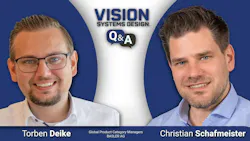
At VISION 2026, Vision Systems Design spoke with Basler AG representatives about why handling those changes is becoming a bigger challenge for machine vision teams. In a follow-up with Torben Deike and Christian Schafmeister, global product category managers for the company, they described a modular approach that lets the camera coordinate lens and lighting through a single GenICam-based interface. The result aims to be less integration work, quicker deployment, and vision architectures that can adapt and scale across logistics and factory automation.
Read what they had to say.
Editor’s note: The following Q&A may have been edited for clarity and style.
Vision Systems Design (VSD): What challenges are your machine vision customers currently facing?
Torben Deike (TD): Cameras, lenses, and lighting have all become much better in recent years. The challenge today is no longer the individual component—it’s making them work together. Each part comes with its own interface, its own software, often its own controller. So, our customers spend a lot of engineering time on integration instead of on their actual application. And that effort repeats with every new project.
VSD: Why is this topic becoming increasingly relevant for companies right now?
TD: Because vision systems are becoming much more dynamic. In logistics, robotics and factory automation you see more product variants, more robots, shorter machine lifecycles—and objects that change in size, height, and position all the time.
The challenge today is no longer the individual component—it’s making them work together.
- Torben Deike
VSD: In your view, what is needed to meet these growing demands?
Christian Schafmeister (CS): Systems need to adapt automatically—and they need to be built from parts that already fit together. That’s what lens and lighting control does: the camera becomes the orchestrator of the entire vision system.
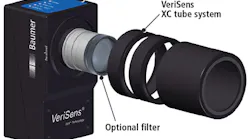
A complete vision system with lens and lighting control only consists of a camera, a lens, a light—and one cable. When the object distance changes, the camera adjusts focus and aperture automatically. At the same time, it adapts the brightness and keeps the flash synchronized with the exposure time. And the light is detected by the camera automatically—no manual parameterization at all.
The interesting part is what’s missing in our system: no external light controller, no second power supply, no second SDK. Everything runs over a single I/O line, through the standard GenICam interface.
And it’s modular. Some customers only need lens control, because the working distance changes. Others only need light control. Many need both—and that’s a choice, not a package. You pick the lens technology, you pick the light type, you connect it with the matching cable variant. The interface stays exactly the same. That’s what allows customers to reuse the same architecture across many machines.
VSD: Can you give a real-world example?
CS: Take a parcel conveyor. Flat envelopes, then a large carton—the distance to the label changes with every item, and so does the reflected light. Traditionally you’d set one compromise and accept that some codes aren’t read. With our approach, the system simply follows the object. Consistent image quality, reliable code reading, no manual intervention.
VSD: In which applications is lens and lighting control particularly useful, and in which is it less so?
CS: There’s a simple rule: does the working distance change, does the illumination change, or both? If the distance varies, you need lens control. If the lighting conditions vary, you need light control. If both vary, the combination gives you the biggest benefit. That’s typically logistics, robotics, electronics inspection, or flexible production lines.
If the distance varies, you need lens control. If the lighting conditions vary, you need light control.
- Christian Schafmeister
It’s less relevant when objects are stationery and conditions are stable; then fixed settings do the job. Although even there, customers often come to us for a different reason: they’ve run out of free I/O lines on the camera, because triggers, encoders, and PLC signals already use them up. We need just one.
VSD: What specific changes do companies experience when they implement Basler’s approach?
TD: Three things. First, less hardware: no external light controller, no extra power supply, less wiring. Second, less effort: one SDK instead of two or three, one interface, automatic detection of the connected light—so commissioning is faster and there are fewer configuration errors. Third, and this is the one customer’s value most over time: they get an architecture they can reuse. The same setup scales across the next machine and the next project.
This is ensured by both the approach itself and by the variety of components from which customers can build their vision systems. In terms of hardware, customers can choose an ace 2 or boost R camera, a liquid lens from Optotune or a motorized lens from Computar, as well as a Basler light and a Basler Sync Cable. Our goal is to provide the right components for every application, so that customers do not have to adapt their applications to the components.
VSD: Does this only work with Basler pylon SDK?
TD: No. That’s a deliberate design decision. We build on the GenICam standard, so it fits into existing workflows if they are using the GenICam standard.
In the end, customers don’t buy lens and lighting control. They buy faster deployment, lower project risk, and a system that scales.
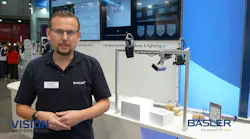
Listen to Torben, Christian, and Justus Basler talk more about the company's vision system architecture in this interview at VISION 2026.
About the Author
 Sharon Spielman
Head of Content
Sharon Spielman joined Vision Systems Design in January 2026. She has more than three decades of experience as a writer and editor for a range of B2B brands, most recently as technical editor for VSD's sister brand Machine Design, covering industrial automation, mechanical design and manufacturing, medical device design, aerospace and defense, CAD/CAM, additive manufacturing, and more.