Bitsensing Launches 4D Imaging Radar for Autonomous Vehicles
Key Highlights
- Provides real-time velocity, range, and elevation data to improve decision-making and object discrimination in autonomous vehicles.
- Operates effectively in challenging conditions such as darkness, rain, snow, and fog.
- Delivers raw radar data access, enabling developers to refine perception models and accelerate large-scale deployment.
- Enhances sensor fusion by offering detailed spatial and motion information.
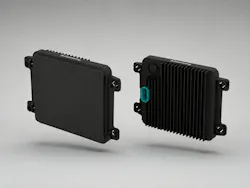
Bitsensing (Seoul, S. Korea) has released a 4D radar system, the AIR4D Imaging Radar, for use in autonomous vehicles.
The purpose of this system is to not only provide a sensor designed specifically for self-driving vehicles, but to move self-driving vehicle technology from the lab to the real world faster and at scale, says Bitsensing CEO Jae-Un Lee. As such, the AIR4D system is designed to deliver detailed 4D sensor data and is optimized for power and heat efficiency. This helps AVs operate more reliably in real-world situations and applications, Lee says.
The AIR4D system also does something many others don’t: it provides raw data outputs to companies that use it. Access to this raw radar data is critical because it enables AV developers to continuously refine perception models, validate performance, and accelerate the path from testing to safe, large-scale fleet deployment.
4D Imaging Radar System at a Glance
The system offers:
• Direct velocity per object. The system measures how fast surrounding vehicles, cyclists or pedestrians are moving in real time, enabling faster and more accurate decision-making for AVs.
• Long-range detection up to 300m. It identifies vehicles and obstacles farther down the road, giving AVs more time to react safely.
• Night/zero-light environment accuracy. The 4D radar can perform in near-total darkness (<0 lux).
• Harsh weather stability. The system delivers strong sensing performance in challenging conditions that can reduce visibility for other sensors, as 4D radar millimeter-wave frequencies penetrate adverse environmental conditions such as rain, snow, and fog. Deep integration with camera sensors. The system works in combination with cameras, and its robust distance and velocity measurements complement the high-resolution imagery from cameras.
How 4D Radar Builds on 3D
The main difference between 3D and 4D radar is that 4D measures velocity in addition to range, left/right, and up/down positioning of an object. In other words, a 3D radar will detect an object at a precise point in space; 4D radar will detect how fast and in what direction that object is moving in addition to where it is.
Traditional 3D automotive radar was designed mainly for advanced driver assistance systems (ADAS) functions, where the radar itself processes and simplifies the environment into predefined outputs. That works for functions such as adaptive cruise control or automatic emergency braking, but it limits flexibility for autonomous driving companies developing their own perception and AI stacks, explains Lee.
“Access to raw or intermediate radar data changes that approach significantly, Lee says. “AV developers can work directly with richer radar information—including Doppler, elevation, and signal-level characteristics—instead of relying only on filtered object lists or fixed-point cloud outputs.”
Another difference is the inclusion of elevation data in 4D radar, which gives radar vertical awareness, allowing the system to better understand the height and physical structure of objects in the environment, Lee notes.
“Traditional 3D radar can detect range, speed, and horizontal position, but it has limited understanding of an object’s vertical shape or height,” Lee says. “By adding elevation data, 4D radar improves object separation and helps autonomous systems better interpret whether an object is actually blocking the vehicle’s path.”
For example, without elevation information, it can be more difficult to distinguish between a large overhead road sign or pedestrian overpass that a vehicle can safely pass under versus a tall obstacle that would result in a collision. Elevation also helps separate roadside infrastructure from vehicles or pedestrians in dense urban environments.
Compared to vision-only systems, 4D radar also maintains reliable perception in conditions where cameras struggle, such as darkness, glare, rain, fog, or low-contrast scenes.
The result is more stable object classification and environmental understanding across a wider range of real-world driving conditions. This also means that radar becomes a more active part of perception and sensor fusion, instead of a secondary validation sensor behind cameras or LiDAR. It also gives AV companies more freedom to optimize how radar data is fused, interpreted, and trained within their own autonomous driving architectures.
Integration Challenges
While 4D radar is a useful addition to AV systems, there are challenges when it comes to integrating it into a radar-camera fusion, especially at scale, in a camera plus radar architecture, Lee notes.
The biggest challenges are time alignment, spatial calibration, and consistency across many vehicles, Lee says.
“Radar and cameras operate differently,” Lee says. Cameras capture rich visual scenes, while radar measures range, velocity, angle, and reflections. To fuse them accurately, the system needs precise timestamps, stable extrinsic calibration, and reliable matching between radar points and image features.”
At fleet scale, this becomes more difficult for a variety of reasons. For one, sensor mounting tolerances, vibration, temperature changes, maintenance, and vehicle-to-vehicle variation can shift calibration over time. In fact, recent radar-camera calibration research shows that accurate extrinsic calibration is essential and that finding reliable correspondences between radar and camera data remains difficult.
Nevertheless, Lee notes, 4D radar can improve the ability to handle such functions pedestrian vs. vehicle vs. roadside object discrimination—in fact, significantly more than previous generations of automotive radar.
“Higher resolution 4D radar provides richer spatial and motion information, allowing autonomous systems to better distinguish objects based on characteristics such as size, shape, height, position, movement, and velocity patterns,” Lee explains. “This improves the system’s ability to separate pedestrians, vehicles, roadside infrastructure, barriers, overhead structures, and other objects within complex driving environments.”
For example, pedestrians typically exhibit smaller and more irregular motion patterns, while vehicles have larger structures, more consistent movement trajectories, and different velocity behaviors. Elevation data also helps determine whether an object is elevated, passable, roadside infrastructure, or directly within the vehicle’s path, he says.
This becomes especially valuable in dense urban traffic, nighttime driving, adverse weather, or partially occluded environments where camera-only systems can struggle.
Next Steps for Implementing 4D Radar for AV Deployment
While 4D radar systems such as AIR4D significantly benefit AV technology, it is not meant to replace existing sensors but rather augment them. The goal, then, is not to replace other types of sensors, but to improve reliability, redundancy, and environmental understanding, especially for situations in which vision-based systems alone become less dependable.
“This is particularly important for AV deployments operating continuously across diverse weather and lighting conditions,” Lee says.
There are also trade-offs between radar resolution, power consumption, and thermal constraints when deploying high-resolution 4D radar in fleet-scale AV systems. For one, higher radar resolution requires more processing, larger data throughput, and more complex antenna architectures, all of which can increase power consumption and thermal load. For AV systems operating continuously at fleet scale, which becomes important because power efficiency, heat management, reliability, and hardware cost directly affect commercial scalability.
“This is one of the key differences between building radar for conventional passenger vehicle ADAS vs. designing radar for autonomous driving platforms,” Lee says. “AV systems require not only higher perception performance, but also architectures that can operate efficiently and reliably over long durations in real-world deployment environments.”
Related: Bitsensing Unveils ADAS Kit for Commercial Vehicles
About the Author
 Jim Tatum
Jim Tatum
Senior Editor
VSD Senior Editor Jim Tatum has more than 25 years experience in print and digital journalism, covering business/industry/economic development issues, regional and local government/regulatory issues, and more. In 2019, he transitioned from newspapers to business media full time, joining VSD in 2023.