Smart Surveillance: The Impact of AI-Enabled Drones on Public Safety and Critical Infrastructure
Key Highlights
- Drones provide quick, cost-effective aerial surveillance with high-resolution imaging and the ability to access hazardous or hard-to-reach areas.
- Advanced AI and machine vision enable drones to detect, classify, and track objects automatically, reducing operator workload and increasing response speed.
- Enhanced imaging systems, including thermal and multispectral sensors, allow for effective monitoring in low-light, fog, or smoke conditions, improving situational awareness.
- Onboard edge computing and AI facilitate real-time decision-making, threat detection, and event flagging, even in low-connectivity environments.
- Applications span border security, infrastructure inspection, emergency response, industrial site monitoring, and public safety operations, transforming traditional security paradigms.
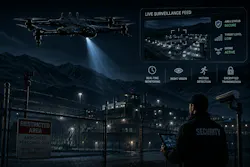
Over the years, integral assets have driven organizations to devise advanced and innovative security and surveillance methods. Traditional surveillance techniques, such as patrols, fixed cameras, and aircraft, remain essential but lack sufficient coverage and quick response times and can be costly. Unmanned aerial systems (UAS), more commonly referred to as drones, provide an aerial (and more adaptable) viewpoint paired with sophisticated imaging and data processing and intelligence.
Apart from capturing aerial images and videos, digital surveillance drones are capable of far more. High-resolution cameras—both visible and thermal—AI object detection, and edge computing are now integrated within drones.
Along with GPS and advanced sensors, drones can deliver timely aerial intelligence for infrastructure security, emergency response, border monitoring, and public-safety operations.[1][2]. As such, several crucial applications of surveillance are being impacted, such as security of different infrastructures, emergency response, surveillance of borders, and various public safety concerns.
Why Drones Matter for Security & Surveillance
Drones can enter many places that otherwise could not be entered. With current drone technology, monitoring potentially dangerous situations is made easier while keeping humans out of danger. They can be used to monitor an industrial facility, inspect isolated infrastructure, or survey areas where a disaster occurred.
Key advantages include:
- Quick to set up
- Cost-effective
- Display high-resolution imaging
- Can be used in hazardous and hard-to-reach locations
- Are flexible in mission planning
- Cover large areas
Because of these advanced drone advantages, they can be used effectively for both routine and time-sensitive security operations.
Machine Vision Is Driving Smarter Surveillance
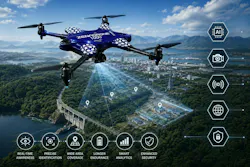
Modern security and surveillance drones must have flying and interpreting capabilities. Drones equipped with machine vision technologies do not have to depend on a human to analyze images. Drone systems that integrate computer vision algorithms. They are capable of detecting artifacts such as vehicles and people. They can also analyze the surveillance region and identify abnormal movement behavior.
Drones utilize edge computing technology and AI-assisted image processing to reduce the operator's workload and empower investigators to respond to security concerns promptly. The combination of advanced security surveillance drone technology, streamlines the analysis of visual data, and renders near-instantaneous reporting to empower security personnel to address threats to the security of the location being protected. Onboard computer vision systems can support object detection, classification, and tracking, although their accuracy depends on factors such as altitude, lighting, weather, sensor quality, and computing capacity [3][4].
Advanced Imaging Technologies Enhance Situational Awareness
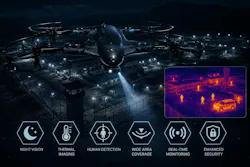
Security operations often last long after the sun sets. To provide the needed visibility, even in the most difficult conditions, surveillance drones come equipped with several imaging systems, which may include:
- High definition 4k, RGB cameras
- Infrared thermal cameras
- Multispectral imaging systems
- Gimbaled, stabilized imaging systems
With the variety of sensors, operators are also able to detect and monitor moving targets and heat signatures and track situations in fog, smoke, and darkness.
AI and Edge Computing Improve Real-Time Decision Making
AI is now a foundational element of contemporary aerial surveillance. Edge computing utilizes onboard processing in the drone, instead of streaming every video frame to a remote control center for analysis.
This approach offers several advantages, including faster threat detection, reduced communication bandwidth, improved operational efficiency, and more reliability in low-connectivity environments.
They use artificial intelligence to classify objects automatically, track multiple targets continuously, identify abnormal behavior, and flag significant events that require human intervention at the earliest. Processing data onboard or near the point of collection can reduce the amount of information transmitted to remote systems and support faster operational analysis, particularly where connectivity is limited.[4][5].
Applications Across Industries—Surveillance or security drones are becoming more pervasive in all areas of public, defense, safety, and even private life.
Border and Coastal Surveillance—Energy facilities, power plants, pipelines, transportation hubs, construction sites, and communication towers require constant surveillance. Drone technology can be used by security personnel to inspect these objects periodically and reveal any suspicious activity at an early stage.
Industrial Site Security—Traditional military patrols can struggle over larger geographical areas. Surveillance using drones makes it possible to monitor several objects and ensures a faster response.
Emergency Response—Drones offer aerial knowledge to responders over natural disasters or public emergencies, which proves useful for search and rescue missions, damage evaluations, evacuation coordination, and resource relocation. Drones can support search and rescue, incident assessment, situational awareness, nighttime operations, and post-disaster damage evaluation.[1][2][6].
Industrial Site Security—In an effort to bolster perimeter security and surveillance operational activity, aerial surveillance is becoming more commonplace at manufacturing facilities, warehouses, construction sites, and logistics centers. Organizations that are looking for developments in advanced security surveillance drone technology can find out how most aerial intelligence platforms work today.
Challenges & Considerations
Despite various benefits associated with using surveillance AI-Powered drones, several aspects should be considered before their implementation.
Regulatory Compliance
Drone operators must comply with the aviation regulations applicable in the country and airspace where they operate. In the United States, many civil small-drone operations fall under FAA Part 107, while certain missions—such as some flights in controlled airspace, beyond visual line of sight, or under public aircraft rules—may require additional authorization or waivers.[7]
Data Privacy
Organizations should establish policies governing what data drones collect, who can access it, how securely it is stored, and how long it is retained. Privacy, civil liberty, and ethical considerations should be evaluated before deploying drones for surveillance or public safety missions.[1][5]
Cybersecurity
Because drones rely on wireless communications and digital systems, robust encryption, secure firmware updates, and secure communication channels are necessary to mitigate cybersecurity risk. Increasingly connected and automated uncrewed systems introduce cybersecurity and AI-related risks, therefore organizations should apply controls for system access, software and firmware integrity, communications, data protection, incident response, and supply-chain risk management.[5]
Environmental Conditions
More adverse weather conditions include strong winds, heavy rains and dense fog that will hamper the flight performance as well as impair imaging.
The Future of Intelligent Aerial Surveillance, Enhanced Autonomy
This leads to a wave of increasing degrees of autonomy, sensor fusion, AI and wider security ecosystems for the next generation of surveillance drones (drone swarms). Tech advancements like 5G connectivity, autonomous navigation, swarm coordination, and sophisticated machine learning will accelerate all of aerial intelligence in terms of both speed and precision. Advances in autonomous navigation, AI, onboard processing, communications, and multi-drone coordination are expected to broaden surveillance capabilities, but they also introduce regulatory, safety, cybersecurity, and ethical challenges.[1][5]
References
- Harriss, D., Sheh, R., & Geappen, K. (2024). Autonomous Aerial Drones Connecting Public Safety: Opportunities and Challenges for the Future. National Institute of Standards and Technology. NIST publication
- U.S. Fire Administration. (2024). DHS Releases Guidance for Unmanned Aerial Systems for Public Safety Missions. USFA/FEMA guidance
- Recent Real-Time Aerial Object Detection Approaches, Performance, Optimization, and Efficient Design Trends for Onboard Performance: A Survey. (2025). Sensors, 25(24), 7563. Peer-reviewed research
- Bithas, P. S., et al. (2022). A Survey on Machine-Learning Techniques for UAV-Based Communications: A Survey on the Convergence of Edge Computing and AI for UAVs
- Sheh, R., & Harriss, D. (2024). Cybersecurity and AI Risk Management for Uncrewed Systems—Challenges and Opportunities Using the NIST Frameworks. National Institute of Standards and Technology. NIST publication
- Von Nonn, J. W., et al. (2024). An Open-Source Workflow for Scaling Burn Severity Metrics from Drone to Satellite to Support Post-Fire Watershed Management. Environmental Modelling & Software. USGS research record
- Federal Aviation Administration. Public Safety Toolkit for Unmanned Aircraft Systems. FAA Public Safety Toolkit
About the Author
 Andrew Mabry
Andrew Mabry
Andrew Mabry is a content strategist at ZenaDrone, writing content about AI, autonomous drones, machine vision, and unmanned aerial systems (UAS).