High-Precision Strobe Illumination Control for TDI Imaging
Key Highlights
- How TDI line scan cameras improve sensitivity through charge integration
- Why transport speed changes affect image brightness
- The importance of precise strobe synchronization for TDI imaging
- Key performance requirements for TDI strobe controllers
- Example implementation using a dedicated line strobe controller

1. Introduction
High-speed industrial inspection requires continuous imaging of moving objects while maintaining high sensitivity and consistent image quality. Time Delay Integration (TDI) line-scan cameras have become a key imaging technology for applications including semiconductor, battery, display, web, and printing inspection.
Unlike conventional line-scan cameras, TDI cameras improve sensitivity by accumulating photo-generated charge or image data from multiple imaging stages synchronized with object motion. However, achieving their full performance requires precise synchronization of the illumination, camera, and transport systems.
In Charge-Domain TDI (CD-TDI) systems, the effective exposure conditions are determined not by the camera, but by the timing and pulse width of the illumination. Consequently, the strobe illumination controller directly determines image quality.
This article explains why high-precision strobe illumination control is essential for CD-TDI imaging, outlines the key performance requirements of a strobe controller, and presents a practical implementation example.
2. Why CD-TDI Requires Dedicated Strobe Illumination Control
Two fundamentally different TDI architectures are used in industrial imaging: Charge-Domain TDI (CD-TDI) and Frame-Domain TDI (FD-TDI).
CD-TDI transfers and accumulates photo-generated charge directly within the image sensor as the object moves across successive sensor stages. Because accumulation occurs before signal amplification and digitization, CD-TDI provides exceptionally high sensitivity and low noise, making it the preferred choice for demanding high-speed inspection.
FD-TDI, by contrast, acquires multiple images independently and combines them digitally after acquisition. Although this approach improves sensitivity, it cannot match the low-noise performance of charge-domain accumulation.
Because this article focuses on maximizing image quality in high-speed industrial inspection, the following discussion assumes a CD-TDI imaging system.
For CD-TDI imaging, charge transfer must remain synchronized with object motion. In encoder-based systems, changes in transport speed directly alter the camera line period and, consequently, the effective exposure time.
Fixed-interval illumination is therefore insufficient. Instead, every illumination pulse must be synchronized with the encoder signal while its timing and pulse width are precisely controlled. Even small timing errors can produce brightness non-uniformity and reduce the accumulated signal-to-noise ratio (SNR).
Ultimately, the performance of a CD-TDI imaging system depends not only on the camera, but also on the precision of its strobe illumination control.
3. Image Brightness Variations Caused by Transport Speed Changes
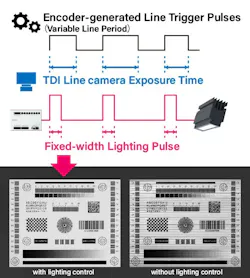
In encoder-synchronized CD-TDI imaging, changes in transport speed directly alter the camera line period and, consequently, the effective exposure time. Shorter exposure reduces image brightness, whereas longer exposure increases it.
Even small speed fluctuations caused by servo dynamics or mechanical vibration appear as line-period variations. Because a CD-TDI camera accumulates signals over multiple sensor stages, these timing errors accumulate, producing brightness non-uniformity and reduced signal-to-noise ratio (SNR).
A practical solution is to illuminate the object with strobe pulses that are significantly shorter than the effective exposure time. When each pulse is synchronized precisely with the encoder signal and remains entirely within the exposure window, the influence of transport-speed variations is greatly reduced.
As a result, the effective exposure is determined primarily by the illumination pulse width rather than by the camera line period, enabling stable image brightness over a wide range of transport speeds.
4. Performance Requirements for Strobe Controllers
Stable CD-TDI imaging requires more than sufficient illumination intensity. A strobe controller must generate precisely timed illumination pulses while maintaining synchronization with both the camera and the transport system.
Three characteristics are essential.
High-Speed Response
Changes in transport speed immediately alter the encoder pulse interval and camera line period. The strobe controller must respond rapidly to maintain synchronization between illumination and image acquisition.
Pulse-to-Pulse Reproducibility
Because CD-TDI integrates signals over multiple sensor stages, variations in illumination timing or optical output accumulate directly in the final image. Every illumination pulse must therefore be reproduced with highly consistent timing and intensity.
Low Timing Jitter
Even with fast response, pulse-to-pulse timing variation changes the phase relationship between illumination and image acquisition, producing fluctuations in the accumulated signal. Minimizing timing jitter is therefore essential for stable image quality.
Together, these characteristics define the performance of strobe illumination control and, ultimately, the imaging performance of a CD-TDI system.
5. System Integration Requirements
Modern inspection systems require precise synchronization of the illumination, camera, encoder, and motion controller. Accordingly, the role of the strobe controller extends beyond illumination control to system-level synchronization.
An encoder-synchronized CD-TDI controller should provide:
- Distance-based trigger generation from encoder input
- Camera trigger outputs synchronized with illumination pulses
- Support for TTL, LVTTL, RS-422, opto-isolated, and open-collector interfaces
These functions enable the controller not only to determine the effective exposure conditions, but also to coordinate the transport system, camera, and illumination as a single synchronized imaging system.
6. Implementation Example: LEIMAC IHP Series
The LEIMAC IHP Series provides the high-speed, high-precision illumination control required for encoder-synchronized CD-TDI imaging. In addition to driving illumination, it generates synchronized camera triggers, enabling coordinated control of the entire imaging system.
The controller delivers illumination response within 3.0 μs and camera-trigger response within 1.2 μs. Illumination timing and pulse width are programmable with 40 ns resolution, enabling precise control of the effective exposure conditions required for high-speed CD-TDI imaging.
The IHP Series supports TTL, LVTTL, RS-422, opto-isolated, and open-collector interfaces. together with aA 32-step sequence control function that automatically switches illumination conditions and timing according to the inspection process. This simplifies synchronization while reducing the processing load on external controllers.
Rather than functioning solely as an illumination driver, the IHP Series is designed as a synchronization controller that coordinates illumination, camera triggering, and encoder timing within a CD-TDI imaging system.
7. Conclusion
CD-TDI line-scan cameras have become a key technology for high-speed industrial inspection by combining exceptional sensitivity with high-speed image acquisition. Their full performance, however, depends on precise synchronization of the illumination, camera, and transport system.
Unlike conventional area-scan imaging, where exposure is controlled by the camera, the effective exposure conditions in CD-TDI imaging are determined by illumination control. Consequently, image quality depends directly on the strobe controller's response speed, timing accuracy, and encoder synchronization.
As inspection systems continue to evolve, the strobe controller will become more than an illumination driver. It will serve as the synchronization hub of the imaging system, coordinating illumination, image acquisition, and object motion to maximize inspection performance.