Transforming Automation: Ritesh Gupta on Zebra Technologies' AI-Driven Platform
Key Highlights
- Single-vendor solutions such as Zebra's offer benefits like streamlined integration but also present trade-offs that need consideration.
- Integrators are shifting focus toward data architecture and AI orchestration to support complex automation systems.
- Front-line teams and engineers require new skills in AI, data management, and system integration to operate modern, connected operations.
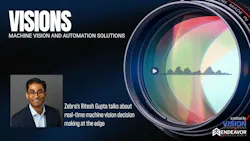



In this episode of Visions: A Machine Vision and Automation Solutions Podcast, host Jim Tatum interviews Ritesh Gupta of Zebra Technologies about the company’s evolution from hardware data-capture to a unified, AI-driven automation platform that integrates machine vision, RFID, mobile computing, and software to enable real-time decisions at the edge.
They discuss the benefits and trade-offs of a single-vendor stack, how integrators’ roles are shifting toward data architecture and AI orchestration, and the skills front-line teams and engineers will need for intelligent, connected operations.
Related: Fixed Scanners, Big Gains
Related: Interview with Tom Bianculli
Related: Total Wine & More Implements Machine Vision, AI to Streamline Store Operations
Visions: A Machine Vision and Automation Solutions Podcast, is the podcast for engineers, designers, integrators, and end users who want to keep an informed eye on the imaging and machine vision industry. Every Tuesday we will explore the latest in imaging trends, developments and solutions. Here you will find interesting, useful insights and observations from expert interviews, solo episodes, even the occasional panel discussion, all of which aim to expand your knowledge on imaging and machine vision.
Transcript
Well, hello and welcome to Visions: A Machine Vision and Automation Solutions Podcast. I'm your host, Jim Tatum, senior editor of Vision Systems design and Visions is an Endeavor Business Media production from your friends at Vision Systems Design. Here you'll find the latest on everything from end user machine vision solutions to trends, developments, and perspectives on all things machine vision and imaging. Whether you've been working in the industry for a while or you're just starting to take a closer look at it, this podcast is designed to grow your knowledge and bring greater focus to your understanding of the imaging and machine vision industry. And now on to our show.
Well, hi everybody, and welcome to Visions. Today we're going to take a closer look at what's amounting to a real paradigm shift in our industry. As you know, automation is rapidly advancing machine vision from image capture and defect detection to decision making and outcomes. Consequently, this shift is underpinning strategic planning across our industry. For example, well, if you visited Zebra Technologies at Automate back in June, for example, as we did, you probably noted that they weren't just showcasing new products. They were showcasing a fully connected automation ecosystem that brings together a number of technologies, including machine vision, RFID, mobile computing software, and AI. Intrigued? We were. Our guest today is Ritesh Gupta, director of application Engineering in the Machine Vision organization at Zebra Technologies. Ritesh was kind enough to spend a few minutes with us to break down Zebra's evolution. From data capture provider to automation partner. What that means for manufacturers and integrators. How and why AI driven workflows are reshaping the role of machine vision engineers and integrators, and how intelligent, connected frontline operations will likely define the future of industrial automation. Welcome, Ritesh, and thanks very much for joining us here on visions today. When we spoke at automate, you guys were showcasing what was a pretty much a holistic soup to nuts vision system set up. So I wanted to get into a little bit more about that, what you guys are doing and what's pushing it. If we could just start there.
For sure. Um, you know, and so look, when um, our strategic goal is to provide essentially an end-to-end intelligent automation platform for the frontline, right? And so when you think about what's going on with the frontline worker, just capturing data is just no longer sufficient, right? You know, and our customers, um, are looking to act on what is happening into their ecosystem in real time. And so when we combine components such as, um, machine vision, right? And especially if you think about something like a pack bench or a scan tunnel or the ability to know what the OCR text is, or even if there is an anomaly, let's say that, you know, there is damage to an item.
Combine those kinds of examples with RFID and especially our AI driven software like the Aurora Suite. What essentially that allows us to do is to transform the business from a hardware provider into more of an automation partner who is able to essentially bridge that gap between the physical and the digital intelligence, right?
And so this is where the key value proposition comes in, which is to how to drive the decisions directly at the edge of the enterprise. Now Zebra's core vision is around, um, improving and the frontline operations. Now the frontline operations are digitized, they are automated and intelligent. And what we believe is that the companies that realize and implement this vision, they are winning today and will be the leaders for tomorrow as well. On getting the frontline operations to be digitized, automated, and intelligent.
Okay, so this has been in the works for a little while. Um, as a sort of a culmination of planning from the past couple of years.
Indeed. You know, and so if you think about Zebra's evolution where this has happened, right? You know, we have, um, not only looked at, you know, the hardware capability, you know, the software capability, uh, and when you combine those two things today, you know, that answers what has happened, but that is not good enough. You know, the important thing to provide insight is what are the actions? What do I need to do next? And so when you think about all of the ingredients that Zebra is providing, you know, be it on the mobile computing side or the RFID side, machine vision side barcodes, printers, Zebra is the only one that has a holistic portfolio. But having this unified ecosystem, this is the growth accelerator, which, uh, allows us to have complex capabilities, especially, you know, that live on the edge, right? You know, to be able to remove that friction and enable our customers to be more intelligent about what is happening into their ecosystem and their operations, and then especially be able to answer the question, what is it that the associate or the worker needs to do next?
And that kind of flows into the next one. And you may have already somewhat answered it, but, um, basically, you know, for decades, machine vision integrators create value by integrating components from multiple vendors. So Zebra and other suppliers assemble increasingly complete automation ecosystems as the integrator of the future, become less of a technology assembler and more of a data architect. I mean, how does their role change.
Absolutely. And so again, you know, if I think about, you know, the Zebra's unified ecosystem, right? You know, this is a massive growth accelerator for integrators. Um, because, you know, by having this unified ecosystem where you have simple, uh, simplified fixed scanning and complex 3D optical inspection in, uh, capabilities live on the same software platform, we essentially remove the friction of low level integration, which basically means that the integrators get to spend less time on basic setup, but more time on designing high value, scalable automation solutions, which basically allows them to take on more projects and deliver a faster time to value to their customers.
Now, the other important thing to also recognize is that when you think about the entire Zebra ecosystem, all of the products and components, you know, interact with each other. And what that allows the integrators to now think is think beyond is to think beyond just the machine vision part or the RFID part or just the mobile computing part, right? You know, they get to go one step above in the stack to think about, you know, how each one of these different components are going to essentially provide that visibility into that action that I was talking about.
Now, when you think about from an intelligent operation perspective, and this is where the integrators have the ability to move up the chain, is to be able to provide real time insights, to be able to have adaptable processes and systems, but also automation that empowers people because that is where the continuous improvement comes in, you know, especially that gets embedded in the daily work and the tasks.
Okay. So then to go a bit further, um, what are some other pros and cons with, uh, going with a stack from Zebra.
For sure. And so, you know, the integrated Zebra stack, right? The primary advantage becomes speed and simplicity. Um, you know, our firm belief is to especially you on the vision side to make it simple and easy to use. And so when you think about an integrated stack that offers a single source, be it for procurement, deployment and support, right? But it also allows the operations to scale beyond just basic barcode traceability to more deep learning enabled visual inspections using the exact same software. So that allows the individual to grow into that ecosystem. Um, you know, in looking at the other challenges that the customer might have, but this also drastically reduces the learning curve, right? And so now you have reduced the deployment time, which goes from weeks to days. And also, of course, you know, that reduces the total cost of ownership. Now, traditionally what we have seen is that, you know, you have a multi-vendor approach where the integrators can cherry pick, you know, from the best of the breed, so to speak, and especially for extreme edge cases.
The downside with that aspect is the complexity. So when you think about, you know, an integrator who is working with multiple different vendors, right? You know, they have to manage multiple SDKs, hardware incompatibilities, and especially the person who gets to bear the brunt of that is the customer, right? You know, when, because now when time comes for a support or there is a technical support issue. Well, who do you go to? And so what we see is that, you know, some highly specialized applications might require a multi-vendor setup, right? You know, but the majority of the modern use cases are better served by an integrated platform, which allows for that interoperability without, you know, sacrificing any, any high-end performance. And especially this is where, when, when, when, when we look at the Zebra portfolio, the Zebra ecosystem, the ability to have the machine vision cameras talk natively to a Zebra mobile computer or to a Zebra printer allows or even RFID, right? You know, the interoperability across allows for an integrator to essentially expand into the other aspects of what the customer is looking for, but with one vendor.
Okay, okay. And all that is utterly depends on what the customer's needs are at the time, I'm assuming, so, okay, are there any circumstances, situations that this might not be the most appropriate thing for the customer? And if so, how do you handle that?
Well, so it comes down to understanding what the customer challenges are, you know, and, uh, realizing which technology solves the right customer challenge. Look, you know, it's kind of like using the right tool for the right job, but understanding how do you improve at each step of the way that the customer is looking at from their workflow aspects?
Okay, look, we know that, you know, the, from a customer standpoint, their workflows are more critical than ever. I mean, there is pressure on the operational cost. There is elevated customer expectation, right? We all know that the demand for speed and of course, the seamless service, right? You know, which requires the digitization and the mobile access. We know about the challenges with the supply chain disruption. We also know the challenges with the worker empowerment. And this is whereby utilizing all of these components from Zebra and Zebra, we understand that the speed and complexity of businesses increase as it increases, the workflows become even more critical. And we also know that in order to succeed, our customers, especially at the frontline, need to be more connected and empowered. And that is where Zebra comes into the ecosystem together, being able to offer that.
Okay. Um, what kind of new skills will machine vision integrators need as this comes more and more to the forefront?
Fantastic question.
What do I need to know?
Absolutely. Right. You know, and so the way I see it is that the role of a machine vision engineer fundamentally shifts from being a rule-based programmer to be more like an AI orchestrator. And, you know, if you think about like in a traditional rule-based ecosystem, engineers spend multiple hours and I have done the same thing. I'm a vision engineer by trade, you know, where I would be sitting there tweaking algorithms, figuring out the filters, writing some really complex edge detection code which can easily break if the lighting changes, for example, or if even if the production, um, orientation or the product orientation changes, right? You know, that can easily destroy, you know, the amount of time that I would have spent in writing that rule-based application. What we are seeing is that with the AI driven workflows, the engineers will focus more on feeding the system. The quality data and their core task will revolve around how to curate the training images, the labeling, the defects, managing exception handling and optimizing the neural network versus looking at, you know, what was there in the past. By the way, by doing this, right, you know, using the AI driven workflows, this allows the engineers to solve the problems that were previously impossible for traditional algorithms, right? So if you consider especially inspecting organic or irregular shapes or variable surfaces, right? You know, that has always been a struggle with the rules-based programming kind of thing, right? By going more towards the AI driven workflows, this ultimately reduces their time spent on the manual recalibration. So I do see that evolution happening, you know, where the skill sets will fundamentally shift from a rules programmer to an AI orchestrator.
Any timeline on something like that before evolution completely changes the nature of the job.
I think that is kind of like upon us, you know? So especially, let's say within the next five to ten years, you know, as, as this technology stack becomes more unified and AI driven, they will have to evolve from just being, um, hardware and holistic workflow consultants, right? To be more, um, as I was saying, you know, the AI enablers or AI orchestrators. So if you consider, you know, some of the capabilities that I see that, um, the, uh, machine vision, uh, developers will have to do is, you know, they will have to look at AI and deep learning model training. You know, especially going from just writing the pixel-based rules, you know, to deploying AI models, um, as we see the convergence of it and OT, right. You know, and especially with the data pipelines, you know, they will have to understand how to securely connect the operational technology, right? You know, things like cameras, robots with the enterprise IT systems and cloud platforms and data analytics dashboards, right? Because that is what the business is asking, especially if you think about like, you know, from a VR or a robot integration perspective, this is where I see the integrators have to master vision guided robotics for dynamic inspections. You know, like bin picking or looking at items that are shiny or which have clear parts.
Okay. Well, given those kinds of challenges, what is what is the next overall great challenge you see, given the direction this is all going?
I think the next big challenge really coming comes about, you know how to become that AI orchestrator. I recently saw this at one of the lectures at MIT, which was that the new programming language now is English. It's no longer C, C++, C Sharp or Python. It's English, which is learning. How do we actually tell AI? What is it that we are looking to do? Right. You know, especially as we look at the role of that AI driven workflow engineer, they need to think about what the end result is, right? You know, how do they go about curating those images? Right? You know, how do they go about labeling the defects? Right. You know, managing those exceptional handles, handling that I was talking about. So that goes into an evolution of one step above where today’s day-to-day roles have been.
Okay. So then what's the next step for Zebra from the Zebra standpoint? You know, our ecosystem. And of course, as we know that Zebra is a very strong channel-enabled organization. You know, where we have over ten thousand partners, we look at how do we drive the innovation from the beginning, you know, and especially, you know, when you think about innovation, Zebra is providing all of these different components, you know, so we provide the recipe, we provide the ingredients for the recipe, right? You know, and that is where I see the next evolution happening that our partners and, you know, specifically the customers that are working with us, they, they start to realize that what are the different steps in their processes and their businesses that they can optimize and utilize? And especially by having an ecosystem, you know that a unified ecosystem that allows us to offer the kinds of technology that these customers and partners need to be able to make their workers be more proficient, especially, you know, when they are much more oriented to supporting the customers, right? You know, those workers now become really the frontline champions.
Okay. Any other thoughts or reflections or anything you want to add to what we've said thus far?
You know, so my thought there is that when people tend to think in segmented views, the thinking is around the broken-up pieces, be it like machine vision or RFID or mobile computer and printers and such. I think when you look at what Zebra is doing, especially by enabling that end-to-end intelligent automation platform that now allows us to elevate ourselves to be at a one level above, which is where we transform from just being a hardware provider to be a comprehensive automation partner that bridges the gap between the physical and the digital. And ultimately, the intention there is that we are driving the decisions directly at the edge of the enterprise to enable that frontline worker. I'll just leave you with the closing thought, which is that the organizations have to optimize their frontline operations, right? And this is where Zebra allows to provide the capabilities which enable the organizations to have their critical assets visible to able to empower and connect the teams, leverage the AI driven insights. And then, of course, you know, to accelerate the frontline efficiency and all of these pieces, right. You know, are, uh, you know, the commitment and the Zebra’s approach behind this is, you know, we want, you know, the frontline workers, right, you know, to really, truly have the practical solutions to be able to help them now.
Well, that's a wrap for this episode of visions produced by Endeavor Business Media, a division of endeavor B2B. Thanks very much for tuning in. If you enjoyed today's show, be sure to subscribe to the podcast and share this episode with a colleague who would find it helpful. Until our next episode, you can find us at vision dash systems dot com or on LinkedIn, Facebook, or for more insights, updates, and breaking news to keep you in the know. Thanks for tuning in. Until next time, stay focused on your visions.
About the Author
 Jim Tatum
Jim Tatum
Senior Editor
VSD Senior Editor Jim Tatum has more than 25 years experience in print and digital journalism, covering business/industry/economic development issues, regional and local government/regulatory issues, and more. In 2019, he transitioned from newspapers to business media full time, joining VSD in 2023.