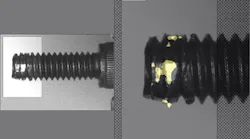
Why Image Quality Still Matters in the Age of AI
At VISION 2026 in Stuttgart last month, Michael Stelzl, managing director at MSTVision, told Vision Systems Design what he sees as one of the biggest misconceptions surrounding AI and machine vision: the belief that AI can compensate for poor image quality.
According to Stelzl, successful machine vision systems still depend heavily on high-quality image acquisition. He said that investing in imaging and illumination remains critical because both rule-based and AI-driven inspection systems perform better when the underlying images are good. In his view, AI is not a substitute for proper imaging.
Many people think AI can do anything. From our point of view, that's not correct.
- Michael Stelzl, managing director, MSTVision
In addition, Stelzl showcased MSTVision's GPU-based area-scan photometric stereo platform, capable of processing up to 1 GB/s. He noted that the company offers three illumination options tailored to different applications:
- Segmented ring light for diffuse surfaces
- Flat dome light for highly reflective or shiny surfaces
- Dome light as a compromise between the two.
He said this combination of high-speed processing and flexible illumination allows the company to optimize system performance for a wide range of inspection applications.
Related: Inside Lucid's 20-Camera RDMA Architecture and Triton All-in-One | Vision Systems Design
Related: The Machine-Vision Stack Behind Autonomous Systems | Vision Systems Design
About the Author
 Sharon Spielman
Head of Content
Sharon Spielman joined Vision Systems Design in January 2026. She has more than three decades of experience as a writer and editor for a range of B2B brands, most recently as technical editor for VSD's sister brand Machine Design, covering industrial automation, mechanical design and manufacturing, medical device design, aerospace and defense, CAD/CAM, additive manufacturing, and more.